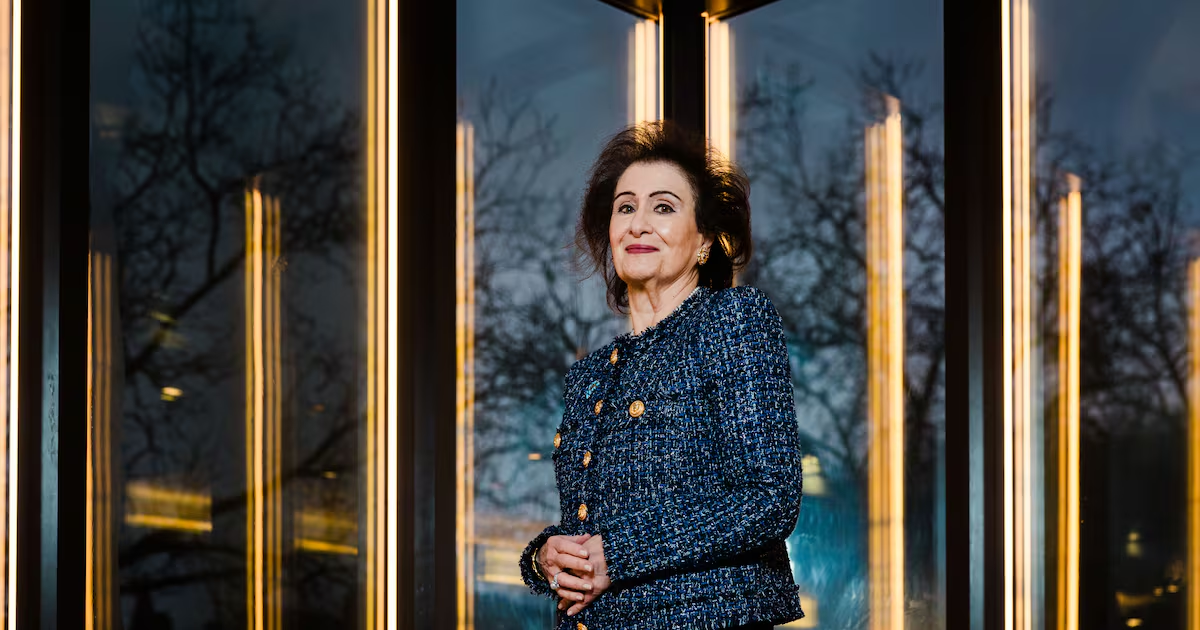
Women risk being “left behind twice over” in the transition towards artificial intelligence-powered economies in the Arab world, if the technology is developed without their voices in the room, the founder of a leading Arab women’s organisation has warned.Haifa Al Kaylani, a development economist who has dedicated more than two decades towards empowering Arab women, said the need to address these gaps was urgent.“If AI is developed without Arab women's voices in the room, it will encode the biases of the past into the technologies of the future. We simply cannot allow this to happen,” she told The National.“The window to address this is narrow, perhaps the next five years, and it is one of the most urgent priorities I see."The Arab Women’s International Forum in Cairo in 2004, with Suzanne Mubarak, at the time Egypt's first lady, and foreign minister Amre Moussa in attendance.InfoThe Arab Women’s International Forum, which Mrs Al Kaylani founded in London, will mark its 25th anniversary this year with a focus on spotlighting AI as a “frontier” for women’s empowerment.The programme seeks to equip female entrepreneurs with the skills, networks and policy advocacy needed to navigate future AI-driven economies. “We would like to see a sustained pipeline of Middle East and North African women [going] into AI and deep-tech roles, accessible capital for women-led tech start-ups in the region,” she said.Policy work was needed to ensure equal access to digital education and addressing “algorithmic bias that disproportionately affects women,” she said.The programme would take in cohorts covering climate tech, FinTech, AI safety, healthcare innovation.Haifa Al Kaylani and Masdar's Dr Lamya Fawwaz at Cop28 in Dubai. Photo: MasdarInfoA defining decade The next decade will be a "defining one" for women in the Arab world, with major challenges to overcome, Mrs Al Kaylani said.Although there are more women than men at studying at universities in many Arab countries, there are fewer of them in jobs. The female labour force in the Middle East and North Africa is the lowest in the world at about 20 per cent compared with a world average of 50 per cent. “The gap is between graduation and employment, and it represents an enormous waste of human capital,” Mrs Al Kaylani said. “No economy can reach its full potential while half its talent sits on the sidelines."Women also still face legal constraints in some countries across the region, although “real progress” had been made, she said. “Until women can sign a lease, secure a loan, register a business and travel on the same terms as men, economic equality will remain aspirational,” Ms Al Kaylani added.OptimismThere is also the devastation brought about by recent wars. "The women of Syria, Yemen, Sudan, Libya, Gaza and Lebanon have endured circumstances that no economic empowerment agenda can address on its own, and we must not lose sight of them," she said.Nonetheless Ms Al Kaylani remains “profoundly optimistic”. “I have watched the Arab world change profoundly over 25 years. The young women I meet today are more confident, more connected, more entrepreneurial and more globally minded than any generation before them,” she said.“The challenges are real, but the trajectory is unmistakably forward.”Twenty-five years of AIWFMrs Al Kaylani looks back with pride on the journey of the AIWF, which has long sought to build bridges between Arab women and the rest of the world. She launched the organisation in London in 2001, holding its first conference on the growing economic role of women in Arab society the following year, with the support of Queen Rania of Jordan. She recalled how Sheikha Fatima Bint Mubarak, Mother of the Nation, brought 12 Emirati women technology students from the UAE in 2003 to attend what had by then become an annual event for London's Middle Eastern business and diplomatic community.The AIWF was then invited to Madrid by Spain’s first female foreign minister, Ana Palacio, for the first conference bringing women of the Arab world, Spain and Latin America together. Its 2004 conference on women in agriculture was the first of its kind to be hosted at the League of Arab States in Cairo. Christine Lagarde, at the time the French foreign minister, chaired the forum’s annual conference in Paris in 2009 .The Young Arab Women Leaders programme was launched in 2011 by the AIWF, in collaboration with PwC Middle East, working with more than 2,200 young women to help them build their businesses. In recent years, the AIWF has focused on sustainability and the environment, teaming up with Masdar's global initiative, Women in Sustainability, Environment and Renewable Energy, better known as WiSER, to produce a report for Cop28 in Dubai, among other events.In recognition of her services to women and young people, Ms Al Kaylani ws appointed an Officer of the Most Excellent Order of the British Empire (OBE) in 2023."I admire the women who have built businesses and institutions from the ground up in environments where the path was not laid out for them, and who have then turned around to widen that path for the next generation," she said.“I always say that we cannot achieve anything worthwhile in silo, and that it is only through working in coalitions of partnership that we can move mountains and achieve the unimaginable,” she said.
Arab women's voices to be 'must be heard' in AI revolution | The National
Haifa Al Kaylani remains 'optimistic' about women's empowerment in Middle East despite challenges posed by AI, high unemployment and political disparities
871 words~4 min read