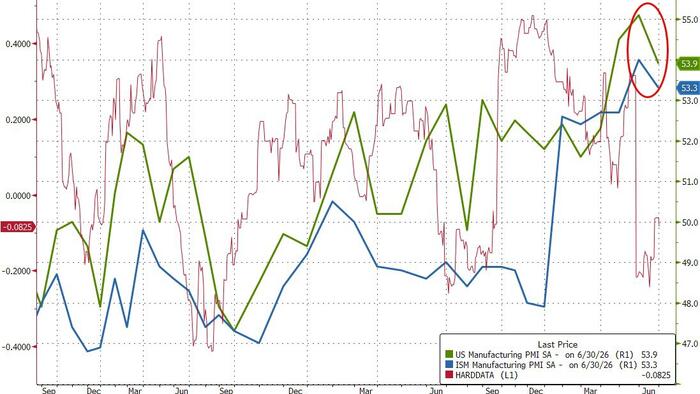
The big economic data release of the week is coming out Thursday, when the Labor Department releases its personal consumption expenditures index. It’s the measure focused on consumer spending and is the Fed’s preferred measure of inflation. The 12 regional Federal Reserve banks also put out reports of their own. On Tuesday, the Chicago Fed published its National Activity Index, which paints a mixed picture of the economy: Manufacturing output doesn’t look bad; personal consumption, though, doesn’t look great.The CFNAI sums up a bunch of indicators covering different slices of the economy — including manufacturing activity, which picked up in April. “That’s not surprising to us,” said Nancy Vanden Houten, lead economist at Oxford Economics.There are a number of factors that are boosting manufacturing right now, she said. One of them is last year’s big tax and spending law.“Another big factor is the artificial intelligence buildout, which has created demand for lots of inputs, such as computers and electronics,” Vanden Houten said.Manufacturing is also being propped up by businesses boosting their inventory levels. Vanden Houten said that a lot of businesses’ inventories are too low right now. “If inventories get too low, you’re going to see some increases in manufacturing output to restore inventories on the part of businesses,” she said.On the negative side of the ledger, the Chicago Fed index also found that consumer spending has been slowing down.Menzie Chinn, an economics professor at the University of Wisconsin, said consumer spending had been boosted by last year’s tax cuts. But then consumers got slapped by the side effects of war in the Middle East.“So higher gasoline prices for sure, sort of the uncertainty associated with the war,” he said. “What that’s done is it’s offset what we would have gotten from the tax cuts.”The Chicago Fed Index also found that employment slowed in April. That’s not necessarily a bad sign yet, considering that the labor market overall is in pretty good shape, according to the University of Iowa’s Peter Orazem.Put another way? “There’s plenty of consumer demand to justify the number of jobs that are currently in the U.S. economy.”But that also means the health of the labor market depends on consumer demand.“So signals that the consumer demand might be weakening is a little bit concerning,” Orazem said — especially since consumer demand has been keeping the U.S. economy strong over the last couple of years.Get smarter about economic dataFrom February 2026: Why the Fed relies on PCE data to inform monetary policyFrom September 2025: Why trustworthy data is so important to everyone in the U.S. economyFrom June 2022: What do different measures of inflation tell us?
Manufacturing is strong, consumers are a bit shaky, Chicago Fed says
Tax cuts don’t seem to be juicing the economy as promised.
438 words~2 min read