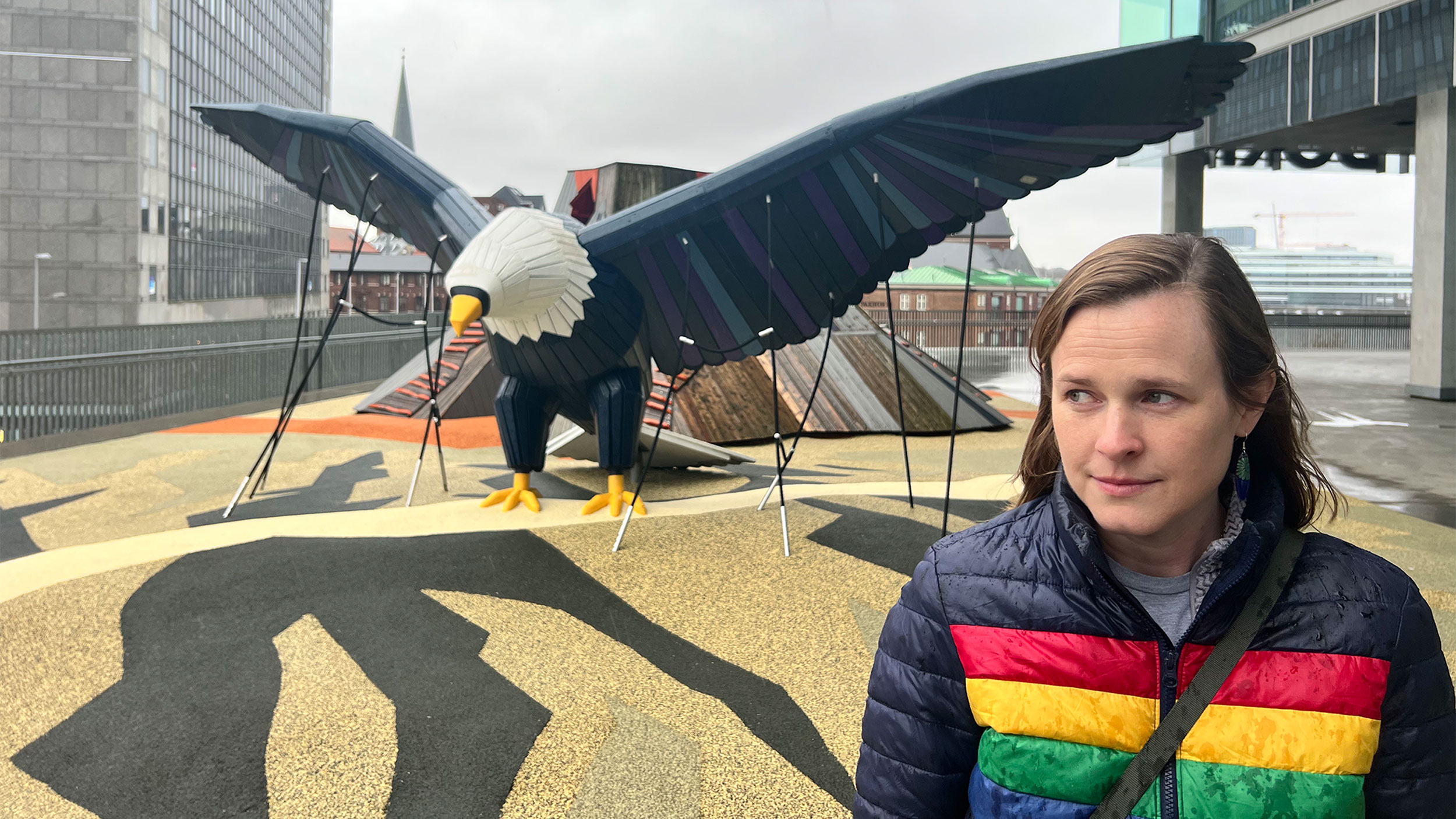
In January, Bane and Debra Cook packed up their lives in Texas and relocated to Leiden, a Dutch city known for its canals, historic center and green spaces.“It’s great here,” Bane told The World, praising the Netherlands’ walkability, healthy living and food quality. “You could actually call the cheese here cheese, as opposed to cheese products.”But good Gouda wasn’t what drove the Cooks abroad. More than a lifestyle change, it was an escape from a political climate in the United States in which they no longer felt at home.“We needed to get away to regain our sanity,” Debra said.Bane and Debra Cook on a trip to Brussels in February 2026.Courtesy of Debra CookA US Army veteran who served in Iraq and South Korea, and later worked in Afghanistan as a civilian, Debra was already familiar with life overseas. But after President Donald Trump returned to the White House, she and her husband decided it was time to leave. The couple cited gun violence, taxes funding foreign wars and what they saw as cultural regression on issues like abortion rights as the key drivers.“All the rollbacks of all of the policies that have been put in place for people who have fought for decades for equality,” Debra added, “those rights were being taken away.”Now, they no longer see themselves returning. “There are just so many things that are backwards that happen there,” Bane said.Every four years, some Americans joke about leaving the country if their preferred presidential candidate loses. The Cooks are among those who actually left. While it’s unclear just how many are exiting since the last election, a November 2025 Gallup poll showed that 1 in 5 Americans would like to leave — and the number was higher among women in the country: 40% of those aged 15 to 44 would like to get out for good — a fourfold increase compared to a decade ago.Jana Sanchez co-founded the Netherlands-based relocation company GTFO Tours in 2025 after seeing growing interest from Americans in life outside the country. (And, yes, GTFO stands for “Get the —- Out.”)“We decided that it would be really helpful to create a tour where people could get a very detailed view of what it’s like to live in the Netherlands and meet all the people who would help them,” Sanchez explained.Jana Sanchez (center) shows clients around Den Haag on May 19, 2026.Photo courtesy of Jana SanchezMany early clients belonged to groups that felt were increasingly vulnerable under the Trump administration, according to Sanchez, including LGBTQ+ families and households that included immigrants. After the killings of Renée Good and Alex Pretti by US federal agents in Minneapolis, she said interest has broadened beyond those initial groups. Though the newest clients tend to be wealthy, “we can also help people who don’t have a lot of money,” she added.For about $2,000, Sanchez and business partner Bethany Quinn guide fellow Americans through visas, taxes, schools and housing.“We help everybody from that first call of ‘Oh my God, I want to get out, where can I go?’ to their actual move here,” Sanchez said.But there can be a difference between moving somewhere and living somewhere.A globe at the public library in Aarhus, Denmark, April 10, 2026.Joshua Coe/The WorldEmily Gant, a 35-year-old originally from Atlanta, has spent much of her adult life overseas and said many Americans underestimate the challenges of relocating.“I do think Americans tend to completely under-research whatever they do when they move,” she said.Gant, who vlogs on social media about German politics and life as an immigrant, pointed out that Europe is not immune to the polarization some left-leaning Americans might hope to escape.In Berlin, where she has lived for three years, the rise of Germany’s far right has prompted worried calls from relatives back home.Emily Gant stands outside the local Immigration Office in Berlin after receiving permanent residency in Germany in June 2025.Photo courtesy of Emily Gant“They’ll say, ‘I heard basically the Nazis are back in Germany — aren’t you worried?’” said Gant, who is Jewish on her mother’s side. “And I’m like, ‘No, it’s literally still safer here than it is back in the United States.’”She cautions, though, that moving abroad is not a cure-all.“There are problems everywhere,” Gant said. “There’s no perfect place or magical ‘wonderland’ where you can escape to.”An estimated 4.4 million Americans were living abroad in 2022, according to the Federal Voting Assistance Program, but the Association of Americans Resident Overseas put the number at 5.5 million in 2024.There are no firm figures on how many leave each year. The Wall Street Journal reported that a record 180,000 Americans moved abroad in 2025, based on incomplete data from 15 countries. The number, the WSJ suggested, could be higher.Americans have long left their country over politics, war and social conflict — from Loyalists after the Revolution to Black Americans escaping slavery before the Civil War and Vietnam draft resisters who fled to Canada in the 1960s and ‘70s.More than politics, however, today’s affordability crisis has inspired many to look elsewhere in recent years, said Ernesto Castañeda, director of the Immigration Lab at American University. Nearby countries like Mexico and Ecuador — along with digital nomad hubs such as Portugal and Spain — have become especially attractive to retirees and remote workers seeking lower costs of living.“If they move abroad, then they can earn a US salary and live in a place that is cheaper,” Castañeda said.Other countries are actively recruiting Americans. Last year, France introduced initiatives to attract US-based researchers affected by funding cuts and political pressure in academia.“Countries are competing for Americans,” he added, “because they’re coming with know-how and some cash.”Aisha Bullard sits with her husband James inside the Original Drip, a coffee shop they own in Dakar, Senegal, on March 2, 2026.Courtesy of Aisha BullardBut sometimes it’s not even about the financial incentives.Aisha Bullard, a lawyer and entrepreneur from Richmond, Virginia, found a new sense of home in Senegal.Since 2020, Bullard has lived in Dakar with her husband and daughters after initially planning only a short cultural stay. But they soon discovered that Dakar offered their daughters a chance to broaden their worldviews.“My kids’ friend groups are … just this rainbow of faces” at school in Senegal, she said. “I can’t imagine them going back to not having that sort of diversity of experiences — and beyond just race.”Bullard, who is Black, said living in West Africa has changed the way she thinks about race and identity in the US. She recalled realizing how many social anxieties her family had internalized — from worrying about how Black children are treated in public to pressure to prove they belonged in spaces where her daughters were “frequently the only Black kids.”Overall, Bullard said life in Dakar feels calmer, more communal and less driven by fear and competition than in the US.“I’m proud to be American – I’m proud of all the contributions that I’ve been able to make there and that my ancestors were able to make there,” she said, but “the world is a big place, and there’s so much we can learn from other people, so much that we can learn about ourselves by exploring other places.”Madeline Fafoutis stands in front of a US-themed playground in Aarhus, Denmark, April 10, 2026. Originally from the US, she moved to Denmark with her husband and three children ahead of the 2024 elections.Joshua Coe/The WorldMadeline Fafoutis reached a different conclusion during her latest experience exploring another place: She doesn’t want to raise her family in Denmark long term.She first moved to Europe when her husband enrolled in a master’s program in the Netherlands in 2016. After a stint back in Virginia, the family settled in Denmark as they decided where to build their future.“We felt as though Danish culture and society really valued families and children in a way that we didn’t see in the US,” said Fafoutis, who has three children.But after nearly two years, she said her family has struggled to fully integrate socially.“We never felt unwelcome,” she said, “but we always felt separate, which is understandable.”Fafoutis and her family now plan to return to the Netherlands, where they already have community ties.While she still has family and a strong friend network in Virginia, and visits at Christmas when it turns into a “big friend reunion,” Fafoutis sees her future in Europe.“Just because we’ve moved away doesn’t necessarily mean we’ve given up on rooting for the American dream,” she said. “But at this point, we just have to choose what’s best for us and for the kids.
‘GTFO’: The Americans moving overseas in search of a better life - The World from PRX
Every four years, Americans joke about leaving the US if their preferred presidential candidate loses. For some, though, the idea is more than a punchline — it’s a genuine exit plan. More often than not, it’s not about politics but about exploring options.
1,427 words~6 min read