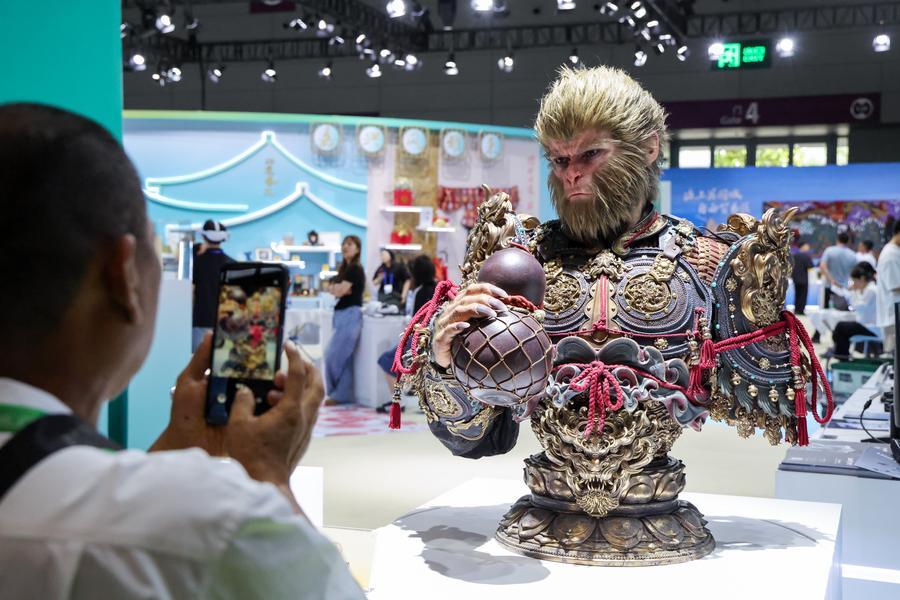
*A new generation is rediscovering traditional culture not by preserving it behind museum glass alone, but by reimagining it through web novels, animation, fashion and social media.*Young Chinese today are increasingly using social media and digital storytelling to connect cultural heritage with wider audiences.*China's post-2000 generation, having grown up during a period of rapid national development, possesses the confidence to engage with the world on equal footing.BEIJING, May 26 (Xinhua) -- At a time when voices can easily be lost in the overwhelming volume of online information, many young people in China are finding new ways to make themselves heard.In the recently completed web novel "When the Curtain Falls" by 26-year-old writer Wang Huaiyu, elements of intangible cultural heritage, including traditional Chinese opera, lion dance and Suzhou embroidery, are woven into a story that has drawn more than 66 million views.Wang is among a group of young writers incorporating traditional cultural elements into online literature, a genre that has gained wide readership in recent years. He previously drew widespread attention with an earlier work that garnered more than 100 million views and was later adapted into an animated series.The success reflects a broader trend in China, where a new generation is rediscovering traditional culture not by preserving it behind museum glass alone, but by reimagining it through web novels, animation, fashion and social media.With China's population aged 14 to 35 expected to remain around 350 million by 2030, young people are increasingly viewed as a key force driving technological innovation, industrial transformation and cultural creativity. Cities including Beijing and Shanghai have also rolled out measures to support youth entrepreneurship and innovation in cultural industries.A visitor takes photos of a "Black Myth: Wukong" character bust at the 21st China (Shenzhen) International Cultural Industries Fair in Shenzhen, south China's Guangdong Province, May 23, 2025. (Xinhua/Liang Xu)LEGACY REIMAGINEDIn his work "When the Curtain Falls," Wang said he incorporates extensive elements of traditional Chinese culture, from world-building and naming systems to character design, describing tradition as the "root and foundation" from which creators draw inspiration and reinterpretation.During the writing phase, he devoted considerable time to studying traditional Chinese opera and consulting experts including a renowned inheritor of Suzhou embroidery."Like many young people of my generation, I became interested in traditional culture after spending a lot of time learning about it," Wang said, adding that as the internet continues to expand its reach, young people today are becoming increasingly open to traditional culture.Wang's success stories are not alone in the field of online literature, which has gained a growing international reach. The narratives of defying fate and chivalry, along with restrained yet powerful forms of emotional expression, are both distinctively Chinese and accepted globally, said cultural scholar Li Hao.In 2025, "Lantern Festival Joy," a Song Dynasty-themed novel by Wang Yurong, a writer in her 30s, was adapted into a micro-drama translated into multiple languages, including English, French and Vietnamese, attracting more than 30 million overseas views.Overseas, the original creator community now exceeds 1.3 million people, producing more than 2 million works with overseas market revenue reaching 5.64 billion yuan (about 826 million U.S. dollars), according to a 2025 report.Cast members take part in the filming of a micro-drama at a film and television shooting and cultural tourism base in Laoling, east China's Shandong Province, Dec. 18, 2025. (Photo by Ma Hongkun/Xinhua)Beyond online literature, similar shifts are visible in cultural entrepreneurship.Driven by the belief that "old treasures should adapt to modern life," Shi Yi, a post-95s entrepreneur from the eastern Chinese city of Suzhou, has built a career on reinventing Song brocade, a silk textile known for its intricate craftsmanship. Inscribed on UNESCO's List of Intangible Cultural Heritage in 2009, its revival has been driven not only by traditional artisans, but also by a new generation of innovators like Shi.Inspired by a "digital motif archive" at the Suzhou Silk Museum, Shi selects classic patterns such as cloud motifs, scrolling floral designs and bird-and-flower imagery, reinterpreting them into products ranging from handbags and cushions to notebooks and even tea tables."We must recognize that today's lifestyles are very different from the past," Shi said, adding that the key is creating modern applications that encourage people to use and wear these cultural products in their daily lives.Innovation has also expanded the boundaries of the industry itself. Shi's tailor shops morphed into a silk brand with annual sales approaching 5 million yuan. Recently, her silk brooch collection, inspired by ancient Chinese women playing polo, was showcased in Paris and received wide acclaim.China's cultural and creative industries have expanded alongside such individual efforts. The sector reached 99.982 billion yuan in 2024, up 7.98 percent year on year. Products tied to cultural IPs have also seen strong sales in recent years, including a phoenix-crown fridge magnet selling more than one million annually, and a game skin inspired by Dunhuang motifs surpassing 40 million sales.Foreign guests attending the Global Leaders' Meeting on Women learn about a handbag made of Song brocade, a type of fabric developed during the Song Dynasty (960-1279), while visiting the Silk Street building in Beijing, capital of China, Oct. 14, 2025. (Xinhua/Xu Bingjie)GROWING CONFIDENCEYoung Chinese today are increasingly using social media and digital storytelling to connect cultural heritage with wider audiences. A 2025 report by China Youth Daily showed that 88.7 percent of young respondents were willing to promote China-chic culture, while 91.4 percent noted that more China-chic IPs would gain international reach.Scholars have pointed out a shift in mindset fueled by economic affluence. China's post-2000 generation, having grown up during a period of rapid national development, possesses the confidence to engage with the world on equal footing, Hu Xianzhong, a professor at the Central School of the Communist Youth League of China, noted in an article.This confidence is increasingly expressed through the global presence of hanfu clothing, traditional music and other cultural forms, he said.Ma Ruomeng, a Chinese designer based in Italy, often performs the pipa in traditional attire in the streets of Milan during her spare time. She also participates in local cultural exchange events, introducing audiences to traditional Chinese folk music.Since 2023, Ma has also been recording her street performances and posting them online. "Music is my way of communicating with the world," she said, adding that she hopes to experiment with rock and other modern styles, using music to connect people from different cultural backgrounds.Children in China-chic costumes participate in a costume and cosplay competition during a cultural festival in east China's Shanghai, Oct. 26, 2025. (Xinhua/Liu Ying)According to a ByteDance report in 2025, more than 870,000 creators with over 10,000 followers posted content related to intangible cultural heritage on Douyin, the Chinese version of TikTok, while the number of post-2000 users producing such videos rose by 63 percent year on year.Liu Yajing, a content creator who focuses on recreating traditional craftsmanship and has over 20 million followers across platforms, said the key to promoting intangible cultural heritage lies in "authentic experiences and genuine storytelling."She said she hopes to serve as a bridge between audiences and the cultural heritage, inspiring viewers through her videos to further explore the essence of traditional culture on their own.(Video reporter: Zeng Wei; Video editors: Liang Wanshan, Zhu Cong, Zhou Yang and Hui Peipei) ■
Xinhua Headlines: Young Chinese breathe new life into traditional culture
Xinhua Headlines: Young Chinese breathe new life into traditional culture-
1,205 words~5 min read