When glowing projectiles from a Russian Oreshnik ballistic missile streaked out of the night sky near Kyiv early on May 24, multiple videos recorded an odd detail. Despite a rumble of apparent impacts as the objects crashed to earth, there were none of the explosive flashes that usually accompany a missile strike.Blurry video captured during the two previous strikes with the weapon, on Dnipro in November 2024 and Lviv in January 2026 showed a similar lack of primary blasts.“They don’t seem to be carrying any explosives,” Pavel Podvig, a senior researcher at the United Nations Institute for Disarmament Research, told RFE/RL. The hypersonic projectiles that emerged from the Oreshnik, glowing with the heat of atmospheric reentry “are probably heavy objects, with the idea that the destructive force will come from the kinetic energy,” he added.
Projectiles from an Oreshnik missile plunge towards Bila Tserkva in the early hours of May 24.
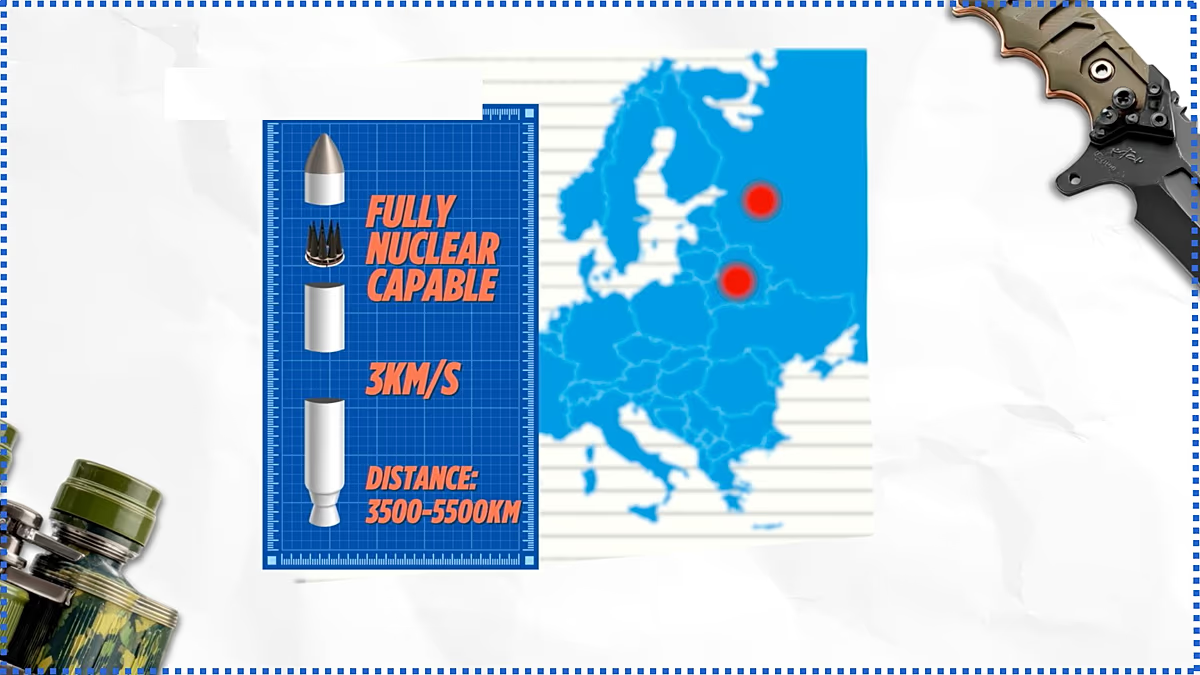
Konrad Muzyka, a defense analyst with Rochan Consulting, says the Oreshnik strikes appear to be carried out with around 36 “kinetic penetrators,” which emerged from six reentry vehicles released from the missile in its final arc of flight. Those projectiles, he says, “rely on extremely high impact velocity to destroy or penetrate targets rather than carrying large explosive charges.”But with an estimated cost of tens of millions of dollars per missile, many commentators -- including Russians -- have questioned the utility of hurling hypersonic chunks of metal or concrete at Ukrainian targets.“Just insanely expensive hardware slammed into the ground,” Russian military blogger Vladimir Romanov posted on Telegram alongside videos of the latest Oreshnik strike. “All for the sake of a pretty picture that nobody believes anymore (except pensioners),” he added.The Oreshnik (hazel tree) is a medium-range ballistic missile estimated to be around 12 meters long. It has a range of some 5,000 kilometers and a reported payload of more than one ton. The mobile weapon is transported on a relatively small vehicle and was named for its ability to disappear into the landscape like a tree in a forest.