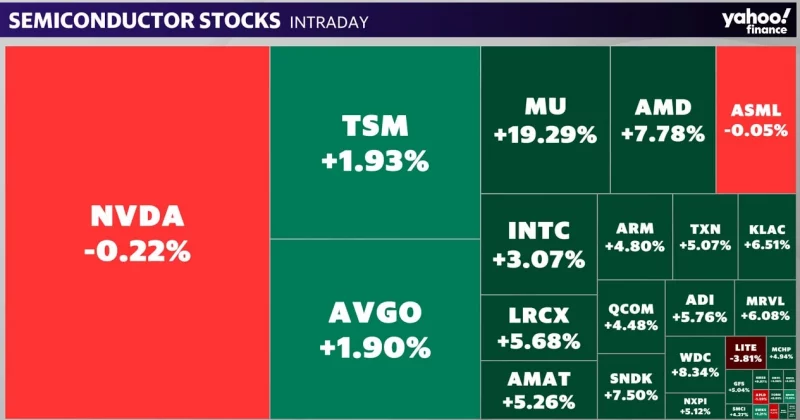
ToplineChipmaker Micron Technology hit a $1 trillion market value for the first time Tuesday after shares jumped 18%, topping $890, fueled by a Wall Street upgrade signaling that memory chips are one of the most important parts of building AI along with processing chips made by the likes of Nvidia. The Micron Technology Ink logo is displayed on a mobile phone with the company branding visible in the background, in this photo illustration in Brussels, Belgium, on December 14, 2025. (Photo by Jonathan Raa/NurPhoto via Getty Images)NurPhoto via Getty ImagesKey FactsUBS analysts raised their price target more than threefold to $1,625, implying a potential valuation of close to $1.8 trillion for the company in the next 12 months.The upgrade was the highest target of any of the 46 Wall Street firms covering Micron, well above the consensus price target of $684.32, per FactSet dataMicron is up 177% this year and has surged more than 800% over the past 12 months, making it one of the best-performing stocks in the S&P 500 this year. Key BackgroundMicron makes memory chips—the hardware that holds the data a machine pulls from, separate from the processing chips like Nvidia GPUs that do the actual computing. For decades, memory was the unglamorous corner of the semiconductor industry, a commodity business historically defined by brutal cycles where the business would struggle when demand died as inventory piled up. The AI boom upended that. Modern AI systems need enormous amounts of data sitting right next to the processors crunching it, making memory chips one of the scarcest and most valuable components in an AI server. Micron is one of three companies globally that can make it at scale, alongside South Korea's Samsung and SK Hynix. Unlike American rivals like SanDisk, which focuses on flash memory chips that store data long-term, Micron also makes more active, high-speed memory chips that feed AI processors in real time—the part of the market that has exploded with the AI boom. CEO Sanjay Mehrotra told investors on the company's most recent earnings call that Micron had already sold out its entire 2026 supply of high bandwidth memory chips. Last week, the company announced a $2 billion expansion of its Manassas, Virginia, factory, part of a broader U.S. push to bring chip production back to American soil. TangentWall Street's biggest names have been piling into Micron in recent months. Billionaire David Tepper's Appaloosa Management increased its bet on Micron by 11% this year, making it the firm’s second-largest holding, at $562.5 million. Ray Dalio's Bridgewater, the world's largest hedge fund, has gone even further: in its most recent filing earlier this month, the firm reported it increased its position in Micron by nearly 66% and more than doubled the stock's weight in its portfolio—part of a broader rotation that saw Bridgewater dump enterprise software names like Salesforce and ServiceNow in favor of AI chip stocks including Nvidia and Broadcom. What To Watch ForMicron reports its next earnings in June. Investors will be looking for confirmation that production of its newest chips is on schedule and that long-term customer contracts are holding up, as well as whether increasing capacity from Samsung and SK Hynix starts to threaten the tight supply that has powered Micron's rally.
Micron Hits $1 Trillion Market Value—Latest Winner Of AI Chip Boom
AI's memory chip boom just minted another trillion-dollar company.
540 words~2 min read