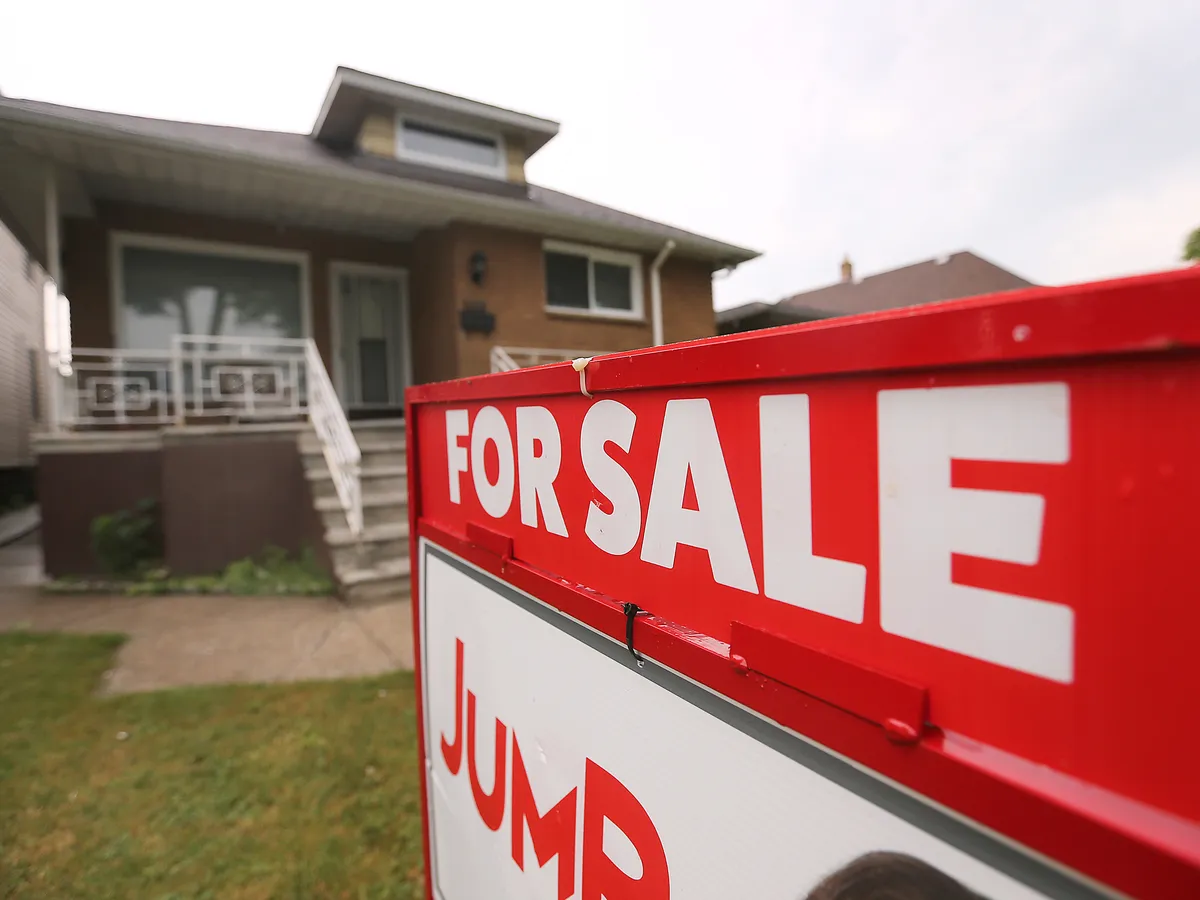
Skip to Content News Archives Economy Energy Oil & Gas Renewables Electric Vehicles Mining Commodities Agriculture Real Estate Mortgages Mortgage Rates Finance Banking Insurance Fintech Cryptocurrency Work Wealth Smart Money Wealth Management Investor Personal Finance Family Finance Retirement Taxes High Net Worth FP Comment Executive Women Puzzmo Newsletters Financial Times Business Essentials More Innovation Information Technology FP500 Podcasts Small Business Lives Told Tails Told Shopping Financial Post Store Obituaries Place a Notice Advertising Advertising With Us Advertising Solutions Postmedia Ad Manager Sponsorship Requests Classifieds Place a Classifieds ad Working Profile Settings My Subscriptions Saved Articles My Offers Newsletters Customer Service FAQ News Economy Energy Mining Real Estate Finance Work Wealth Investor FP Comment Executive Women Puzzmo Newsletters Financial Times Business Essentials HomeReal EstateFailed transactions are on the rise hitting Canada's slumping real estate market, says surveyIn this environment of heightened geopolitical risk, real estate agents say the typical considerations don't seem to applyLast updated 25 minutes ago You can save this article by registering for free here. Or sign-in if you have an account.Real estate agents had a mixed take on where the market is headed, with 43 per cent saying they were "confident" the market will rebound over the next 12 months. Photo by Gavin Young/PostmediaCanada’s slumping real estate market is being hit by a rise in the number of failed transactions, says a new survey of more than 1,000 real estate agents.Subscribe now to read the latest news in your city and across Canada.Exclusive articles from Barbara Shecter, Joe O'Connor, Gabriel Friedman, and others.Daily content from Financial Times, the world's leading global business publication.Unlimited online access to read articles from Financial Post, National Post and 15 news sites across Canada with one account.National Post ePaper, an electronic replica of the print edition to view on any device, share and comment on.Daily puzzles, including the New York Times Crossword.Subscribe now to read the latest news in your city and across Canada.Exclusive articles from Barbara Shecter, Joe O'Connor, Gabriel Friedman and others.Daily content from Financial Times, the world's leading global business publication.Unlimited online access to read articles from Financial Post, National Post and 15 news sites across Canada with one account.National Post ePaper, an electronic replica of the print edition to view on any device, share and comment on.Daily puzzles, including the New York Times Crossword.Create an account or sign in to continue with your reading experience.Access articles from across Canada with one account.Share your thoughts and join the conversation in the comments.Enjoy additional articles per month.Get email updates from your favourite authors.Create an account or sign in to continue with your reading experience.Access articles from across Canada with one accountShare your thoughts and join the conversation in the commentsEnjoy additional articles per monthGet email updates from your favourite authorsSign In or Create an Accountor“It’s safe to say failed transactions are up and I can confirm that at a more micro-level, in our business,” Joel Fox, chief operating officer of Ownright Law, said.Financing failure was the top cause of failed transactions so far in 2026, 34 per cent of agents said, and 38 per cent of agents said more deals were falling apart over financing issues compared with two years ago. Respondents also tagged client indecision as relevant to deal delays.Fox said the top reasons for the increase in failed transactions included buyers adding multiple conditions to their offers, providing an “easier off-ramp” to escape, and buyers who didn’t have the required money on closing day because, say, their purchase depended on the sale of another property that falls through or the purchase price of that property declines between the agreement date and the closing date.Get the latest headlines, breaking news and columns.By signing up you consent to receive the above newsletter from Postmedia Network Inc.A welcome email is on its way. If you don't see it, please check your junk folder.The next issue of Top Stories will soon be in your inbox.We encountered an issue signing you up. Please try againOn the seller side, some people aren’t able to finalize their deals because the sale price wouldn’t adequately cover the debt attached to the title of the home they are selling.“This is much more prevalent these days as property values have fallen and people have high-interest mortgages — sometimes more than one — registered on title,” Fox said.Other major headwinds cited by agents in the survey — which was conducted between March 27 and April 29 across Canada, excluding Quebec, by Ownright, an Ontario company that closes real estate transactions — included economic uncertainty and political instability in the United States.Nearly seven in 10 agents said clients were warier of taking on risk prior to 2022, while 40 per cent cited economic worries — including recession fears — as the major cause of hesitation among potential buyers, 17 per cent cited employment uncertainty and 15 per cent cited interest rates.The survey also said nearly one-quarter of agents reported that U.S. political and economic instability “frequently” undercut deals, while 69 per cent said it occasionally played a role.“The calculation of participating in the housing market has gotten more complicated,” Fox said. “People are thinking about the broader economy, how that impacts them, and even more than that, that kind of geopolitical environment and all the uncertainty that’s being driven from south of the border.”In this environment of heightened geopolitical risk, he said the typical considerations don’t seem to apply.“Historically, it’s been a calculation of, ‘Are interest rates going down or up? Is the average house price going down or up?’ And, depending on the direction of those two metrics, you kind of have a good idea of how the housing market is going to be doing,” he said.Those factors don’t appear to be holding as much weight as they used to.Average selling prices are down nearly 19 per cent since February 2022, when the market peaked during the COVID-19-induced buying frenzy, and sales have declined 40 per cent from their March 2022 high, according to Canadian Real Estate Association data.Fox said he doesn’t expect the housing market to rebound anytime soon.“We’ve felt, and very strongly believe, even from the beginning of the year, that we didn’t see or believe that the market was going to be rebounding,” he said.Real estate agents had a mixed take on where the market is headed, with 43 per cent saying they were “confident” the market will rebound over the next 12 months, while 25 per cent are pessimistic about future prospects and 28 per cent are neutral. Join the Conversation This website uses cookies to personalize your content (including ads), and allows us to analyze our traffic. Read more about cookies here. By continuing to use our site, you agree to our Terms of Use and Privacy Policy.
Failed transactions are on the rise hitting Canada's slumping real estate market, says survey
Canada's slumping real estate market is being hit by a rise in the number of failed transactions, says a new survey of agents. Read here
1,124 words~5 min read