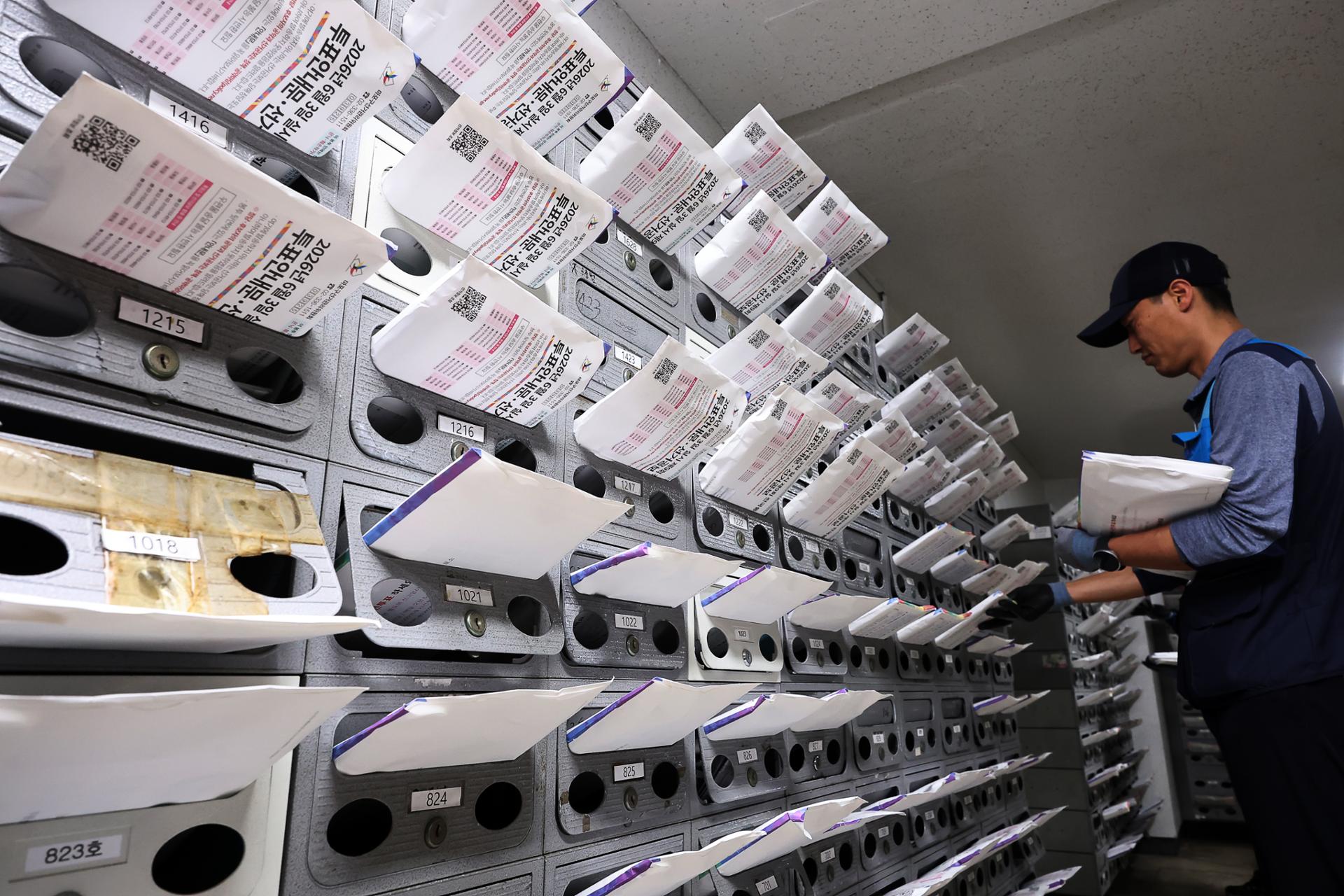
A mail carrier delivers election pamphlets for the June 3 local elections in Mapo District, Seoul, Sunday. YonhapWith the June 3 local elections approaching, election pamphlets are set to arrive at households nationwide, but concerns are growing that the mass mailings waste resources while going largely unread.Under the Public Official Election Act, election pamphlets must be mailed to every household no later than 10 days before election day. This year's election pamphlets were sent out by Sunday and are expected to arrive by month's end at the latest. The law caps pamphlets for local government heads at 12 pages and those for local council members at eight. The environmental cost is steep. According to the National Election Commission (NEC), election pamphlets for the 2022 local elections totaled 580 million sheets and weighed 12,853 tons, enough to consume some 210,000 trees. Yet few voters actually read them. A survey of 6,820 eligible voters by the Korean Government Employees' Union between February and March found that just 11 percent read the pamphlets in detail, while 52 percent skim them and 37 percent do not read them at all or throw them away unopened.Some lawmakers have tried to move election pamphlets to digital formats, but the efforts have repeatedly stalled. In 2024, Democratic Party of Korea Reps. Youn Kun-young and Kang Deuk-gu introduced amendments to send campaign materials via text message and mandate the use of recycled paper, respectively. Last year, Rep. Kim Jae-won of the minor liberal Rebuilding Korea Party introduced a similar bill allowing voters to receive election pamphlets by email and text, but it has seen no progress. Accessibility for voters with disabilities also remains a concern, though a 2020 revision to the Public Official Election Act requires the NEC to distribute audio and digital braille files alongside printed pamphlets when candidates submit them. Five candidates in last year's presidential election provided USB flash drives containing digital pamphlet files compatible with screen readers. The Korea Blind Union told The Korea Times that although it lacks data on how frequently visually impaired voters use the flash drives, there is a need for more formats such as online audio links.“Unlike other disability types, visually impaired people vary greatly in how they receive information. That difference is not a matter of preference. It is a matter of whether access is possible at all,” the union said. Rep. Kim Yea-ji of the People Power Party, who is visually impaired, said last year that accessibility has improved, but called for further progress. “We must expand available formats for visually impaired voters, including QR codes, and revise the NEC's guidelines to reflect their voices,” Kim said.
580 mil. sheets, largely unread: Election pamphlet waste problem returns ahead of June 3 vote - The Korea Times
With the June 3 local elections approaching, election pamphlets are set to arrive at households nationwide, but concerns are growing that the mass...
440 words~2 min read