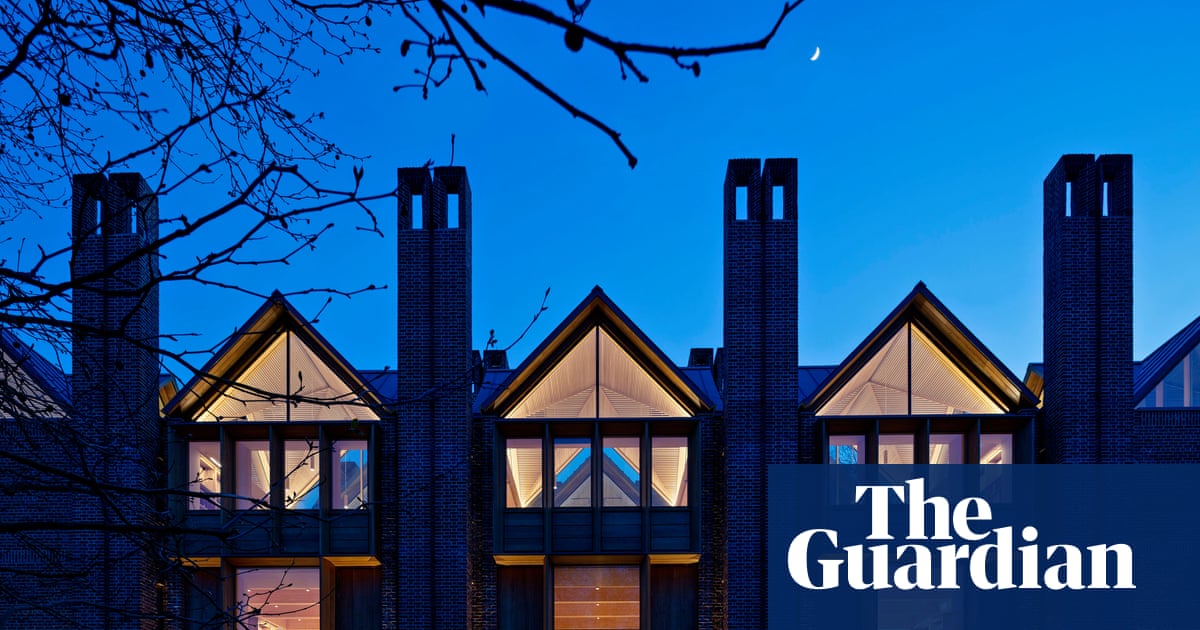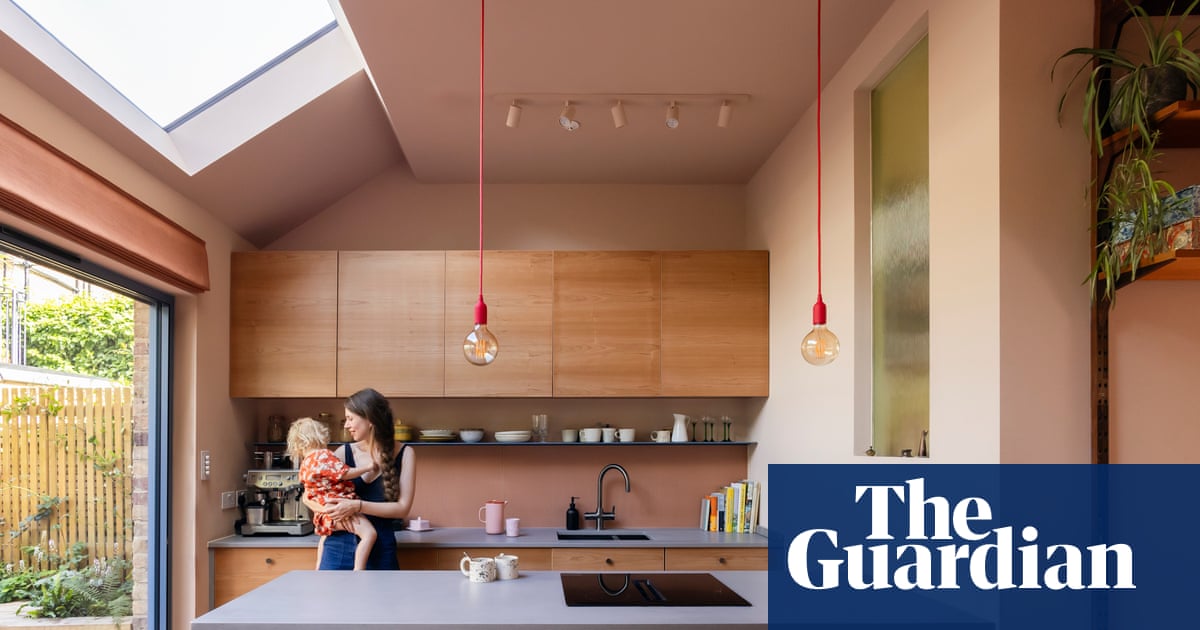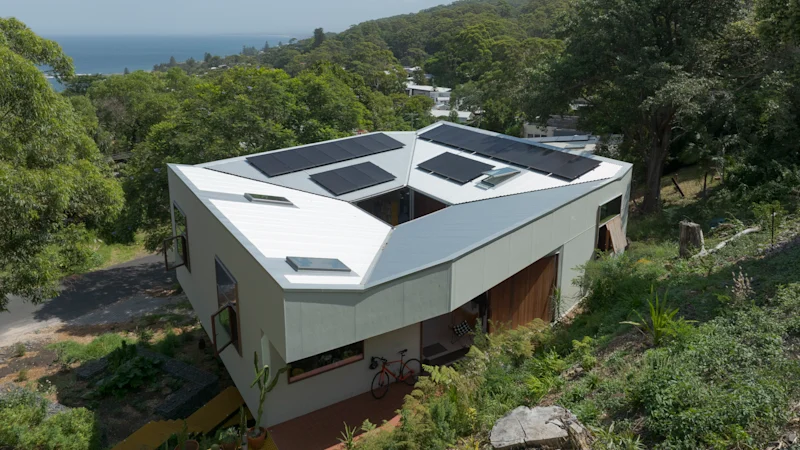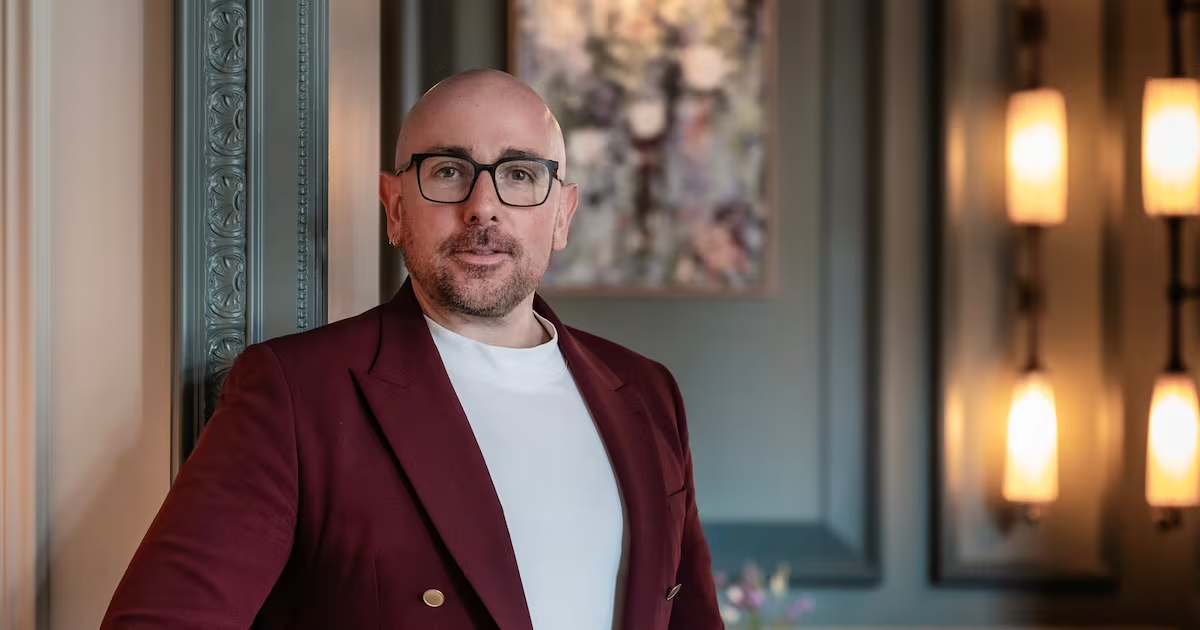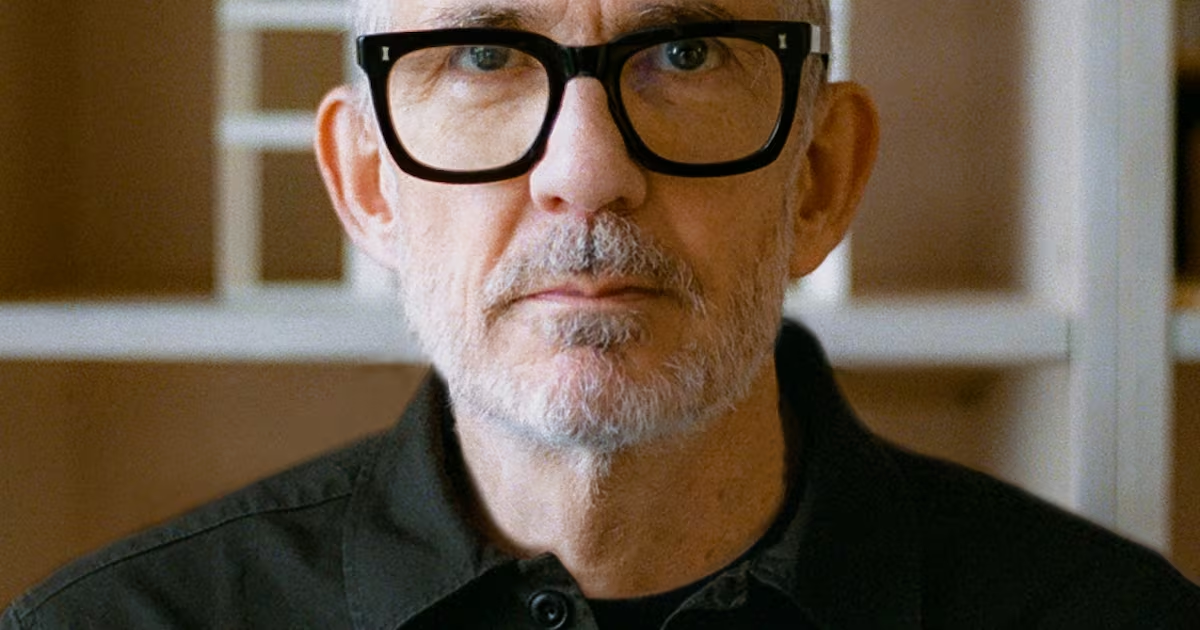
Níall McLaughlin has been revisiting one of his buildings, a quarter of a century on. Jacob’s Ladder was built in woodlands, in the Chilterns area of southern England. Its most recent owners wanted some changes. “The new client said to me: ‘We feel, when we looked at this house, that it had been designed by a juvenile spirit.’” McLaughlin pauses with a wry smile. “And then they looked at me slightly sideways and said: ‘Do you think you could recover that?’ So,” he continues, “I have been recovering my juvenile self. It’s good fun.”Irish architects are increasingly lauded. There are Grafton’s Versailles, Stirling and Pritzker prizes; O’Donnell+Tuomey’s design of an entire new quarter in London; and Heneghan Peng’s inclusion this year in Time magazine’s 100 Most Influential Companies of 2026. And then there is Níall McLaughlin Architects. That whisper of fun is the aspect less frequently mentioned in all the accolades and awards the Dublin-born designer has won since he graduated from University College Dublin, in 1984. As well as being elected to Aosdána, he has exhibited at Venice Architecture Biennale, won the Stirling Prize, been given an honorary MBE and, most recently, added the Royal Gold Medal, the UK’s highest architectural honour, to the list.From a clutch of Oxbridge university buildings to churches and convents, and from individual homes to larger housing projects, McLaughlin’s buildings are beautiful, often with a quality to the light that touches on the spiritual.Níall McLaughlin Architects: Jacob’s Ladder. Photograph: Nick Kane Now based in London, the architect has been a thought leader in sustainability, bringing an understanding of site to his work that makes you see the place rather than just the building that’s in it. Then there is that whisper of irreverence (despite the churches and convents), but perhaps the real genius of McLaughlin’s work is that he is hugely curious and caring about people. You might call it humanity.“Often, when I’m feeling a bit out of sorts with architecture,” he says, “I’ll get on my bike or the Tube and go down there. I’ll sit in the playground outside the housing block.” He’s talking about Peabody Whitechapel, the social-housing project his firm completed in east London, for which he was shortlisted for the Stirling Prize in 2015. He didn’t win that year, but if he had it would have been the first time in the award’s history that social housing was so recognised.Níall McLaughlin Architects: Peabody Whitechapel. Photograph: Nick Kane Níall McLaughlin Architects: residents at Peabody Whitechapel. Photograph: Nick Kane “There’s an old Afghan man,” McLaughlin continues. “He sits there, leaning on his walking stick, and I’ll sit beside him. We’ll watch the kids playing, and people go in and out. “It’s the sort of building that just completely disappears when you build it. Nobody sees it as exceptional or different. It’s just part of the background to the city. But you have people coming and going, and there are the simple decisions you made, which are almost nothing to do with what people think of as architecture.”He describes parents’ ability to see their children playing as they prepare food; daylight in the circulation areas; natural ventilation in the bathrooms, “those quite ordinary things. It’s very different from the high-profile, ultra-bespoke thing, but it’s almost more fulfilling in a way.” Delving into the history of the area, McLaughlin discovered waves of immigration and industry over time. French Huguenots, Irish, Bangladeshi. In 1936 the “battle of Cable Street” saw the Irish and Jewish populations together standing up to the National Front, halting the march of Oswald Mosley’s British Union of Fascists. “All this happened on our site.”Cities can play a powerful role in welcoming newcomers to a country, giving them space to settle, find community, find work. “People don’t understand the way that architecture can facilitate that sense of settling and belonging, connection and becoming a citizen,” McLaughlin says. “Often, I call it the kind of carbohydrate of the city. It’s just there quietly, doing its work.” Get the molecules and bonds right, he says, and they allow for communal and public lives that enable people to live well. “I’m interested in that aspect of architecture, which is almost below the threshold of our conscious thinking but which allows us to thrive if it works.”This idea of invisible architecture has also led to a series of sensitive commissions. Completed in 2009, and winner of an Architectural Association of Ireland award, McLaughlin’s Orchard Respite Centre is set in an old walled garden in south Co Dublin. Commissioned by the Alzheimer Society of Ireland, its series of interconnected spaces incorporate gardens and courtyards while pathways loop back, “always returning a person home again”.Níall McLaughlin Architects: Orchard Respite Centre, in south Co Dublin. Photograph: Nick Kane Níall McLaughlin Architects: the recently announced Museum of Jesus’s Baptism, in Jordan A Maggie’s centre in Cambridge, to support people living with cancer, has recently received planning approval, while one of McLaughlin’s latest projects is the recently announced Museum of Jesus’s Baptism in Jordan, scheduled to open in 2030.The Alzheimer’s respite centre, designed for people with cognitive impairment, brought challenges. “The first thing I have to understand is how other people are going to experience that building – or else what am I doing?” he asks. “The difficulty with dementia is you can’t really get a realistic picture of that.“Full disclosure,” he continues. “There were things we intuited that we got wrong.” McLaughlin may look like the quintessential architect, down to the black clothes and black-framed glasses, but it is only later I realise I have never heard anyone else in his profession admit having erred.An exploration of the project and its lessons was at the heart of McLaughlin’s Losing Myself installation, representing Ireland at Venice Architecture Biennale in 2016; you can see the results online, at losingmyself.ie. He recalls the chief executive of the Alzheimer society at the time, Maurice O’Connell, saying, “This is our first prototype building, and when it’s finished we’ll have the building, and we’ll have our mistakes, and both of them are forms of information.” “I thought,” the architect says, “that was a very pure way of putting it.”McLaughlin was born in Geneva in 1962. “My dad was with Unesco and my mum was a teacher.” Growing up in Kilternan, near the Wicklow Mountains, he had a childhood of a kind that few Irish kids today could hope for, although returning recently has been a disorientating experience. “I’m trying to find the old road up through Balally to Sandyford, and it’s [now] these huge highways. We were so lucky,” he says. “You could go at the end of the back garden, over the wall, through Richardson’s fields and you’d be up to the Three Rock.” His mother would hang a red blanket out of the window when it was time to come home. “Otherwise we were just free to roam. It was very privileged.”Architecture hadn’t been McLauglin’s first choice of career. “The first time I remember being consciously aware of it was the summer I put it down on my CAO form. It was, I think, my 10th choice.” He recalls that while swithering all summer, as he puts it, he walked through Trinity College Dublin late one rainy night and looked up at what is now the Eavan Boland Library, by Ahrends, Burton and Koralek.“I couldn’t quite tell you even now what I felt, but it was a deeply fascinating and mysterious thing. There was something about it, and I began to notice buildings a bit more. And I suddenly thought, almost on a kind of turn, that I would try to do it. “You don’t study it in school,” he continues. “So it’s not brought to your attention in any overt way. It’s just sort of there all the time. So to have it as a subject of study, and to find that it unpacks these incredible worlds, I was so lucky.” Níall McLaughlin Architects: the designer with his fellow directors After graduating, McLaughlin got a job with Scott Tallon Walker, but it was a depressed period in Ireland.“I’d say 90 per cent of our class went away somewhere. By staying at home you almost felt left out.”London came about by accident.“Scott’s was an amazing company. I worked directly with Ronnie Tallon. I think he’s the best architect Ireland ever had. But I somehow felt I had to go and try other things.” With the goal of working in the United States, McLaughlin stopped off in London to do contract work. “I don’t know if you’ve anything like that in your life, that one day you turned left when you could have turned right, and then everything was different afterwards?” he asks. His Sliding Doors moment was the French House, a small bar in Soho, in central London, where he ran into Tom Gray, a former classmate, who happened to have a spare room. That was 1988. He planned to stay for a few months but remained, setting up his own practice in the city in 1990. “I think I left Portobello Road” – where Gray lived – “in 2012,” he says. His Irish accent hasn’t left him.“It was a funny thing, a strong thing in my life. For the first time, I met a group of people – I completely got them, and they completely got me. Home is home, but this felt like home in a different kind of way. I was hanging out with a bunch of musicians, photographers, writers, really thoughtful people living in this really easy, enjoyable way. It felt like an absolute paradise.” McLaughlin was invited to speak at an event for the Irish diaspora, under the heading We Made London. “And I turned it around and said: ‘London made me ...’ I’m incredibly grateful for what this society has given me.”Despite all the accolades, his practice remains deliberately small. This “is a bit of a challenge, because I’ve got two competing instincts. One of them is to keep my practice small, and the other is to do everything I can to maintain and nurture the staff that I have, allowing that development and growth within the practice without growing it into a bigger organisation. It’s a significant challenge. We’ve managed so far.” McLaughlin and his team are based above an Aldi on Camden High Street.“The office at the moment is like a building site,” he says. It is also an epicentre for a broad church of belief systems. The team are working for a new Shia Muslim burial ground and, with a group of Sunnis, for the Oxford Centre for Islamic Studies. “We’re doing work on a synagogue. We’ve done an Anglican church. We’ve done a theological college, and now we’re doing a cathedral in Sydney and a multi-faith prayer space in Toronto. Architecture,” he says, “is a real education in life.”Níall McLaughlin Architects: the Carmelite prayer room in Dublin. Photograph: Alice Clancy Niall McLaughlin Architects: a preliminary impression of the Hornsby cathedral precinct redevelopment, in Sydney With such a roster of projects, where does McLaughlin’s own spirituality sit? “I was recalling yesterday something that my mother said to me. She was a profoundly religious person, and she always said: ‘There’s no point in having a conversation about: do you believe this? Do you believe that?’ She said: ‘What I notice is that you need to put yourself into situations where you’re open to the dimension of the sacred.’ And we live in a world that closes us off all the time.” Perhaps that’s the thing. Whether they’re houses or housing, libraries, museums, centres for care or sites for devotion, Níall McLaughlin Architects’ buildings create space for things, imaginations and lives to open up once more.Immersion, Níall McLaughlin’s Royal Gold Medal exhibition, is at Riba North, in Liverpool, until Sunday, June 7th
Irish architect Níall McLaughlin: ‘Home is home, but moving to London felt like home in a different kind of way’
The Dublin designer was awarded British architecture’s highest honour this year. His buildings prioritise their users’ wellbeing
1,966 words~9 min read