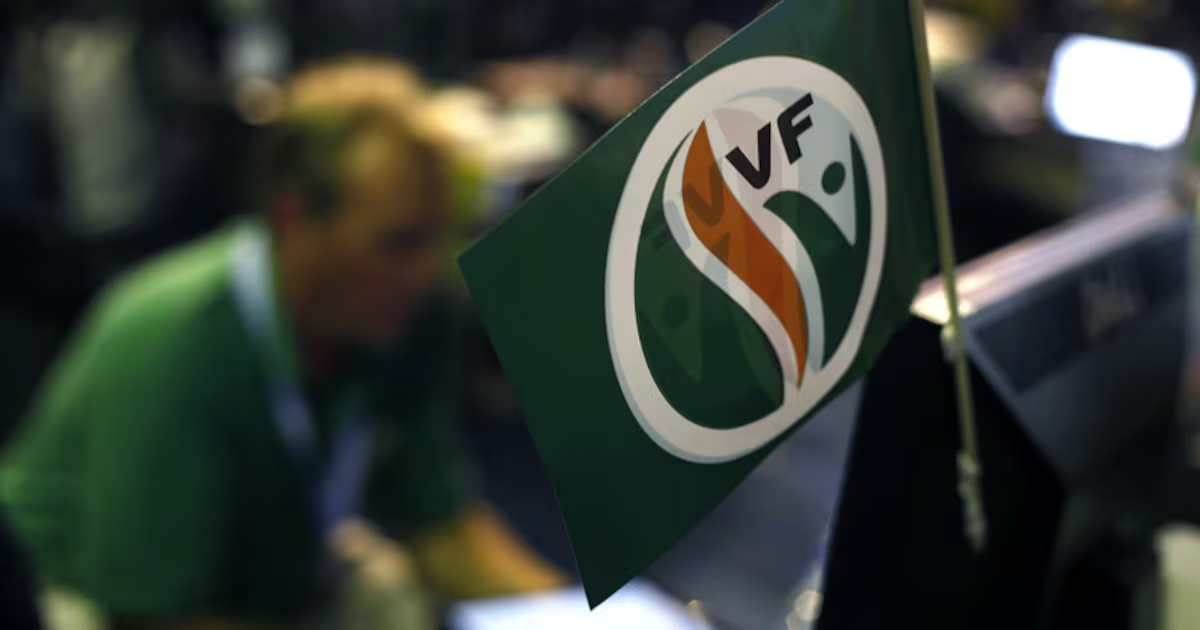
The Freedom Front Plus has launched its new election campaign with the slogan “It’s Our Time”, a confusing revelation to those of us who hadn’t realised it was 1962. Others are reacting less with surprise than with anger: in the past few days I’ve seen online comments by some on the left bitterly claiming that older supporters of the FF+ already had their time holding the levers of power in South Africa and managed to produce nothing but a crime against humanity. While I appreciate the sensitivities around this, I must point out that these accusations are slightly unfair. The Mulder brothers might have been raised by BJ Vorster’s minister of propaganda ― the same BJ Vorster who in 1942 declared that “we stand for Christian nationalism which is an ally of National Socialism [Nazism]” ― but when it came time for young Pieter and Corné to make their own way in politics, they didn’t follow their father, Connie, into the National Party. No, they went somewhere far more racist: Andries Treurnicht’s Conservative Party, which had split with the Nats because Treurnicht (and presumably everyone who joined his party) thought PW Botha was a pinko liberal who was about to usher in a nightmare world in which black people were allowed to eat their lunch in the kitchen rather than on the back steps. All of which is to say I want to refute the claim that the FF+ helped run the apartheid regime. It didn’t, mainly because some of its members were too right-wing for the apartheid regime. Of course, this will be scant consolation for those South Africans who might be twitchy about allowing people who actively campaigned against democracy in favour of white supremacy to get near the levers of power in an African democracy. But if I can offer them some solace, it is to point out that FF+’s primary offering is the promise to campaign for the self-determination of Afrikaners and other ethnic minorities. When they say “It’s Our Time”, they aren’t announcing a plan to take over this country, because their plan, ultimately, is to leave it, at least spiritually and politically. Still, it’s made me reflect once again on how strange it is that so many politicians associated with catastrophic ideological or moral failures can not only linger in politics but bustle about in front of the cameras, brightly telling us to get over their role in apartheid or the looting of the Zuma years or, in the US, their history as rapists or frauds, and instead vote for them because this time it’s different. Political pragmatismI suppose some of this is the result of political pragmatism, where winning a lasting peace is considered more important than outlawing and rooting out a belief system that has almost destroyed a country. Perhaps to some extent the FF+ is a beneficiary of the same sort of pragmatism that produced the spectacle seen in the US in 1859-66, where abolitionist John Brown caused the deaths of 17 people in a failed bid to end slavery and was hanged for treason, while Robert E Lee, who led a proslavery rebellion that killed 365,000 Union soldiers, went free and became a symbol of American reconciliation. Even the Germans understood that progress would be impossible if former Nazis were permanently excluded from the political process: by 1949 West Germany was cautiously returning the franchise to those who had used it in 1933 to unleash barbarism on Europe. Perhaps democracy must be fundamentally forgiving to keep it safe from becoming self-stifling. But perhaps we must also remember that bad ideas aren’t necessarily erased from the world just because they’ve suffered failure or defeat. Right now you can go onto social media and find white South Africans who will tell you that apartheid could have worked if it hadn’t been betrayed from the inside by verligtes. You can find Americans insisting the Nazis were socialists (because National Socialism, see?) and that fascism therefore hasn’t had a fair shout yet. You can find priests insisting that the world would be better if women stayed at home as doting brood mares. All these people can and do vote: that is how democracy works. But even as it endlessly renews itself it also drags with it the persistent, resistant relics of our past; and so, when someone cheerfully announces that “It’s Our Time”, those of us with long memories would do well to ask them to point at a history of the past 1,000 years and ask: which time is that, exactly? • Eaton is an Arena Holdings columnist.
TOM EATON | It’s back to the future for the Freedom Front Plus
‘It’s Our Time’ slogan sparks reflection on how forgiving democracy should be
765 words~3 min read