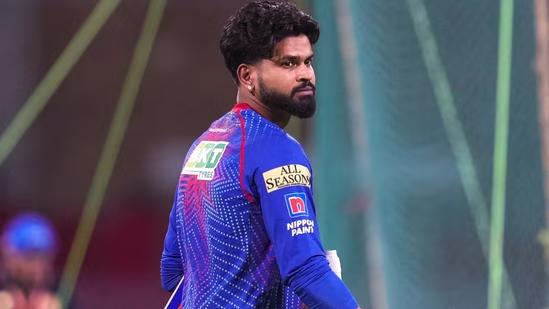
PBKS ended IPL 2026 fifth with 15 points. The franchise reported a profit of ₹27.29 crore, but high bowling costs resulted in a severe deficit. Punjab Kings entered IPL 2026 as last year's finalists and exited the league stage in fifth place with 15 points, one short of the playoff cut. The cricket story of six consecutive wins followed by six consecutive defeats has been told at length. What has not been told is the financial story underneath it, which is starker, more precise, and considerably more damning. The WPA Impact Index assigns a monetary value to every player's appearance across the season, and for PBKS, it reveals a squad built on a structural contradiction that no winning streak could permanently hide.Shreyas Iyer led the Punjab Kings for the second season. (PTI)The top line and what sits beneath itPBKS finished with a season profit of ₹27.29 crore, placing sixth in the ten-team monetary league table. Total worth generated across the campaign came to ₹135.21 crore against a total cost base of ₹107.92 crore. On the surface, that is a franchise operating in the black with a reasonable margin.The surface reading is misleading. PBKS carried the third-highest cost base in the competition, behind only the Mumbai Indians ( ₹112.59 crore) and the Delhi Capitals ( ₹108.57 crore). Teams ranked first through fifth spent between ₹85.80 crore and ₹97.48 crore, comfortably below PBKS's outlay. The season's best commercial performer in the league stage, Sunrisers Hyderabad, have generated a profit of ₹69.46 crore on a cost of ₹87.41 crore. PBKS generated ₹27.29 crore on an investment of ₹107.92 crore. That is not a comparable outcome.The base impact profit-and-loss figure tells the real story. Stripped of rating adjustments and captaincy credits, PBKS's raw cricket value relative to cost results in a deficit of ₹36.45 crore. The ₹27.29 crore headline profit exists because ₹11.72 crore of captaincy premium and positive rating adjustments sit atop a base that is deeply underwater. PBKS are a profitable franchise in the ledger because of subjective quality recognition, not because their auction investments generated commensurate on-field returns.Where the value came fromThe squad's commercial engine was almost entirely located at the top of the batting order, among its three cheapest significant contributors. Prabhsimran Singh, bought for ₹4 crore, generated a worth of ₹19.90 crore across 14 appearances, for a profit of ₹15.90 crore. Cooper Connolly, at ₹3 crore, produced a value of ₹17.39 crore on ₹14.39 crore in profit. Priyansh Arya, at ₹3.80 crore, returned ₹14.06 crore for ₹10.26 crore in profit. Combined cost for these three: ₹10.80 crore. Combined worth: ₹51.35 crore. Combined surplus: ₹40.55 crore.Punjab Kings balance sheet for IPL 2026. (HT Digital)The single best value ratio in the squad belongs to Suryansh Shedge. Purchased for ₹30 lakh, he produced ₹5.91 crore in worth across seven appearances, a surplus of ₹5.61 crore on a negligible investment. His season recovery percentage is the kind of number that makes auction strategy teams recalibrate their models.Shreyas Iyer, the captain, is the player the raw numbers alone cannot fully capture. At ₹26.75 crore he is the most expensive player in the squad, and a player P&L of ₹2.65 crore looks modest at first glance. But the WPA Impact Index credits him with ₹11.72 crore in captaincy value across the season, a figure that reflects something the batting scorecard does not show: the structural role he played in holding a young, inexperienced top order together through a gruelling 14-match campaign. His total P&L, including captaincy premium, reaches a figure that justifies the investment more comfortably. Add to that his match-winning hundred against LSG in the final league game, the innings that kept PBKS's playoff hopes alive to the last day, and Iyer's season reads less like an expensive underperformance and more like the cost of having an anchor at the top when everything else around the bowling unit was coming apart.Also Read: INR 34.21 crore profit despite premium disappointments: KKR's IPL 2026 balance sheet reveals their real savioursWhere the value was destroyedTwo rows in the player ledger account for the team's base-level deficit almost in their entirety. Yuzvendra Chahal, at ₹18 crore, generated ₹3.73 crore in worth across 13 appearances. Profit and loss: minus ₹14.27 crore. Arshdeep Singh, also at ₹18 crore, generated ₹5.07 crore in worth across 14 appearances. Profit and loss: minus ₹12.93 crore. The two of them together cost ₹36 crore, returned ₹8.80 crore, and destroyed ₹27.20 crore of value. That figure represents two-thirds of the entire top-order batting surplus.The PBKS team value waterfall. (HT Digital)Marco Jansen (minus ₹3.79 crore on ₹7 crore), Marcus Stoinis (minus ₹2.51 crore on ₹11 crore), and Lockie Ferguson (minus ₹2.07 crore on ₹2 crore, with negative raw bowling impact) complete the picture of a bowling group that was, by monetary measure, an anchor throughout the season. Ferguson is notable as the only PBKS player with a negative raw impact figure, meaning his bowling cost the team more in match probability terms than it contributed.The verdictPBKS built a squad with a spectacular batting top order on modest contracts, then spent approximately ₹47 crore on four overseas and senior bowling investments (Chahal, Arshdeep, Jansen, Stoinis) that collectively failed to recover their cost. The batting manufactured enough surplus to keep the franchise profitable on paper. It was not enough to compensate for the bowling drain across a full 14-match season, and it was certainly not enough to sustain a playoff push once opposition sides had gathered sufficient data to neutralise a top order that was doing almost all of the work.The lesson in the ledger is not subtle. PBKS paid for bowling at ₹18-crore rates and received ₹3-5 crore output. That gap, not any failure of nerve or momentum, is what ended their season.Methodology noteThe monetary valuations cited in this article are outputs of the WPA Impact Index, a player valuation model exclusively designed by the author. The model assigns a monetary worth to each player appearance by converting impact scores derived from win probability added calculations on a ball-by-ball basis into rupee-equivalent figures, using each player's auction price as the cost denominator. Rating adjustments are applied on top of the raw base impact to account for subjective performance quality, and captaincy value is scored and monetised separately.All figures are denominated in Indian rupees (crore). The worth and profit and loss figures represent modelled valuations and are not official franchise accounting data. They reflect cricket impact as measured by the WPA framework and should be read as analytical estimates, not contractual or financial disclosures.Probuddha Bhattacharjee is a sports writer and analyst with expertise spanning cricket, football, and multi-sport events, with a strong emphasis on data-driven journalism and tactical storytelling. He currently focuses on international cricket, the Indian Premier League, global tournaments, and emerging trends shaping modern sport, blending advanced statistics with strong narrative context to explain performance, strategy, and decision-making. His work aims to bridge the gap between numbers and storytelling, helping readers understand not just what happened on the field, but the tactical and structural reasons behind it.
INR 36 crore down the drain: How Punjab Kings bought IPL 2026's best top order and the worst bowling unit
PBKS ended IPL 2026 fifth with 15 points. The franchise reported a profit of ₹27.29 crore, but high bowling costs resulted in a severe deficit. | Cricket
1,345 words~6 min read