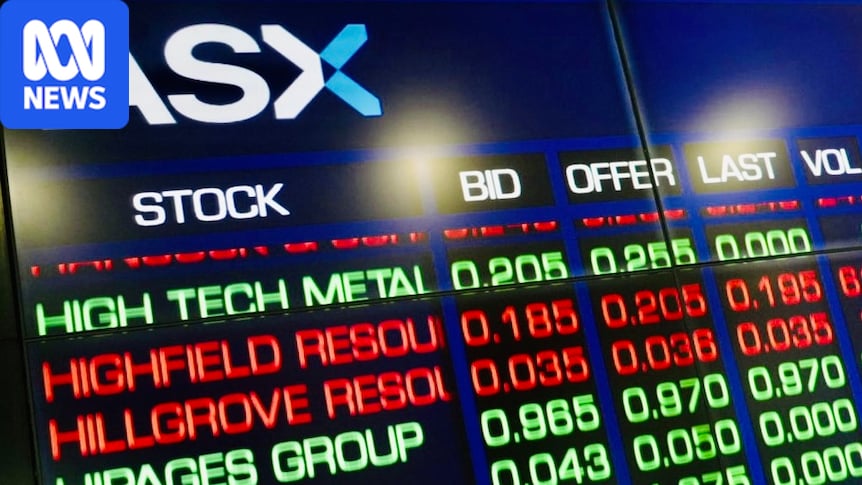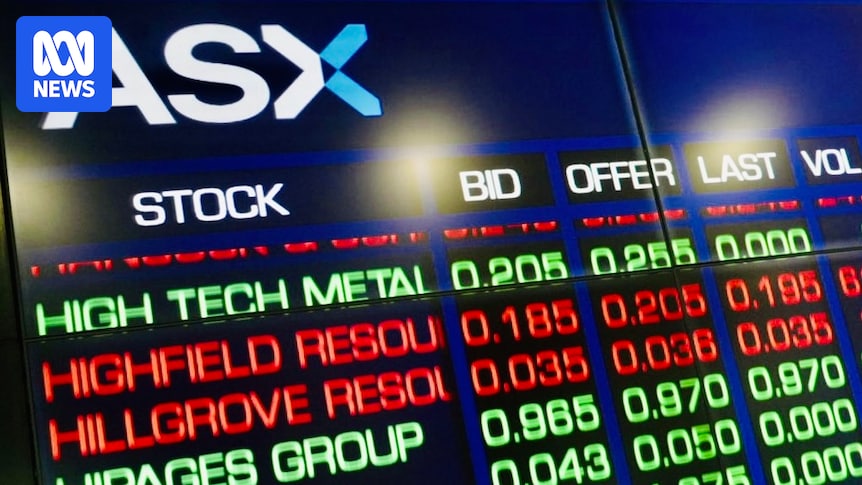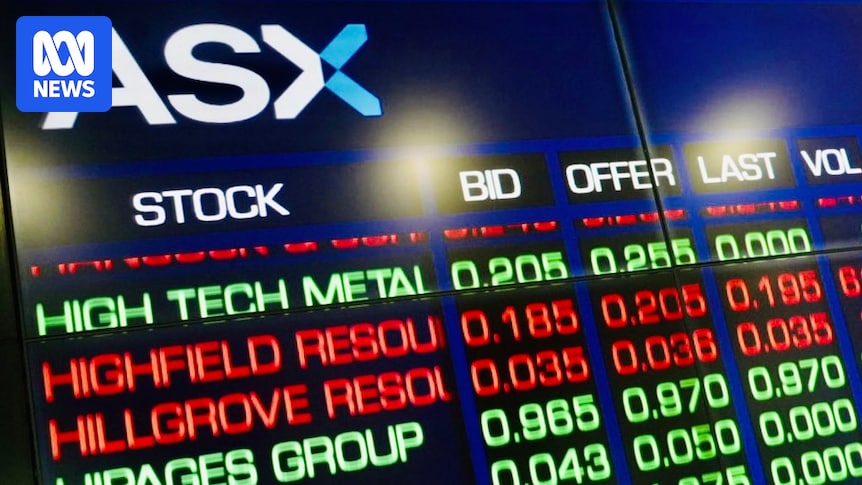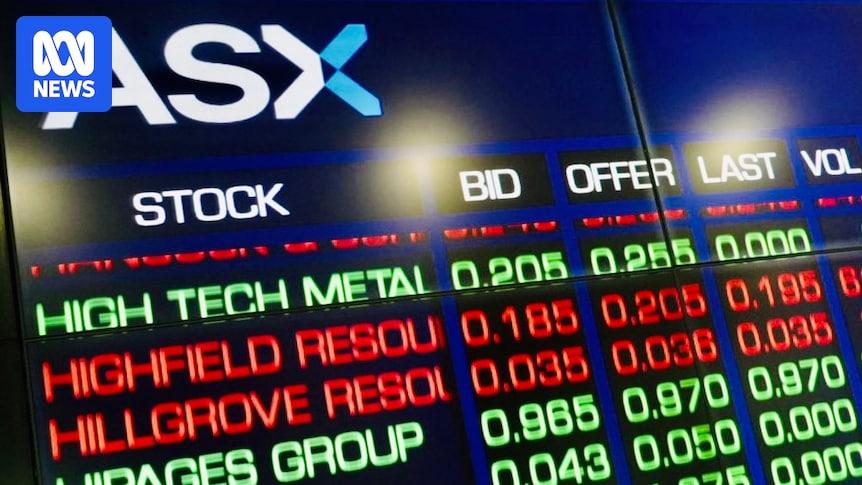
PinnedTue 26 May 2026 at 10:18amTue 26 May 2026 at 10:18amMarket snapshotBy Stephanie ChalmersASX 200: -0.4% to 8,654 points (live values below)Australian dollar: -0.1% to 71.67 US centsS&P 500: ClosedFTSE: ClosedEuroStoxx: +1% to 631 pointsSpot gold: -0.5% to $US4,584/ounceBrent crude: +1.7% to $US97.77/barrelIron ore: -0.1% to $US109.00/tonneBitcoin: -0.1% to $77,130Prices current around 10:15am AEDT.Live updates on the major ASX indices:Key EventTue 26 May 2026 at 11:04amTue 26 May 2026 at 11:04amBanks weigh on ASXBy Stephanie ChalmersIt's a down day for the share market so far, with the ASX 200 now down 0.7%.The major banks are weighing on the broader market, with NAB down 1.%, followed by Westpac (-1.1%), CBA (-1%) and ANZ (-0.9%).Most sectors are in the red:ASX 200 sectorsThe best performing stocks so far are:Fisher & Paykel Healthcare +7.8%Graincorp +3.6%Austal +3.6%DroneShield +3%Sims +2.7%And the worst:ASX -10.6%PEXA Group -5.5%Infratil -4.8%Telix Pharma -4.7%Predictive Discovery -4.5%Key EventTue 26 May 2026 at 10:37amTue 26 May 2026 at 10:37amASX Ltd shares down more than 10%By Stephanie ChalmersShares in stock exchange operator ASX Ltd are the worst performer on the benchmark index this morning so far.The stock is down 10.8% at the moment.The company issued a trading update, including increased capital expenditure guidance for the next financial year, "primarily driven by technology cost inflation and news product development.Capex for FY27 is expected to be in the range of $180-$200 million, and $170-190 million for FY28."The guidance reflects the investments ASX needs to continue to make as a steward of critical market infrastructure," it said.It follows a report from an ASIC inquiry, which ASX Ltd said identified "historical underinvestment compared to global peers".Key EventTue 26 May 2026 at 10:08amTue 26 May 2026 at 10:08amASX falls in early tradeBy Stephanie ChalmersWe're just a few minutes into the session, but the local share market has gone against what futures trade has suggested, and the ASX 200 is down 0.3%.Tue 26 May 2026 at 9:56amTue 26 May 2026 at 9:56amICYMI: Monday's video finance reportBy Daniel ZifferDid you miss Alan Kohler’s finance report last night? Don’t stress, we’ve got you.The numbers refer to yesterday’s data, so catch up on where we’ve been, to get a steer on where you’re going today, with just a few minutes left before the ASX kicks off for the Tuesday session.Tue 26 May 2026 at 9:41amTue 26 May 2026 at 9:41amWinter crop down, Rabobank predictsBy Daniel ZifferAustralia is set to plant a reduced winter crop this year, as the nation's grain growers contend with mixed weather conditions and the impacts of significantly higher farm input costs, Rabobank says in its "2026/27 Australian Winter Crop Forecast".The specialist agribusiness bank estimates Australia's winter cropping area will come in at 23.1 million hectares for the season, down 8% on last year and 4.3% below the five-year average.It's wheat. Australia's wheat planting is estimated to be down by a substantial 20.4% on last year to 9.8 million hectares, according to the annual outlook by the bank’s RaboResearch division. This is 24% below the five-year average.Barley, canola and pulse plantings are forecast to increase on last year's area, with these commodities offering growers potentially stronger margins than wheat, according to report author RaboResearch senior grains and oilseeds analyst Vitor Pistoia.“Australia enters the 2026/27 winter cropping season with a more uneven and weather-dependent cropping area than in recent years.“The season is opening with a clear geographic split across Australia’s cropping regions. Conditions on the northern east coast, particularly in southern Queensland and northern New South Wales, have been dry through summer and early autumn, leaving limited topsoil moisture and delaying sowing.”In contrast, Mr Pistoia said, Western Australia, South Australia, Victoria and southern New South Wales had entered the season with average to above-average soil moisture, allowing earlier seeding (including for canola in WA and SA, which was sown as early as late March).Elevated input costsThe report said elevated farm input costs, particularly higher global fertiliser and diesel prices due to the Middle East conflict, were increasing production costs for Australian growers and influencing cropping decisions this quarter.“These higher costs are encouraging shifts towards lower-input crops and contributing to a reduction in total cropping area,” Mr Pistoia said.Tue 26 May 2026 at 9:32amTue 26 May 2026 at 9:32amICYMI: ABC Business DailyBy Daniel ZifferYesterday, ABC business editor Michael Janda sat down with me for the ABC Business Daily podcast.It's a lot of fun, as we traversed the economic mobility of Australia (how "stuck" we are, and how to fix things), our steel conundrum off the back of falling Chinese output and much more.It's wherever you get your podcasts, or right here!Shortly, I'll chat with the great Gareth Hutchens, and you'll have today's edition in your ears mid-afternoon.And don't worry, I'm just filling in! Regular host Carrington Clarke is back in the chair from Monday.Tue 26 May 2026 at 9:24amTue 26 May 2026 at 9:24amWhat is petrol costing where you are?By Daniel ZifferOK, so the national average price of a litre of unleaded petrol is up, 1.6 cents to 185.8 cents, in the week to Sunday.But what you really want to know is what it’s like where you live?And thanks to the dedicated boffins at the Australian Institute of Petroleum, here’s that very data.One litre, unleaded, and what it costs around the nation (Australian Institute of Petroleum)Tue 26 May 2026 at 9:16amTue 26 May 2026 at 9:16amPetrol up 1.6 cents in a weekBy Daniel ZifferThe national average price of a litre of unleaded petrol lifted 1.6 cents to 185.8 cents in the week to Sunday.Weekly data from the Australian Institute of Petroleum details the jump, which puts the average almost line-ball with the 12-month average figure of 185.6 cents.Tue 26 May 2026 at 9:12amTue 26 May 2026 at 9:12amNew FuelCast examines what might happen when excise cut expiresBy Daniel ZifferEvery time-bound tax concession granted has a ticking clock inside of it.The federal government's three-month cut to fuel excise, to help consumers deal with the skyrocketing cost of juice, expires on June 30.With crude oil prices still massively elevated, is it realistic to think it will be allowed to lapse? Alan Kohler joins me to discuss this and the latest potential deal to end the conflict and reopen the Strait of Hormuz.I call it FuelChat, but the producers have a better name: check out FuelCast wherever you get your podcasts or, in the name of efficiency, right here.Key EventTue 26 May 2026 at 9:07amTue 26 May 2026 at 9:07am🎥 Inside the legal MDMA and psilocybin magic mushroom tradeBy Stephanie ChalmersAt a manufacturing hub in Brisbane, MDMA is being packed into capsules for hospitals and clinics across the country.It isn’t the only drug processed at the lab.Bags of mushrooms will be weighed before the active ingredient inside, known as psilocybin, is extracted.On the black market, they are known as magic mushrooms and are sold for their hallucinogenic effects.But in this facility, they have a therapeutic use.In 2023, Australia changed its laws, becoming the first country to allow authorised psychiatrists to prescribe MDMA for post-traumatic stress disorder (PTSD) and psilocybin for treatment-resistant depression.For the first time, the ABC can take you behind the scenes of this production line, inside the vaults, and all the way to the patients in therapy.Business reporter and frequent blogger extraordinaire Adelaide Miller has this report from inside a facility producing the legal forms of the drugs:Tue 26 May 2026 at 9:01amTue 26 May 2026 at 9:01amUse robots to cut construction costsBy Daniel ZifferOK, not quite, but not far off.A new report from the Committee for Economic Development of Australia (CEDA) and consultants Urbis has found that scaling and adapting modern methods of construction (MMC) could be key to unlocking Australia’s housing supply and easing the nation’s worsening housing shortage.The report, "Built Different: Modern Methods of Construction", found MMC could cut construction times by 20 to 50 per cent and reduce costs by about 20 per cent when implemented at scale.MMC includes:prefabricationoff-site manufacturingmodular or volumetric building3D printingroboticsAI-integrated processesTold you there were robots.CEDA head of research Danika Adams said Australia must not only build more, but build differently, to meet our housing needs.“The National Housing Accord target of 1.2 million new dwellings by 2029 is ambitious, and current progress is falling short.”Slow construction is a huge drag on supply, but not the only one.Dwellings built per construction worker have fallen 40% since the 1970s. Build times have increased by 40% since the pandemic, and construction costs have surged 88% since 2014–15.Here's Clinton Ostwald, Partner at Urbis:“Modular construction is currently used for less than 5 per cent of new Australian homes. Given housing supply is constrained by how slow and expensive it has become to build, modern methods of construction offer a practical way to improve that.“Traditional construction is not keeping up. These methods already exist, they work, and the challenge now is scaling.“We know this is a system-wide challenge, which means it also needs a system-wide response. To scale modern methods of construction, we need better alignment across planning, regulation, procurement, finance and the supply chain so industry has the confidence to invest and deliver at scale."It's not a silver bullet, they say, but it would help a lot.Tue 26 May 2026 at 8:49amTue 26 May 2026 at 8:49amStuck! Not switching jobs, starting businesses or moving interstateBy Daniel ZifferThere's been a great response to my report yesterday about some troubling economic indicators of our "stuckness".Job mobility at multi-decade lowsSelf-employment falling from 20% to 14% in two decadesInterstate moves falling to 1.3% of the population a yearIf you read a popular email newsletter and are wondering where this has all come from, you'll enjoy this article and the great video package our talented editors put together to explain it all.Tue 26 May 2026 at 8:44amTue 26 May 2026 at 8:44amPower prices to fallBy Daniel ZifferPotentially not what you were expecting, but this has been coming.Power prices on the east coast are set to fall.Surging levels of renewable energy and better reliability from coal-fired generators are set to give consumers a break, with benchmark power prices to fall up to 10 per cent for consumers and more for small businesses.In what will be welcome news to power users weary from years of big tariff hikes, the Australian Energy Regulator (AER) has decided to cut the default market offer (DMO) in several states.The offers act as a safety net by setting the maximum, or ceiling, price retailers can charge affected customers.Fewer than one in ten households are on a default offer, but experts say they are a key reference by which all other power prices are measured.Tue 26 May 2026 at 8:32amTue 26 May 2026 at 8:32amUS futures up on peace deal hopesBy Daniel ZifferI've done badly looking at the past US markets today, so let's focus on the future!With the hope that a peace deal with Iran will lead to the imminent resumption of energy supply, markets are up.That's no shock: the Strait of Hormuz is involved in the transport of anything from 10-20% of the world's petroleum and LNG supply.Here's where futures are at the moment:Dow Jones - up 0.9%.S&P 500 up 0.9%Nasdaq up 1.2%Key EventTue 26 May 2026 at 8:30amTue 26 May 2026 at 8:30amBreaking: Power prices to fall for most customers, bigger drops for businessesBy Stephanie ChalmersIn news just out, the Australian Energy Regulator (AER) has decided to cut the default market offer (DMO) in several states.Power prices will fall by up to 7.7% in New South Wales, 10.7% in south-east Queensland, and 1.1% in South Australia.Some customers in South Australia, however, will see an increase of 1.4%.The range in prices is due to some people being on a flat rate, while others are on a time-of-use tariff, which changes throughout the day.But small businesses in all three regions will see much bigger falls in their power bills, down as much as 12.8% in South Australia, 14% in south-east Queensland, and as much as 20.9% in New South Wales.Read more from energy reporter Daniel Mercer:Tue 26 May 2026 at 8:11amTue 26 May 2026 at 8:11amCGT changes to GO forward as ALP pushes throughBy Daniel ZifferLooks like that "AI Albo" campaign didn't get the win it was hoping for.My Canberra colleagues report that Labor will press ahead with its controversial capital gains tax (CGT) overhaul as it continues consultations with businesses, despite privately signalling any carve-outs will remain limited.The federal government plans to introduce legislation bundling multiple budget measures in the House of Representatives on Thursday.Here's the detail:Tue 26 May 2026 at 8:07amTue 26 May 2026 at 8:07amUS markets closed for Memorial DayBy Daniel ZifferMy apologies, in the market snapshot, I'd put figures for the US markets.But they've been shut for the Memorial Day holiday.The figures were from Friday's close.US markets will re-open at 11.30PM AEST this evening.Tue 26 May 2026 at 7:46amTue 26 May 2026 at 7:46amSecret documents show BHP may struggle to reach net zero by 2050By Daniel ZifferHow are they going to make it? That's been the question in the mining industry, and secret documents obtained exclusively by Four Corners and Guardian Australia shed more light on it.The "it" is the ambition and necessity of the world's biggest miner reducing its carbon emissions.Doing so is costly, but not doing so may be more so, as the cost of abatement rises and markets like Europe effectively impose tariffs on products associated with emissions.BHP's vast WA iron ore operations are forecast to cut emissions by just 1 per cent by 2030, leaked internal documents reveal, raising doubts within the company about whether it can meet its pledge to reach net zero by 2050.The documents focus on BHP's operations in WA. Given that those mines account for 30 per cent of BHP's global emissions, big cuts would be needed in the Pilbara to achieve the 2050 goal.The mining giant's delay in the rollout of renewable energy and its first fleet of electric trucks and trains has raised doubts inside the company about whether it can meet its ambitious climate goal."Solutions are still being sought to achieve net zero," it said in a memo from May last year.Separately, the document said delaying climate action into the 2040s "risks achieving 2050 goal".In another document, BHP staff noted its decision to stick with diesel trucks at one Pilbara mine was "inconsistent with the trajectory for greenhouse gas abatement and pathways to net zero".Tim Buckley from the think tank Climate Energy Finance said BHP was not currently on track to meet net zero operational emissions by 2050."Their actions are not aligned with the science," he said.Tue 26 May 2026 at 7:29amTue 26 May 2026 at 7:29amOil tumbles 7% on peace deal hopesBy Daniel ZifferWhat's happening with oil? Here are the latest headlines:Oil prices drop as US-Iran peace talks progress, Strait of Hormuz reopening eyedAnalysts caution oil flows may take months to normalize even if deal is reachedSome tankers have passed through strait, shipping data showsOil prices fell nearly 7% on Monday as optimism grew that the United States and Iran were moving closer to a peace deal that would reopen the Strait of Hormuz, although Washington and Tehran downplayed hopes for an imminent breakthrough.Brent crude futures fell $7.24, or almost 7%, to $96.30 a barrel, and US West Texas Intermediate futures fell $6.30, or 6.5%, to $90.88.(All figures in this post are in US dollars).Trading volumes were light due to the US Memorial Day holiday.Iran's top negotiator and its foreign minister were in Doha for talks with Qatar's prime minister on a potential deal with the US to end the three-month-old war, an official briefed on the visit said Monday.Both sides said they had made progress on a memorandum of understanding that would halt the war and give negotiators 60 days to reach a final deal.'Get some oil moving'"Even though it's not done, there seems to be some hope that we will start to get some oil moving through the Strait of Hormuz," said Phil Flynn, senior analyst with Price Futures Group.But Rory Johnston, founder of the Commodity Context newsletter, sounded a note of caution."We've routinely gotten close and then collapsed on the details multiple times over the past couple of months, and Hormuz remains closed," Johnston said.In a lengthy Truth Social post on Monday, US President Donald Trump said talks with Iran were going "nicely," but warned of fresh attacks if they failed.He urged more Arab and Muslim states to sign up to the Abraham Accords, which were brokered during Trump's first term in office and aim to normalise ties between Arab and other Muslim-majority states and Israel."That could mean a significant reduction of risk premium in the Middle East, especially if a deal with Iran can be done and Iran gives up their nuclear material," Flynn said.Iran's foreign ministry said on Monday it was negotiating an end to the war and was not currently discussing nuclear issues.Even if a peace deal is reached, analysts expect a return to normal oil flows through the strait will take months, while damaged oil and gas facilities are repaired."The underlying supply shortfall of 10-11 (million barrels per day) of crude oil does not go away immediately and will see markets still drawing inventories until Middle Eastern crude production is back online, which is months away," said Sparta Commodities analyst June Goh."We continue to believe that the key factors for the oil market to watch should be the physical oil flows, and so far, flows through the strait remain restricted," said UBS analyst Giovanni Staunovo.Ship-tracking data showed that three liquefied natural gas tankers passed through the strait in recent days, heading to Pakistan, China and India, as well as a supertanker carrying Iraqi crude to China after being stranded for nearly three months.- Amanda Stephenson of Reuters News
Live: Australian stocks fall as US strikes dampen investor sentiment
The local share market is in the red, while shares in stock exchange operator ASX Ltd have tumbled on a trading update. Follow the day's events and insights from our business reporters on the ABC News live markets blog.
TL;DRAI
ASX 200 fell 0.7% Tuesday, with ASX Ltd shares down 10.6% after raising FY27 capex guidance to $180–200M on technology cost inflation. An ASIC finding of historical underinvestment vs global peers puts pressure on infrastructure operators to accelerate tech spend.
2,937 words~13 min read