Students visit a job fair at Kasetsart University in Bangkok in February. Varuth Hirunyatheb
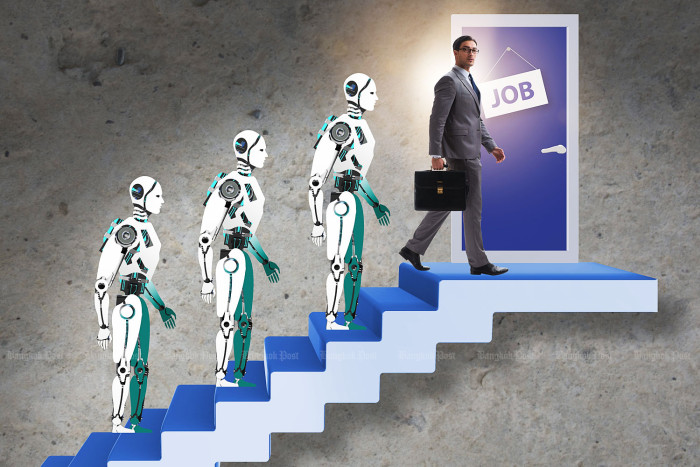
Nearly 9 million workers could potentially be affected by generative artificial intelligence (GenAI), according to estimates by the National Economic and Social Development Council (NESDC).Speaking during a briefing on Thailand's social conditions in the first quarter of this year, Danucha Pichayanan, secretary-general of the NESDC, said the council applied the occupational risk assessment model for GenAI developed by Gmyrek et al (2025), using data from the Labour Force Survey for the fourth quarter of 2025. Out of Thailand's total workforce of 40.1 million people, around 8.7 million workers, or 21.8% of the national labour force, were identified as being at risk of being affected by GenAI.
He said it was undeniable that some professions will be impacted by AI, and that the government has been implementing upskilling and reskilling programmes for workers. Universities have also adjusted their curriculums to mitigate the impact of AI on new graduates entering the workforce.
Thailand's unemployment rate in the first quarter of 2026 stood at 0.94% of the total labour force, equivalent to 390,000 people, up by 9.9% from the same period last year.