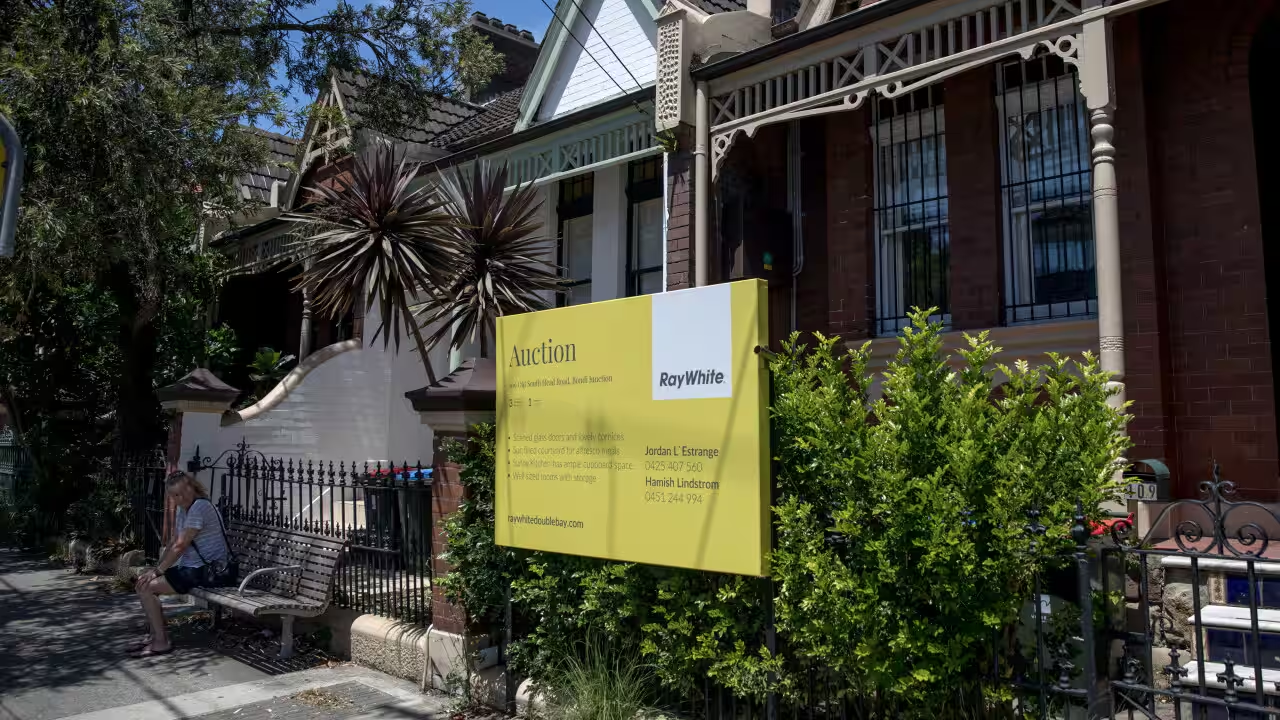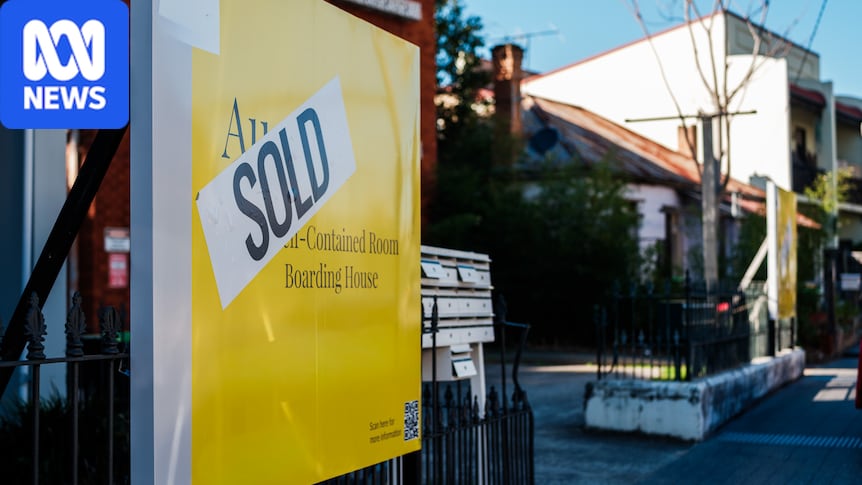
The early signs of an Australian housing market correction are now clearly visible.Demand was dented when the Reserve Bank began increasing interest rates earlier this year.Three consecutive interest rate hikes have taken away borrowing capacity to the tune of tens of thousands of dollars.Then budget leaks around potential changes to negative gearing and capital gains tax further hit sentiment, and demand, in the market.There's been little if any improvement in sentiment in the weeks following the federal budget.On the supply side, there has also been a notable boost in construction activity.Researchers such as Cotality have signalled a property market "downturn", but others including Louis Christopher from SQM Research say "the national housing market has turned, and the downturn is now broadening".And at the heart of the recent property market weakness is less vendor power.Bid-ask spreadA single residential property auction on any given day is a microcosm for the property market.It involves buyers who have, you can assume, borrowed hundreds of thousands of dollars to be in a position to bid for the property and vendors who would like their reserve price to be reached and, ideally, exceeded.The vendors, at a basic level, are asking for a particular price and property hopefuls are bidding to own the property.It creates a bid-ask spread.Auction clearance rates have fallen sharply. (ABC News: Danielle Bonica)The spread is the widest at the start of the auction and narrows all the way to zero when the auctioneer drops the hammer — sold!In a continuously traded market such as shares or bonds, prices in the bid-ask spread are constantly being matched.Indeed, during moments of market panic or dislocation, the spread will close abruptly at the open of trade as the ask price meets the bid; the market "gaps down".Across the country now, individual property auctions have seen a widening of the bid-ask spread.We know this because auction clearance rates have fallen sharply; in other words, auctions are winding up without any bids matching the seller's asking price (which obviously the bidders are unaware of).Auction clearance rates fallIf a sale goes through, it means the auction cleared.Auction clearance rates have been weaker for a few months now.Across the combined capital cities, the preliminary auction clearance rate saw a slight increase last week, reaching 58.2 per cent, up from the 57.5 per cent low recorded the week prior in the wake of policy changes in the 2026–27 federal budget."Despite this modest improvement, the rate has stayed under the 60 per cent benchmark for six of the last eight weeks," Cotality economist Annabelle Mezieres said.For context, at the height of the property boom in March 2021, auction clearance rates were north of 80 per cent.Melbourne's latest preliminary clearance rate came in at 60.2 per cent, which was a slight decrease from the previous week's 61.4 per cent.Sydney saw 823 homes go to auction last week, up by a third on the previous week when 619 auctions were held.The preliminary clearance rate rose to 56.9 per cent, recovering from 49.2 per cent the week prior (similar to lows last seen during the early stages of the pandemic).There's been an increase in bidders not meeting vendor price expectations. (ABC News: Danielle Bonica)"Although the clearance rate lifted, the result remained soft, with the early clearance rate sitting below 60 per cent in eight of the past nine weeks," Ms Mezieres said.Brisbane's preliminary clearance rate came in at a soft 45.7 per cent, the lowest early auction outcome for the city since April 2023.In Adelaide, auction volumes experienced an 8.8 per cent decline from the preceding week, with 135 properties listed for sale.The preliminary clearance rate of 72 per cent remained the highest among all capital cities.Canberra's preliminary clearance rate remained steady at 54.3 per cent.And it's worth remembering that the final clearance rate invariably comes in several percentage points lower than the preliminary figures, as real estate agents tend to be somewhat slower to report non-sales than successful auctions.This is evidence that, across the nation's capital cities, there's been a material lift in bidders not meeting the price expectations of vendors.Fewer participating in the marketReal estate firm Ray White has reported a decline in the number of market participants.Ray White chief economist Nerida Conisbee views the number of people at any given open home as a leading indicator of both the number of market participants and therefore strength of the market."The most important signal remains open home attendance," Ms Conisbee said.Nationally, attendance averaged 2.1 attendees per property, broadly in line with last week, but well below 3.5 at the same time last year."This shows buyer foot traffic has not recovered after the sharp fall seen in recent weeks," she said.It's possible prospective mortgage borrowers cannot see how they are going to meet future repayments.If, for example, there are a total of five cash rate hikes by August 2026, then the borrowing capacity of someone on an average income would shrink by close to $60,000 in total, wiping out 10 per cent of their buying budget since rate hikes began.This, combined with lower clearance rates, she said, "suggests vendors are facing a more selective buyer pool, particularly as more properties come to market".Average active bidders held reasonably steady at 2.0, only slightly down from 2.1 last week, according to Ray White data."This remains an important distinction," Ms Conisbee said."Fewer people are attending open homes, but those who are still participating appear relatively committed."Weakness creeping inAnd there's the critical phrase: bidders "appear relatively committed".When that commitment wanes, the property market may correct or fall rapidly and the weakness may persist.There are signs this market environment has already arrived.People may be trying to sell their homes before the market weakens. (ABC News: Ian Cutmore)With just more than 2,750 properties currently scheduled nationally for auction, volumes of homes going to market this weekend are expected to surge.In part, this is due to the upcoming June long weekend.However, Cotality head of research Tim Lawless said, "possibly, there is an element here of trying to sell before the market weakens further".And that may be the start of an acceleration in the property market downturn."With policy uncertainty still settling, interest rates higher and buyer attendance materially lower than a year ago, this softer demand environment is likely to persist for some time," Ms Conisbee said.SQM's Louis Christopher sees the ingredients for a property market correction."We now expect Sydney to fall by as much as 9 per cent and Melbourne by as much as 7 per cent for 2026," Mr Christopher said.Asking prices are falling in Sydney. (ABC News: John Gunn)"These markets carry the most investor exposure and the thinnest rental yields, so they absorb the tax changes first and hardest — in effect, the changes lift the yield return an investor requires by around 1 to 1.5 percentage points."But, Mr Christopher said, "the weakness is no longer confined to the two big cities"."Our latest monthly data shows asking prices have now begun to fall in Perth, Brisbane, Adelaide and Canberra, each down around 1 per cent over the past month."In terms of a bid-ask spread, a falling asking price is a key indicator of emerging market weakness.That is, the vendor is meeting the bidder, not the other way around.AMP chief economist Shane Oliver sees the property market falling throughout the year, but not nearly by as much as SQM."Australian home price growth this year is likely to slow to around 3 per cent and could go negative over the year ahead due to poor affordability, RBA rate hikes, reduced investor demand likely to result from the Budget moves to wind back negative gearing and the capital gains tax discount and the hit to confidence from the War," Dr Oliver wrote.A correction rather than a crashWhile property market demand has been dealt a blow, it comes at a time when net migration remains strong and housing supply continues to lag demand.The federal government expects net overseas migration to be just shy of 1 million more people over four years, including 295,000 this financial year and 245,000 next financial year, both higher than its previous forecasts.That additional population growth will need about 220,000 more homes, based on the average of about 2.5 people per dwelling.Labor has an ambitious plan to add 1.2 million well-located dwellings to the housing stock by 2029.The latest supply numbers are encouraging in that the March quarter saw a 17 per cent increase in quarterly building approvals since the June quarter of 2024 when the National Housing Accord commenced.It equates to 219,000 new homes overall.But supply remains relatively tight."We are not … forecasting a [property market] crash, and we don't believe one is likely," Mr Christopher said."Australia still has a serious shortage of housing — vacancy rates are near record lows, and we are not building enough homes to meet demand."If anything, investors stepping back tightens the rental market further."That's the onion in the ointment for first home buyers: while dwelling prices may be retreating, an exodus of investors may tighten-up the rental market and push rental prices higher.That is assuming, of course, the market is rational, which the Sydney market, for one, has not been for many years.Given that, the key to the outlook for the property market depends in large part on how deep the damage to sentiment runs."Unfortunately, for the year ahead, the ledger appears dominated by negative headwinds, from rising interest rates, a softening jobs markets to renewed uncertainty around the implications of the most recent federal budget for both investors and first home purchasers," LGT Wealth Management chief investment officer Scott Haslem said.The jobs market may be the wild card for the property market.The youth unemployment rate surged one percentage point to 11.1 per cent in April, according to the Bureau of Statistics.Westpac views this data point as a "leading indicator" for the overall jobs market.Rising unemployment would create a perfect storm for what has been to date an impenetrable property market.
What do plummeting clearance rates mean for the property market?
Early signs of an Australian housing market correction are now clearly visible, and at the heart of the recent property market weakness is less vendor power.
1,648 words~7 min read