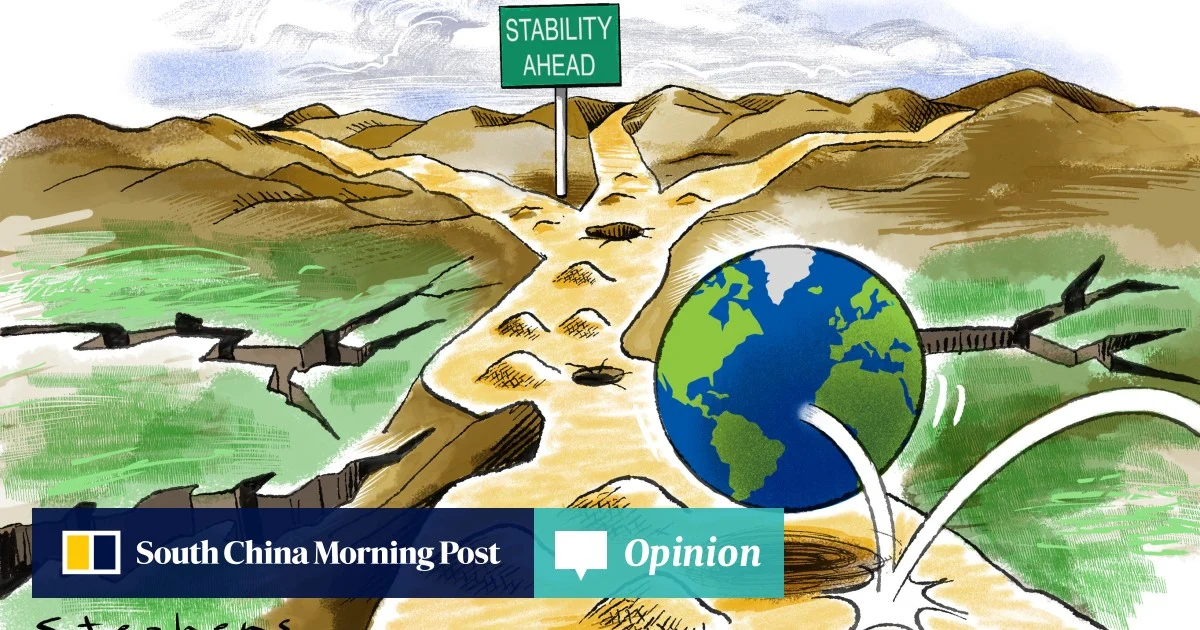
The long arc of history curves towards complexity. Every decade, even year, we are hurtling towards a future that we have neither experienced nor are equipped for. This demands something paradoxical from an individual: institutional competence.For most of human history, complexity was absorbed by stable structures around us. Kingdoms, religious orders, governments, corporations and communities made decisions on behalf of individuals, either directly or through shaping opportunities available to them. A person inherited their identity, geography, profession and even world view, often leading to conformity by choice, which was then reinforced through cultural norms. Life may not have been fair or optimal, but it was structurally legible. That arrangement is unravelling. Today, the individual must navigate levels of complexity once reserved for institutions. A social media entrepreneur in Gurgaon builds a business on a platform whose policies are dictated by Silicon Valley. A virus from a single wet market closes every school on Earth. Subprime mortgages in America upend livelihoods in Chennai.These are not exceptional events. This interconnectedness and related uncertainty define the very texture of modern life. On the flip side, they open up opportunities hitherto unimaginable, but accessible only to those with the fortitude to negotiate instability. The downward shift of complexity has been both insidious and consequential.In such a world, the modern individual increasingly resembles a small sovereign entity. Not merely a participant in predetermined systems, but an autonomous unit required to function under conditions of uncertainty, competition and relentless change.Consider something as ordinary as choosing a career. A generation ago, professions offered relatively stable pathways and identities. People could rely on elderly advice, role models and clear status hierarchies to make choices. Today, job groups disappear and professions reconfigure abruptly. Older generations are none the wiser and role models are hard to find. The lockstep pathway of education through employment to retirement has all but disappeared.Now, imagine you were an institution. You would be better equipped to deal with such conditions. Corporations, for example, have developed the toolkit and talent to tackle interconnected and complex problems at a systemic level. A business would start by surveying the market, analysing competitors and internal strengths. It would articulate a clear product or service strategy, which is then translated into execution.It is no longer sufficient for individuals to work hard within a system. They need to continuously reposition themselves relative to changing conditions. Institutions that once absorbed complexity now generate and amplify it. If life used to be about running faster on a treadmill, it has become more about not falling off of a trampoline.This demands a different approach, one that institutions have been forced to develop through long exposure to complexity.Strategic clarity: Many individuals drift through life, reacting to immediate pressures without a larger framework connecting their decisions. A personal strategy is a stabilising force amidst chaos. A strategy for life does not entail rigid plans or obsessive productivity but a coherent orientation toward one’s own life.Resource allocation: Effective organisations are deliberate not only about what they pursue but also about how much capital and talent each priority deserves. Individuals rarely bring the same intentionality to their own finite resources: time, money and energy. The same is true of relationships.Institutions actively manage stakeholders and alliances. Individuals often drift passively through social circles without consciously nurturing supportive relationships or distancing from corrosive ones.Governance: Knowing which decisions require speed, consultation or deep deliberation. We agonise over minor purchases while making life-altering decisions impulsively because they ‘feel right’. Individuals could benefit from corporate-grade discernment.Culture: The strongest organisations are held together not merely by incentives or efficiency, but by an intentional identity supported by corresponding values and norms. As individuals move between contexts and through life phases, what maintains a coherent narrative? In our fragmented world shaped by algorithms, trends and constant social comparison, internal coherence is no longer a given. A person without an internal culture is perpetually vulnerable to external volatility and manipulation.None of this means turning your life into a management exercise. Institutions at their worst mistake process for wisdom. The goal is not to import their pathologies but to borrow their hard-won insights, lightly and thoughtfully.In a world of disintegrating social contracts, the systems that we expected to take care of us are busy taking care of themselves. By adopting an institutional mindset and selectively adapting their capabilities, individuals may finally learn to engage with institutions not from a position of dependence but from one of greater agency and autonomy.The complexity that once belonged to institutions now belongs to us. This is not just a burden to bear. When navigated well, it becomes the condition for an intentional and self-authored life.(Disclaimer: The opinions expressed in this column are that of the writer. The facts and opinions expressed here do not reflect the views of www.economictimes.com.)
From stability to chaos: Why individuals must now think like institutions - The Economic Times
The modern world demands individuals possess institutional competence as complexity shifts from stable structures to personal navigation. Life's increasing interconnectedness and uncertainty require individuals to adopt strategic clarity, intentional resource allocation, and robust governance to thrive autonomously. This institutional mindset empowers individuals to engage with systems from a position of agency, leading to a self-authored life.
Complexity once absorbed by institutions now falls on individuals, who must navigate instability as autonomous agents without stable career paths or social contracts. Tech leaders should adopt institutional tools—strategy, resource allocation, governance—to manage careers and teams in an AI-volatile market.