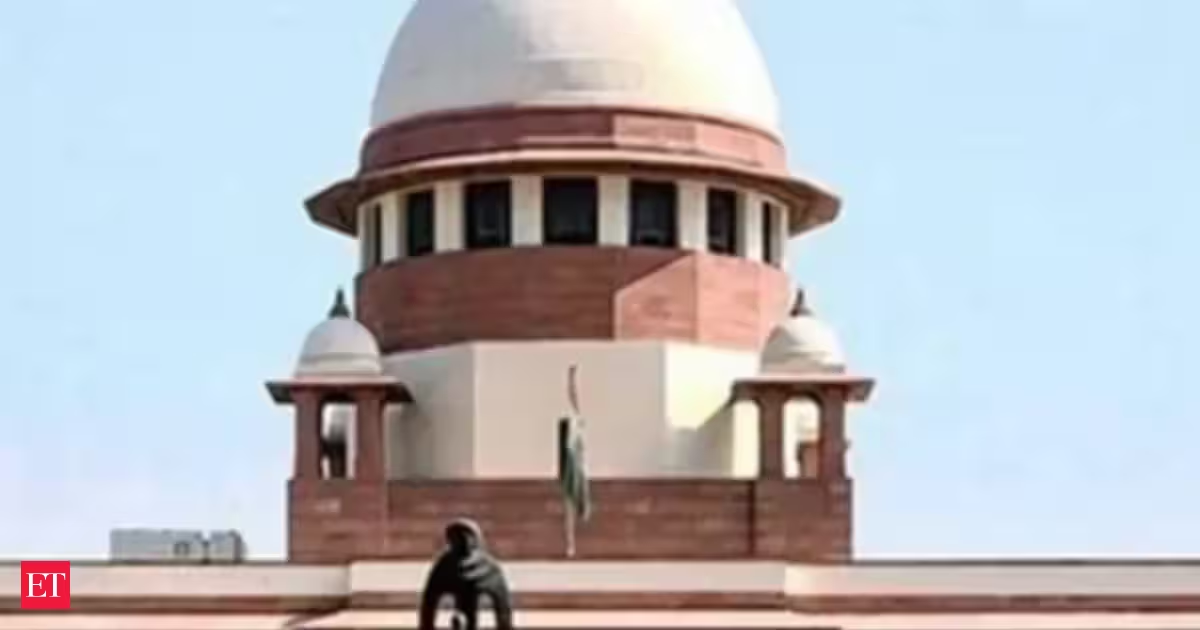
Five separate public interest challenges to the Digital Personal Data Protection (DPDP) Act now await the attention of a five-judge bench at the Supreme Court. Their resolution will decide whether democracy is to deepen and become truly an enterprise between citizens and administration or drifts the populace into suppression.It is too often forgotten that the right to know is part and parcel of freedom of expression — the anchor of democratic functioning, which includes accountability, transparency and participation. (HT Archive)The petitioners argue that under the guise of protecting privacy, the people’s right to access information is being deliberately and unreasonably weakened. For one, a “data fiduciary” — any government, corporation, hospital, university or news organisation — that has collected personal information can now hold it close. That is a separate concern.The disquiet is over Section 44(3). It allows government-held information to be withheld simply because it is to be treated as “personal”, with no duty to weigh privacy against transparency, accountability or the public’s right to know. The Court itself has framed the central question with admirable precision: What is public data and what is private data — and can information about a person holding public office ever be called private?The petitioners argue that Section 44(3) is far too broad, fails the proportionality test laid down by the nine-judge bench in Puttaswamy — legitimacy, necessity and minimal impairment — and drives a coach and horses through Article 19(2), which permits only narrow and carefully tailored restrictions on the fundamental right to know.It strips away the public interest override built into Section 8(1)(j) of the Right To Information Act 2005, which allows personal information to be withheld only where it has no relation to public activity or public interest, or where disclosure would amount to an unwarranted invasion of privacy. Given that neither “personal information” nor “privacy” is defined, both are left open to discretionary interpretation and easy abuse.In sum, the law favours secrecy over openness and puts information about governance — including the conduct of public officials — beyond meaningful public scrutiny.This is regression from where we have come over two decades. It is worthwhile to dislodge the misconception that providing information is a favour from the government, to be granted only when it is not inconvenient or embarrassing.It is too often forgotten that the right to know is part and parcel of freedom of expression — the anchor of democratic functioning, which includes accountability, transparency and participation.Demands for a specific statute to underpin these fundamentals gained strength from movements that began in the villages of Rajasthan. Their unifying slogan “Hamara paisa, hamara hisab” (Our money, our accounts) said it all. It demanded accountability, called for transparency, and asserted participation.The RTI Act was required to transform the governance landscape. Section 4 placed an affirmative obligation on the State to publish information about plans, policies, finances and everyday functioning without waiting to be asked.Section 8 carved out a narrow set of exceptions, so that withholding information had to be justified on public interest grounds. Information Commissions were created as independent guardians against the pull of secrecy baked into the bureaucracy.In significant measure, the Act delivered what it promised. Persistent efforts to get disclosure righted much wrongdoing that would otherwise have remained hidden. These forced audits, inquiries, disciplinary action and prosecutions.Still, decades on, the impulse to hold information close has not subsided. Despite each department’s duty to maintain and organise information, a cursory examination of websites shows how inconsistent, irregular, or entirely absent official data can be. That forces requests to be made. These are then subject to a plethora of rules that differ from state to state and department to department. One may accept revenue stamps as proof of payment, another will insist on judicial stamp paper; complicated fee structures, word limits, restrictions on the number of questions, and endless internal transfers from one public information officer to another are all used to avoid disclosure. Bald, unreasoned assertions are regular features of spurious refusals.Often, the strategy is simply to exhaust the requester into going away with nothing in hand.Fierce resistance from the most powerful has helped set the tone. Even the highest institutions have only reluctantly acceded to the compulsion to give information, whether resisting disclosure of judicial records and appointments, withholding administrative files and fund-use details, or invoking confidentiality to block information that should ordinarily be public.Where Information Commissions might have held the line, financial stress, vacancies and massive backlogs have stymied their guardianship.But for the dogged persistence of active citizens, access to information would quickly have reverted to the default of being tightly held — so deeply embedded is the establishment’s belief that releasing it is always in the discretion of authority. It is not.Information is collected by public servants, using public money, for use in service of the public; to sequester it from the very sources from which it was drawn can only ever be justified, as Puttaswamy defines, to safeguard what falls within the intimate sphere of the individual — personal autonomy, bodily integrity, family life — or where it can be rationally shown to be in the greater public interest to keep it secret. All else must be in the public domain.The fundamental right to know acknowledges once and for all that the government is trustee and partner, not master: It redistributes power and assures every citizen the right to ask, and the State, the duty to answer.Yet two decades in, the nation stands at a perilous crossroads, under the shadow of the DPDP Act.If “privacy” is weaponised to shield public functionaries from scrutiny, the right to know will be hollowed out entirely. We must recognise this for what it is: A battle for the life and soul of our Republic — and do all we can to preserve it.Maja Daruwala is chief editor, India Justice Report. The views expressed are personal
Weaponising privacy to curtail the right to know
If “privacy” is weaponised to shield public functionaries from scrutiny, the right to know will be hollowed out entirely
976 words~4 min read