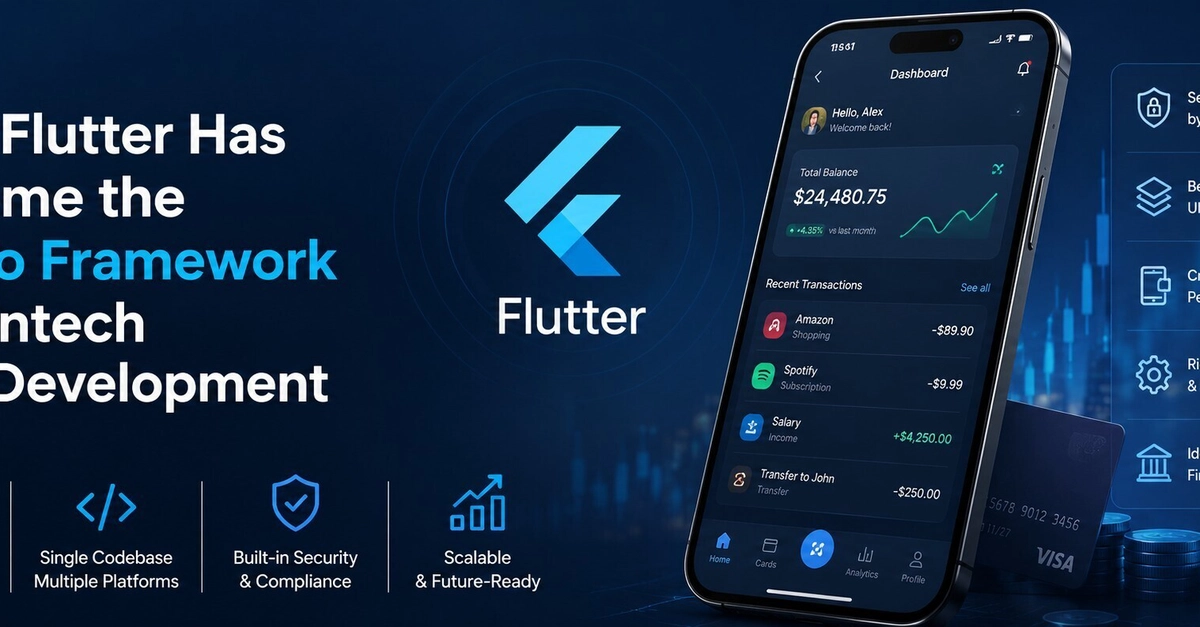
Africa is the fastest-growing fintech market globally, with revenues projected to expand 13x by 2030. The continent already accounts for the majority of global mobile money transaction volume. That kind of growth demands more than ambition; it demands the right tools. Africa's digital payments market is projected to exceed $40 billion by 2026, with over 500 million active mobile money accounts processing more than $830 billion in transactions annually. Every one of those transactions runs through a mobile app. And the startups and banks building those apps are increasingly choosing Flutter.
This isn't a trend driven by hype. It's a practical decision. Flutter solves real problems that fintech builders face every day: speed, cost, security, and scale.
What Is Flutter and Why Does It Matter for Fintech?
Flutter is an open-source UI software development kit (SDK) developed by Google. Mobile app developers use it to build cross-platform mobile apps with a single codebase written in Dart. Flutter renders its own UI using a high-performance graphics engine, which results in fast rendering, smooth animations, and a consistent UI across platforms.
For fintech, this matters because users interact with financial apps during high-stakes moments, transferring money, checking balances, and applying for credit. A laggy or inconsistent UI kills trust instantly. Flutter prevents that.