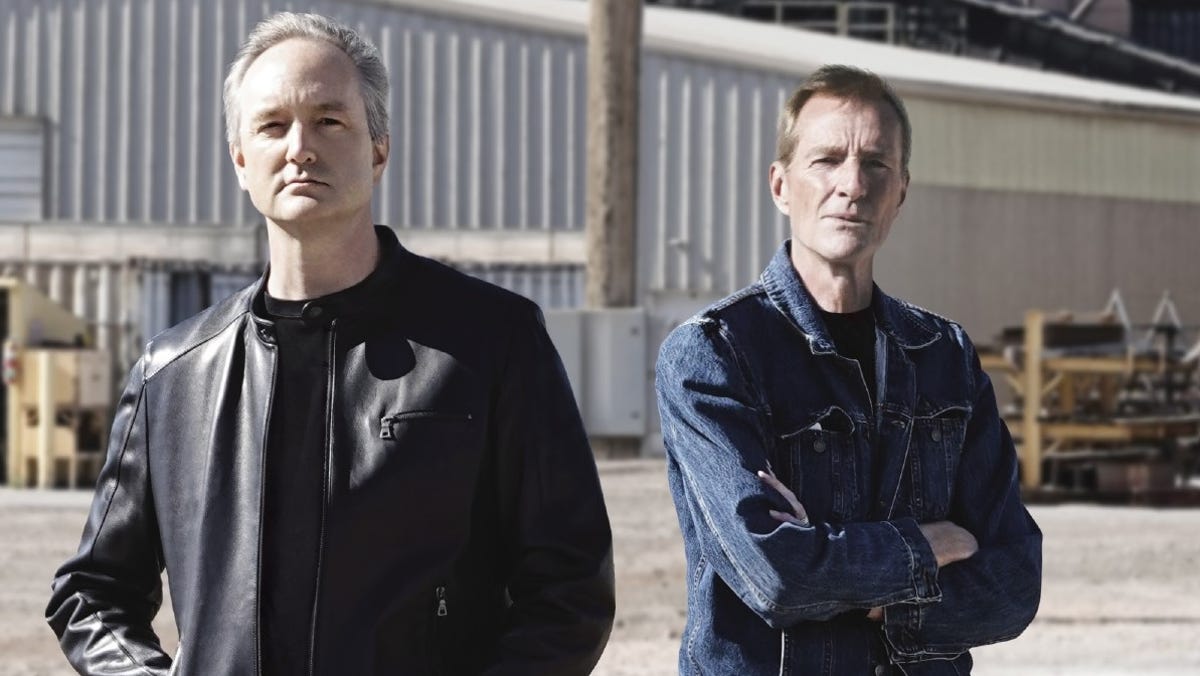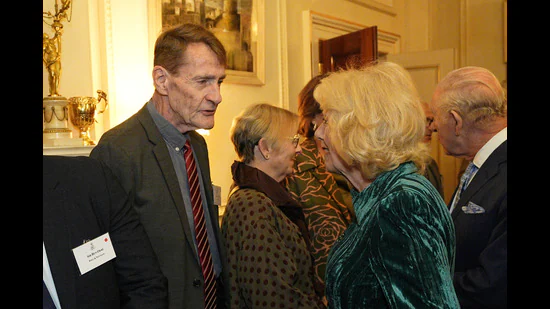
You recently handed over the full reins of Jack Reacher to your brother, Andrew. Of course, you still retain the IP and own the copyright, but do you miss the character on a day-to-day basis after being with him for over two decades?Lee Child talking to Britain's Queen Camilla during a reception for authors at Clarence House, London on Wednesday, March 25, 2026. (Aaron Chown/AP)On a day-to-day basis, no, because I haven’t given him up in my head. It’s always seemed to me that writing is two things. One is the fun part, the initial part, the daydreaming, the what if, how about that, and all those vague questions that you spin a story out of, and that is perpetual with me. I’ll never stop that. The second half of writing is the boring stuff, the typing and the business of it all and the promotion and so on. I’m perfectly happy to give that up.Reacher lives on in my head and I hope in the reader’s head as well, because that was really the fundamental point of a successful fictional character — to have the character migrate outward and be owned by the reader. The reader needs to feel he’s theirs and is independent of me in a way.So, what do you do nowadays on September 1st? Do you have a new tradition? I usually try and take a nap! It’s a deliberate symbol of no longer working. Just do absolutely nothing to emphasise that the old annual ritual is over.Reacher: The Stories behind the Stories is a compilation of pieces that were written as forewords for special editions of the book. Please tell us more. The fact that it’s a collection now was never intended and it sort of took me by surprise. There was this guy, Otto Penzler, in New York, who you probably remember. From The Mysterious Bookshop. He also runs an indie publisher and one of the things he did was to license special editions. He would, as a subsidiary publishing deal, get the file from the publisher and put it in a fancy looking jacket. I was very opposed to that concept from the beginning. Lots and lots of people have wanted to do it and I’ve always said no. There are so many Reacher fans who are completists that they would feel obliged to spend 150 quid on the leather-bound edition of what they’ve already got. I didn’t want to exploit people like that. But Otto does 126 copies of each title, which sell automatically to his collector mailing list so that there was no chance of the ordinary reader being exploited. He wanted these introductions to make them a little more special and add some value. But I knew, obviously, the way collectors behave, that out of 126 copies, maybe 10 people would actually read these introductions, so I felt very liberated and very uninhibited about what I put. They became sort of personal diaries, and I’m not sure who I was addressing them to because I didn’t expect them to be read.And then, you know, tough times in publishing, Otto was always looking for ways to expand. We had the idea of collecting them all and putting them in one volume for mass market sales in the US, and then the UK picked it up. So I am suddenly in a position that these secret private things that I did not expect to be read are suddenly out there, which was a bit of an odd feeling. But I think people seem to be enjoying them and they seem to be taking them as a sort of authentic record of how I was feeling, where I was, and that sort of thing.In these forewords, you’ve talked a lot about trust in your instinct, how you usually have no plan and you trust that your instincts will guide you. Where do you think those instincts come from? That’s a great question because people don’t really believe it or they’re mystified by it, that I just make it up on the spot. They think it’s incredibly insecure just to rely on instinct. But of course, the real thing is that I do have a plan, I do have an outline, it’s a kind of generic amalgam of how fiction works, in particular how thrillers work, and that is from a lifetime of reading. I can’t calculate how many, but there are tens of thousands of books that I’ve read, and you end up with your brain kind of recognising the patterns. So, when I say instinct, you know, it’s an instinctive decision to have an exciting scene or here’s the cliff hanger or here’s the end of the chapter. All of that is never planned. That’s completely instinctive. But what does that mean? It just means that I’m being guided by an immense internal database of everything I’ve ever read, including the bad books. Those are super valuable too. You read a bad book, you are alerted to what you shouldn’t do. You read a good book — and most books are pretty good — and they mould your expectation into a pattern that you can rely on. So to say that I don’t have an outline is true in the moment, but it can’t be true long term because you learn as you read.Reacher as a character has obviously had a very enduring appeal, and still does. Have any of the reasons for his appeal ever surprised you?The development of the responses has surprised me a little bit because it’s enough years now that you can see history happening. In the early days, there would be themes of police corruption or FBI double dealing or bad agents or something like that, and I would get letters, and I mean, literally, physical letters back then, saying, oh, that would never happen. But the public as a whole has become more and more cynical, and so the idea that there would be a bent cop or a bent FBI agent is now taken for granted. That’s a development in the audience and in society that’s been tricky. On some level, the appeal of Reacher is that he’s transgressive. He’s got a heart of gold, of course. His motives are pure, but his methods are outside of the mainstream in terms of how it should be, and I think people found that naughtily attractive a lot of the time. But to do a transgressive character now is much harder because standards everywhere no longer exist, the idea that you shouldn’t do something is disappearing.Anushree Nande is an independent writer, editor, and publishing professional currently based in Mumbai.
Lee Child: “Reacher lives on in my head”
On his Jack Reacher novels, the growth of public cynicism, being guided by an internal database of everything he’s ever read, and why it’s now difficult to create transgressive characters
1,112 words~5 min read