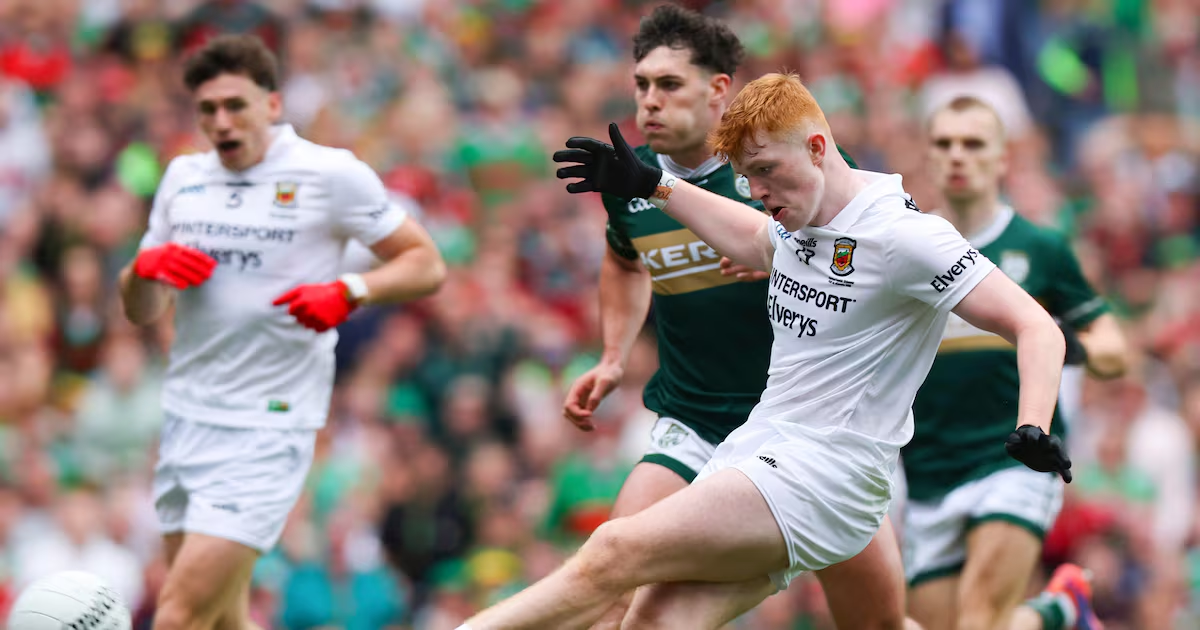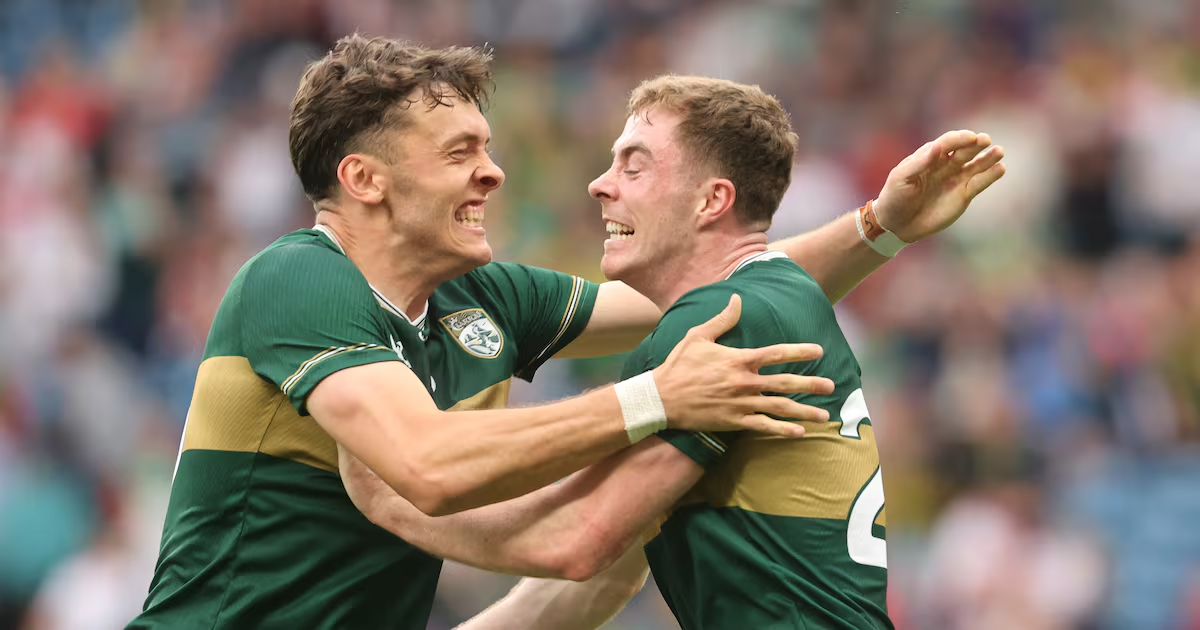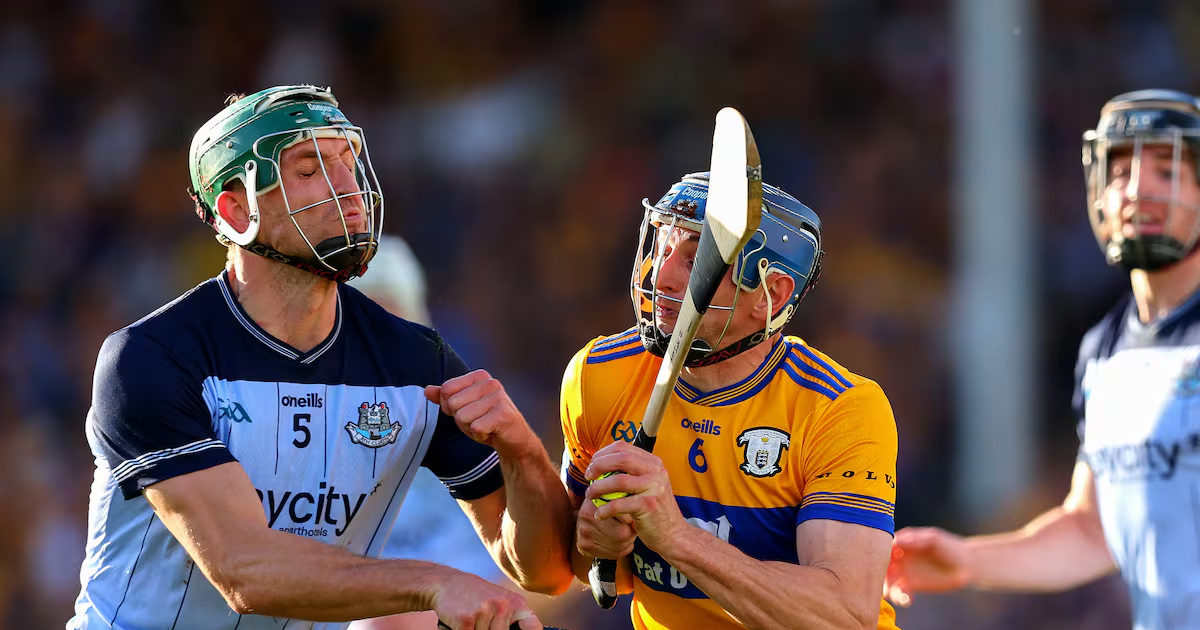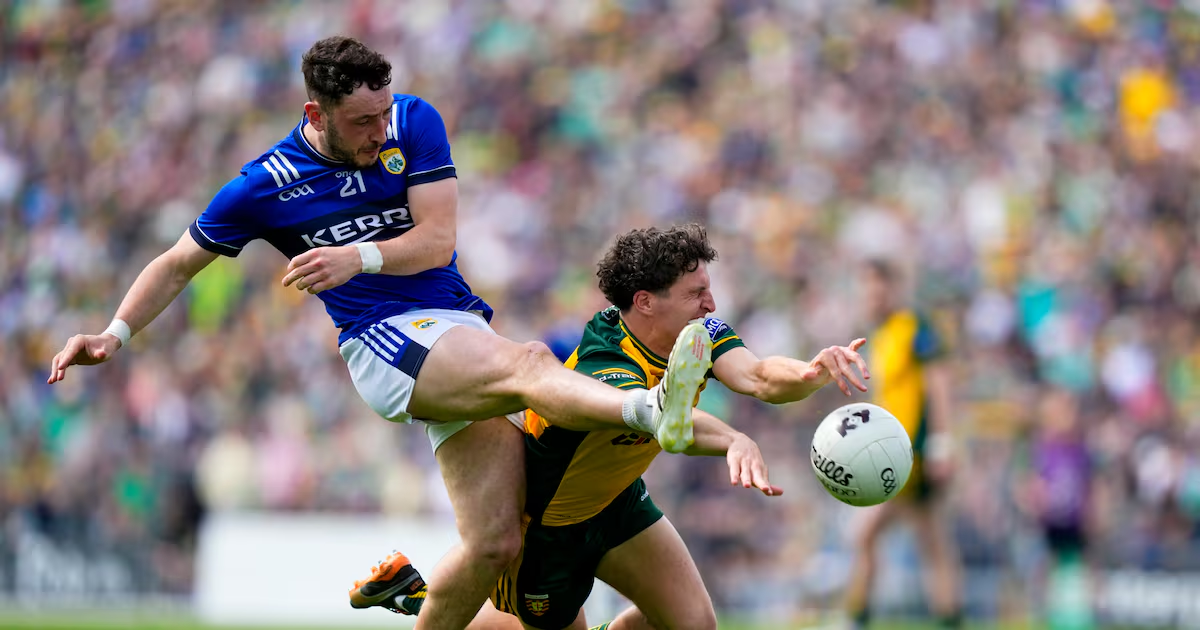
Clifford and Roarty will be itching to go at each other againIt got lost in all the talk around the melee and David Clifford on Caolan McGonagle and Conor O’Donnell on Dylan Casey and all the rest of it but for 35 minutes on Saturday Killarney, we were treated to one of the best one-on-one matchups seen in years. And certainly the best since the new rules came in.In the telling of the game’s story, Paudie Clifford versus Finnbarr Roarty was worth its own chapter, its own episode, its own miniseries. For the whole of the first half, when the wind at Donegal’s backs was really the only thing that separated the two teams, Roarty and the elder Clifford went at it like a pair of twins squabbling over the last toy in the playroom.Detailing Roarty to match Clifford’s every stride on Saturday is as close as he’s come to admitting that Donegal were wrong to leave the Kerry playmaker untagged in last year’s All-Ireland final. Roarty is the reigning Young Footballer of the Year and is eligible again for the award this year – here, he played like a 10-year veteran on the game’s best schemer, shadowing him everywhere, leaving a little extra on him in every tackle, pulling off one brilliant block-down in particular.Still, Paudie Clifford is going to be Paudie Clifford. His scoring return for the day was poor – one point from five shots. But two of those shots were for goals and on another day, he could have put up a proper total. Five shots at goal in the 45 minutes he was on the pitch isn’t bad going for a player who clearly isn’t in the full of his health yet.Roarty did his job to the letter. Clifford will be itching for a rematch. He won’t be alone. Malachy ClerkinDublin find the Cats’ 10 lifeDublin's Donal Burke and Paddy Deegan of Kilkenny in the Leinster hurling championship. Photograph: Bryan Keane/Inpho The late Eugene McGee spoke of his Offaly team’s sensational derailing of Kerry’s five-in-a-row in 1982 as almost a tactical formula. Stay close on the scoreboard and get a late goal so there’s no time to respond. Easier said than done but it is one of the time-honoured templates for springing a surprise.Dublin beating Kilkenny on Sunday wasn’t really a surprise, judged on current form but it was a historical rarity. Putting the most successful county in hurling out of commission before the All-Ireland stages hadn’t happened in 30 years.As their manager Niall Ó Ceallacháin pointed out, only Liam Rushe in the Dublin dressingroom had the experience of beating Kilkenny in championship and he couldn’t play on Sunday. That win in 2013 was the only one in 84 years of the fixture.When they won the replay, 13 years ago, Dublin led by four at half-time, 0-11 to 0-7. Eight years ago, they led for all but four minutes out of 76 and lost to an injury-time Liam Blanchfield goal while protesting a foul in the build-up on Paddy Smyth.In that match they also led by four at half-time, 2-7 to 0-9. On Sunday, Smyth was outstanding at full back in a terrific defensive display by the team.It was Dublin’s first home win in this championship fixture since 1941 – the following year’s Leinster final, which they won, was in Nowlan Park – when they won in Croke Park in November because of that year’s foot-and-mouth outbreak.The outcome was consequential as Kilkenny’s first exit at the round-robin stage. Dublin combined pressure on the scoreboard with the defensive heroics and put themselves beyond even the reach of injury-time goals. They also led by four at half-time, 0-15 to 0-11. Seán MoranTyrone’s shooting stars hit the targetEoin McElholm of Tyrone celebrates his goal. Photograph: James Lawlor/Inpho In the absence of the Canavan brothers – Darragh and Ruairí – and with Darren McCurry not starting, the responsibility for score-getting at the Hyde on Sunday was placed on the shoulders of Tyrone’s younger generation.The evergreen Mattie Donnelly led the line at full forward but the 35-year-old was the only one of Tyrone’s starting six forwards to have played in the 2021 All-Ireland final.It turned out to be something of a coming-of-age day for several of the other Tyrone forwards. Eoin McElholm, an All-Ireland under-20 back-to-back winner in 2024 and 2025, has been tipped for big things for many years but on Sunday it felt like he had finally announced his arrival at senior level with a display of real leadership, capped with a personal haul of 1-3. This is McElholm’s third year with the seniors but it might prove to be a breakout summer if he can maintain his form from the win over Roscommon. Beside him in the full-forward line at Dr Hyde Park was Ethan Jordan, something of a late bloomer as the 26-year-old is in his debut season with the Tyrone seniors after stepping away from a soccer career with Armagh City. Jordan was named Man of the Match last Sunday, scoring seven points – including the winner in the dying seconds. The half-forward line was comprised of Ronan Cassidy, who only made his championship debut against Armagh this year, Seánie O’Donnell (debut 2023) and Ciarán Daly (debut 2024). All six of Tyrone’s starting forwards scored against Roscommon. Add the Canavan brothers and McCurry to that attacking mix and suddenly Malachy O’Rourke has some welcome selection headaches. Gordon ManningEver higher-scoring hurling championship is susceptible to blowoutsCork's Shane Kingston with David Reidy of Clare. Photograph: Tom O'Hanlon/Inpho In the hurling championship competitiveness is under perpetual threat. There is a small colony of top tier counties, and it is impossible to expect all of them to be good all of the time. But in a febrile environment, when a team falls off the pace the potential for suffering is clear to everyone. The group stages of the hurling championship concluded at the weekend with three blowouts from five matches. Of the 25 games played across the two provinces over the last few weeks, nine of them were decided by double-digit margins. Clare and Tipperary – the last two All-Ireland winners – suffered two double-digit beatings each.Compared to last year, the overall numbers are remarkably similar. The average margin of victory this year was 8.96 points; last year it was 8.92. The number of double-digit beatings was nine, the same as this year.But the underlying trends from this year are more concerning. Antrim were completely outclassed in last year’s Leinster championship and were not nearly as competitive as Kildare were this year. Offaly were also not as good 12 months ago as they are now.Six of the double-digit beatings last year involved those teams. This year, though, Tipperary, Clare and Kilkenny absorbed five of the double-digit beatings between them.The round robin format has been a success largely because hurling has gone through a period of unprecedented competitiveness. In 2018, the first year of the format, there were just five double-digit beatings in the group stages and the average winning margin was just 6.7 points – admittedly from a 10 team championship as opposed to 11 now. Hurling has no history of sustaining that kind of competitiveness over long periods. Given that scoring is at an all-time high, the risk of blowouts is greater than ever. As we have seen over the last few weeks, nobody is exempt. Denis WalshTireless Colm O’Callaghan stars despite red cardCork's Colm O'Callaghan was sent off against Meath but still made a big impact. Photograph: Tom O'Hanlon/Inpho A minute before half-time on Saturday night in Páirc Uí Rinn, Meath wing back Seán Coffey bore down on goal. Meath were in one of those flow states that the new game provides, a purple patch where every restart was going their way and if felt like every attack led to them being in front of the posts with ball in hand and time to spare. Meath were 1-16 to 0-11 ahead and a goal from Coffey now would surely have killed the game.But out of nowhere, the beanpole figure of Colm O’Callaghan appeared and the big Cork midfielder managed to get in front of Coffey’s shot. It wasn’t a foot-block – it wasn’t actually any kind of block that you’d recognise. It was more that he had made a lung-busting run and just about managed to insinuate himself between Coffey and the goal. The ball hit his ankle and Cork got away with only being eight down at the break.All of which is to say, there wasn’t an unluckier man in Cork on Saturday than O’Callaghan when his night ended on a red card. He had fought doggedly in a losing battle and had done as much as anyone to haul Cork back into matters by turning the midfield tables after half-time. To get sent off for a mere waft of a hand in Ruairí Kinsella’s face was extremely harsh.There was neither malice nor intent in it – O’Callaghan caught a kickout, held the ball in his left hand while fending off Kinsella with his right. You could see why referee Brendan Cawley reached for the card – but it was careless without being reckless, the stock-in-trade of every midfielder who has ever caught a high ball in the midfield jungle. Cork survived and O’Callaghan at least didn’t suffer the indignity of his sending-off costing them the game. But expect Cork to move heaven and earth to get the slate wiped clean before their Round 2A game in three weeks. Malachy Clerkin
Paudie Clifford and Finnbarr Roarty have battle for the ages: What we learned from the GAA weekend
Dublin find the Cats’ 10th life; Tyrone’s shooting stars hit the target
TL;DRAI
Paudie Clifford and Finnbarr Roarty produced the standout individual duel of the GAA weekend in Kerry's win over Donegal, while Dublin ended a 30-year wait to eliminate Kilkenny at the round-robin stage of the Leinster hurling championship. Tyrone's emerging forwards — McElholm (1-3) and Jordan (7 points, Man of the Match) — signal a depth of attacking talent that gives manager Malachy O'Rourke genuine selection options heading into the championship's decisive phase.
1,585 words~7 min read