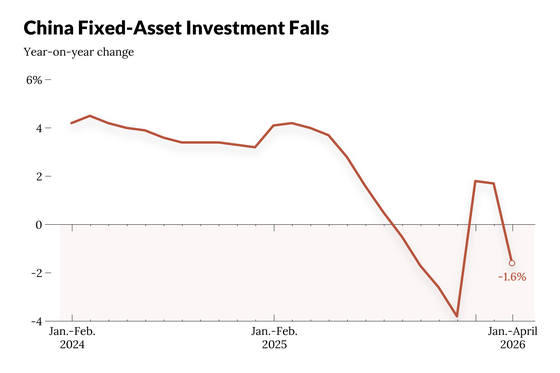
1. China's fixed-asset investment fell back into contraction in April, reversing a first-quarter expansion, as earlier policy support faded before new fiscal tools took effect [para. 1]. Investment declined 1.6% year-on-year in the first four months, compared with a 1.7% rise in the first quarter, and missed the 1.7% average growth forecast in a Caixin survey of economists [para. 2].2. Analysts attributed the April weakness partly to policy timing: early-year gains were supported by front-loaded issuance of special-purpose bonds by local governments, but momentum weakened as focus shifted to risk management, while new ultra-long special treasury bonds and a policy-backed financing instrument had not yet taken effect [para. 3].3. The pullback suggests China's investment cycle remains highly dependent on fiscal timing rather than underlying demand strength [para. 4].4. Despite the weakening momentum, investment in high-tech manufacturing continued to grow, underscoring a shift toward more innovation-driven sectors [para. 5].5. Traditional drivers such as real estate remained weak, and infrastructure growth slowed, highlighting persistent divergence in China's investment structure [para. 6].6. Economists say future growth will depend less on volume and more on the efficiency and allocation of capital, as China enters a stage where high investment growth is harder to sustain given its large base and increasing focus on returns [para. 7].AI generated, for reference only
Analysis: Why China’s Investment Rebound Is Losing Momentum
Investment falls as policy support fades before new fiscal tools take effect
215 words~1 min read