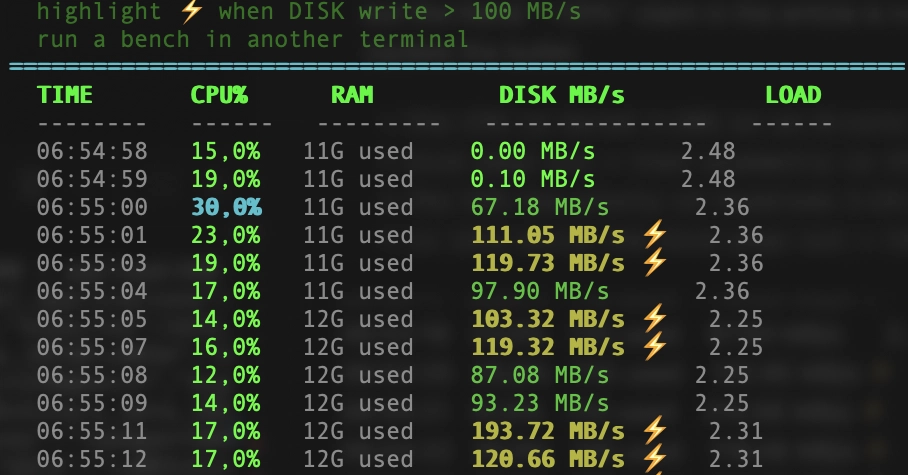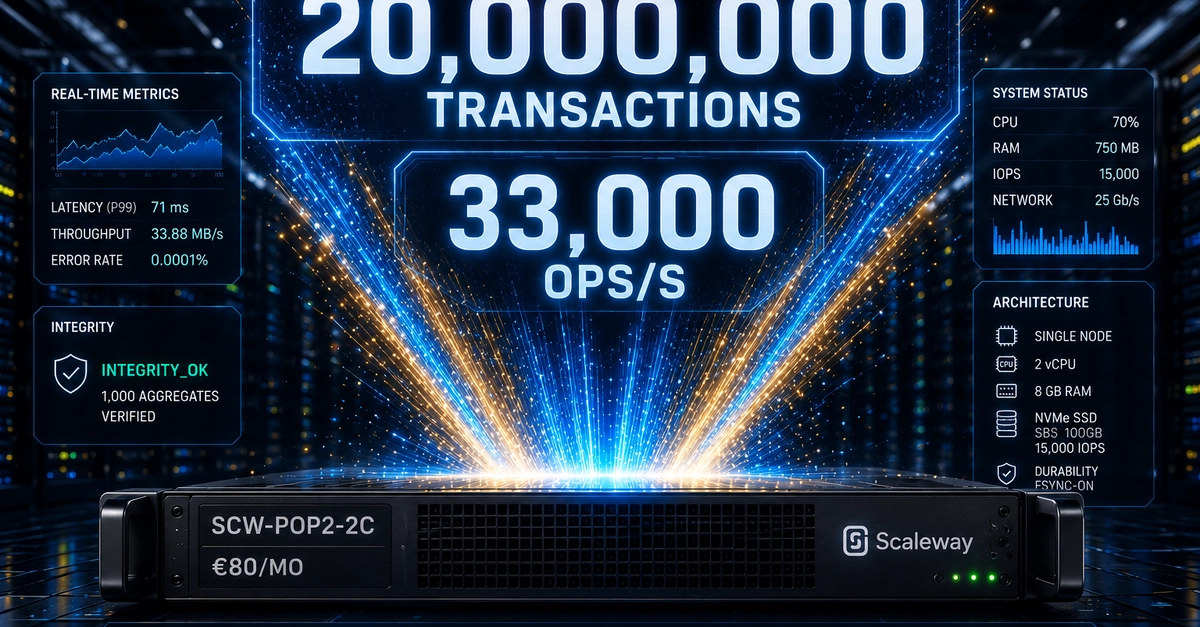
A laptop number is only half the story. The natural next test is whether the same architecture holds on a small, cheap public VM with network-attached storage and strict fsync(2) durability — three constraints that each, on its own, tend to move the bottleneck by an order of magnitude on most stacks. So that's what I ran.
The Setup
VM: Scaleway POP2-2C-8G — 2 vCPUs AMD EPYC 7543 @ 2.8 GHz, 8 GiB RAM. Yes — two vCPUs.
Disk: SBS Block storage, 100 GB, 15,000 provisioned IOPS. Network-attached, not local NVMe.
OS: Ubuntu 22.04, kernel 5.15. Linux strict fsync(2) — every commit hits the SSD for real, no Apple-style controller-cache shortcut.