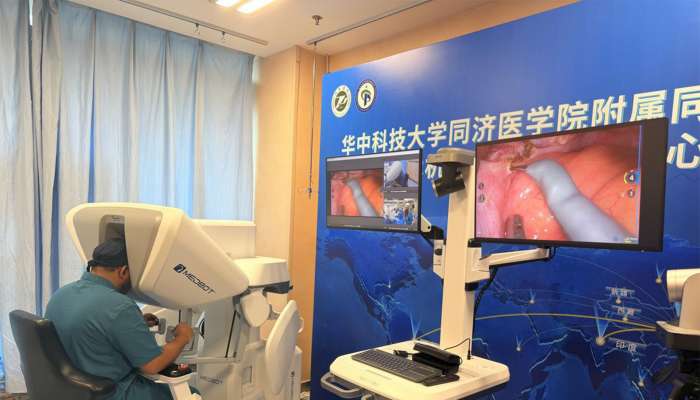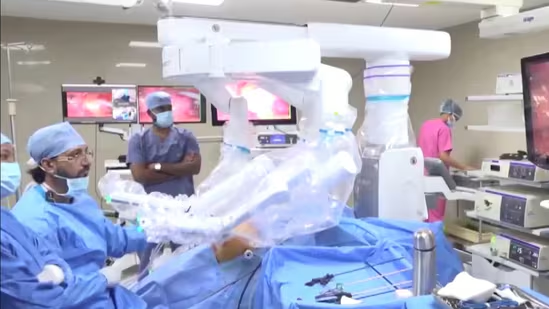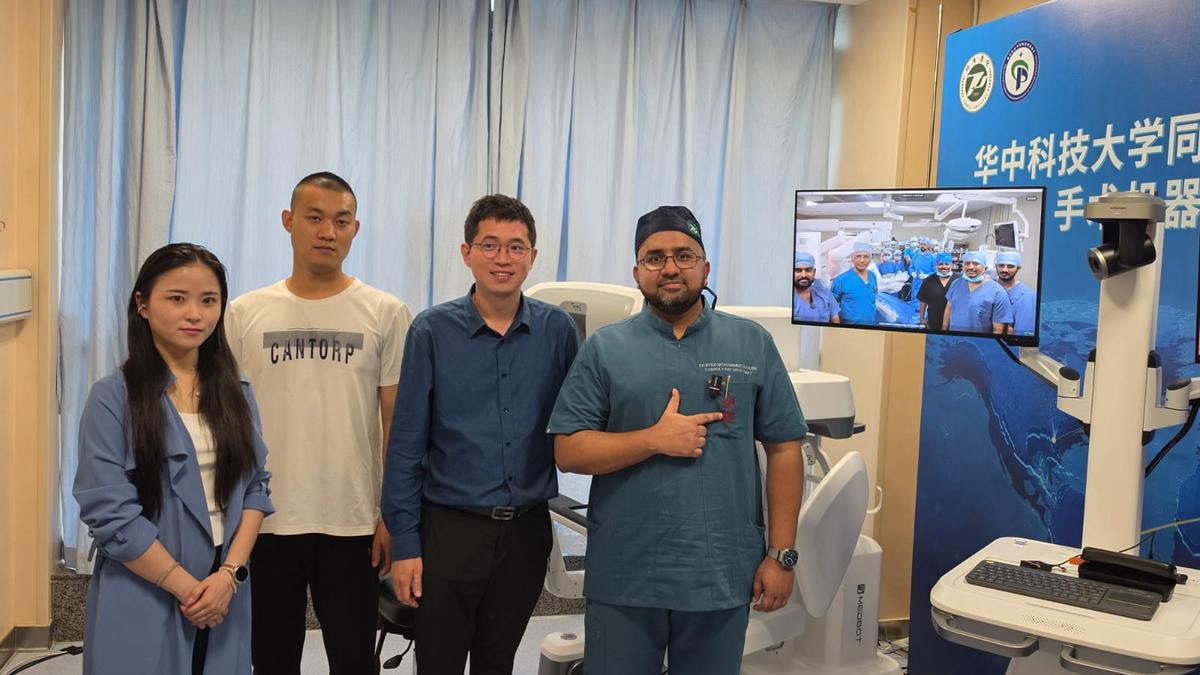
Dr Syed Mohammed Ghouse at Tongji Hospital, Wuhan, during therobotic surgery performed on a patient in Hyderabad over 3,000 km away. Doctors assisting the procedure at AINU Hyderabad are seen on the screen
| Photo Credit: Special Arrangement
For a patient lying inside an operation theatre (OT) in Banjara Hills, Hyderabad, India, the surgeon performing the procedure was not standing nearby, but hunched over an instrument over 4,000 km away in a medical facility on Jiefang Boulevard, Wuhan, China. Yet, according to Syed Mohammed Ghouse, the experience felt almost identical to performing a regular robotic surgery inside the same OT. On May 18, Dr. Ghouse, robotic surgeon at the Asian Institute of Nephrology and Urology (AINU) in Hyderabad, remotely performed a robotic ureteric reimplant procedure on a Hyderabad patient diagnosed with lower ureteric stricture while he was physically present at Tongji Hospital in Wuhan. The patient was prepared for the surgery by the team in Hyderabad, then Dr. Ghouse took over and controlled the robotic system in real time from Wuhan using a high-speed internet connection.Three componentsExplaining how the surgery worked, Dr. Ghouse said robotic surgery is a form of telesurgery. “There are three components of any robotic system — a patient cart attached to the patient, an image cart that processes and displays the visuals, and then there is the surgeon’s console where the surgeon sits and operates,” he explained.He further added that even in a normal robotic surgery setup, the surgeon does not physically stand over the patient performing the procedure directly. “Now we are just extending that concept across very large distances,” he said.