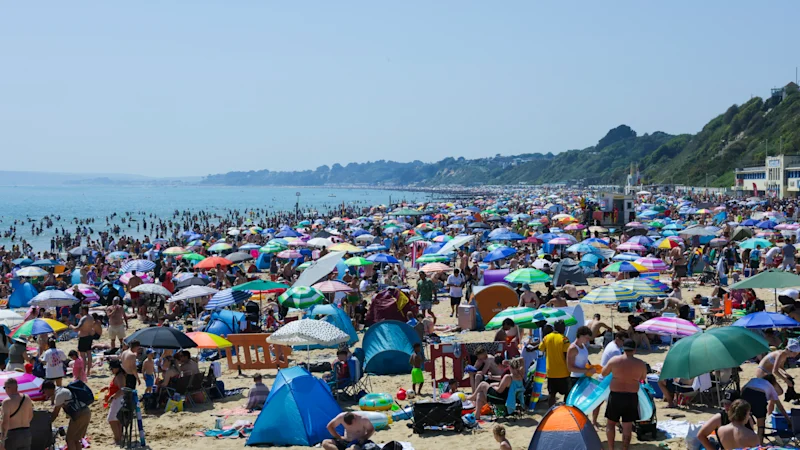
May 25, 2026 — 3:37pmCrowds have packed English beaches over the May long weekend and a heatwave has gripped large swaths of Europe, providing a foretaste of what is expected to be another extreme northern hemisphere summer.A high-pressure heat dome, which warms air as it compresses it towards the ground, is forecast to linger over parts of Europe (including Britain, France and Spain) and push temperatures to as much as 11 degrees above normal, weather models and meteorologists predict.Crowds of visitors at the beach on May 24 in Weymouth, England. An exceptional bank holiday heatwave is bringing record-breaking weather to England with temperatures forecast to climb into the low 30s by Monday. Getty ImagesMet Office deputy chief forecaster Steve Kocher said temperatures were forecast to peak on Monday and probably break spring UK temperature records. Parts of Greater London and south-east England could reach 34 degrees.“As well as it being hot, there will be lots of dry and sunny weather for much of the UK,” Kocher said.Tom Morgan, a meteorologist with the UK Met Office, told the London Telegraph: “We rarely see temperatures above 35 degrees, even in the summer months, so to see temperatures getting close to 35 degrees in May is pretty historic.”Europe is officially the fastest-warming continent on Earth, heating at twice the global average rate, with 2.5 degrees of warming since pre-industrial times, the European Union’s Copernicus observation service said.Sunbathers on Bournemouth Beach on May 25 in England during an exceptional bank holiday long weekend.Getty ImagesThe heatwave comes as the US National Weather Service now rates the chances of an El Nino emerging between May and July at 82 per cent, and the chances of it lingering through December to February at 96 per cent.In Australia, the Bureau of Meteorology also acknowledges that an El Nino this year is likely, with forecasts indicating it will be at least moderate in strength, and possibly strong. The BoM does not use this term, but some scientists have warned of a “super El Nino”, which would be globally catastrophic and contribute to another hot summer in the northern hemisphere.This forecast is based on the level of warming in the central tropical Pacific (Relative Nino 3.4 Index), which is used as the yardstick for an El Nino declaration around the world, though the BoM said this does not always directly affect Australian weather due to other climate drivers.Associate Professor Andrea Taschetto, a climate scientist with the University of NSW, said modelling indicates a 60 per cent chance of an El Nino developing by the end of winter, but warns that implications vary across the nation and regions, and even shift as the seasons change.Sydney may not bear significant effects between September and November, but across the broader Murray Darling Basin, where much of the nation’s food and fibre is grown, conditions are more likely to be hotter and drier than usual should the El Nino set in, she said.The release of massive amounts of heat from oceans after El Nino years tends to cause global average temperature records to break during the following months.On Saturday, Britain surpassed 30 degrees for the first time this year. The highest maximum temperature for Britain on Sunday was in Kew Gardens, London, which reached 32.3 degrees. The UK’s May temperature record of 32.8 degrees was set in 1922, and then equalled in 1944.Most of France will experience temperatures in the low 30s on Monday, including 33 degrees in Paris and 35 degrees in Bourges and Bordeaux, French government forecaster Météo-France predicted.Spain is expected to see the most extreme heat, with highs of 38 degrees possible in the Guadiana and Guadalquivir regions, according to government forecaster AEMET. Seville is forecast to reach tops of 37 or 38 degrees all week.The UK Health Security Agency issued amber heat health alerts for the East Midlands, West Midlands, the East of England, London and the South East – the earliest such an alert has ever been issued. The Met Office’s Morgan said that overnight temperatures could also lead to records being broken, staying above 20 degrees and being “uncomfortable for sleeping”.Last summer was Britain’s hottest on record, with a mean temperature of 1.51 degrees above the long-term meteorological average, surpassing the previous record of 15.76 degrees set in 2018.All five of Britain’s top five warmest summers by mean temperature were in the 21st century in a series dating back to 1884, the Met Office said.However, a prolonged heatwave in 1976 – when 16 days exceeded 32 degrees, compared with nine days in 2025 – means that year still holds the record for highest average maximum temperature (rather than mean temperature).A summer as hot or hotter than 2025 is now 70 times more likely than it would be without human-induced climate change, analysis by Met Office scientists suggests.with BloombergGet to the heart of what’s happening with climate change and the environment. Sign up for our fortnightly Environment newsletter.From our partners
UK wilts under brutal spring heat as records set to tumble
A “heat dome” is forecast to linger across parts of Europe as the prospects of an El Nino continue to firm.
821 words~4 min read