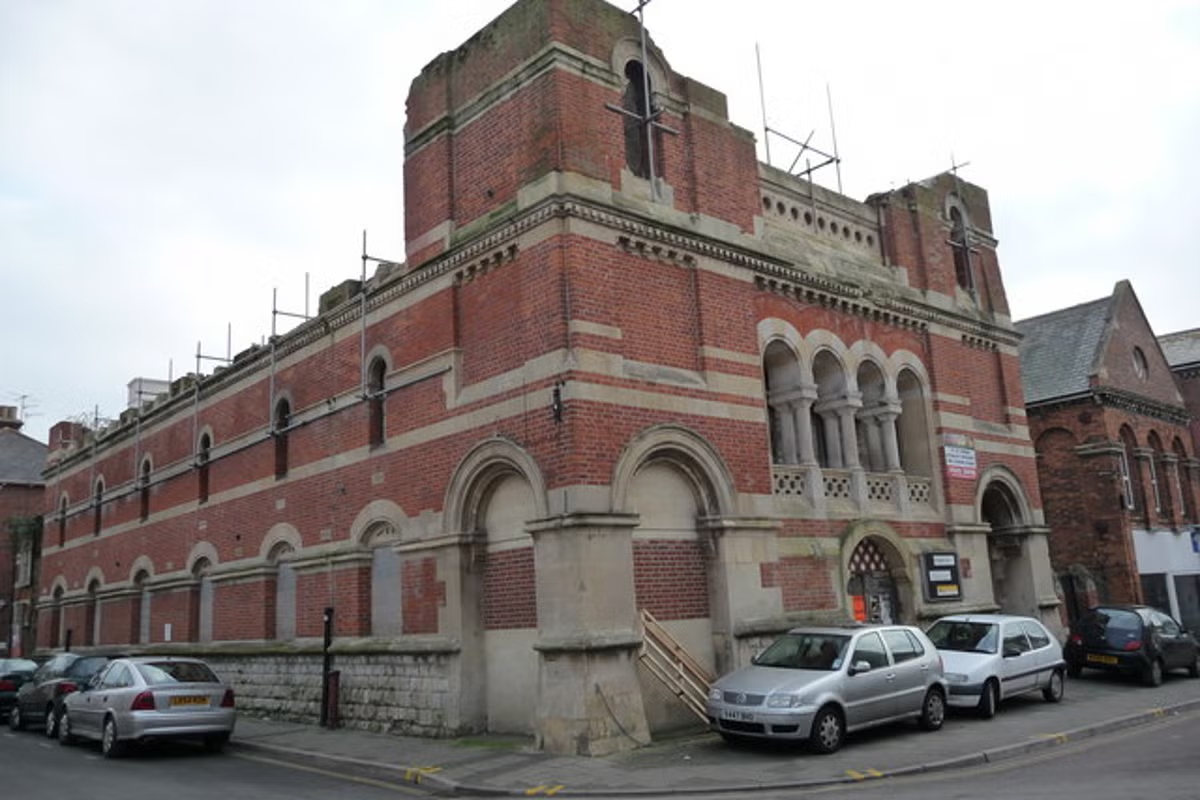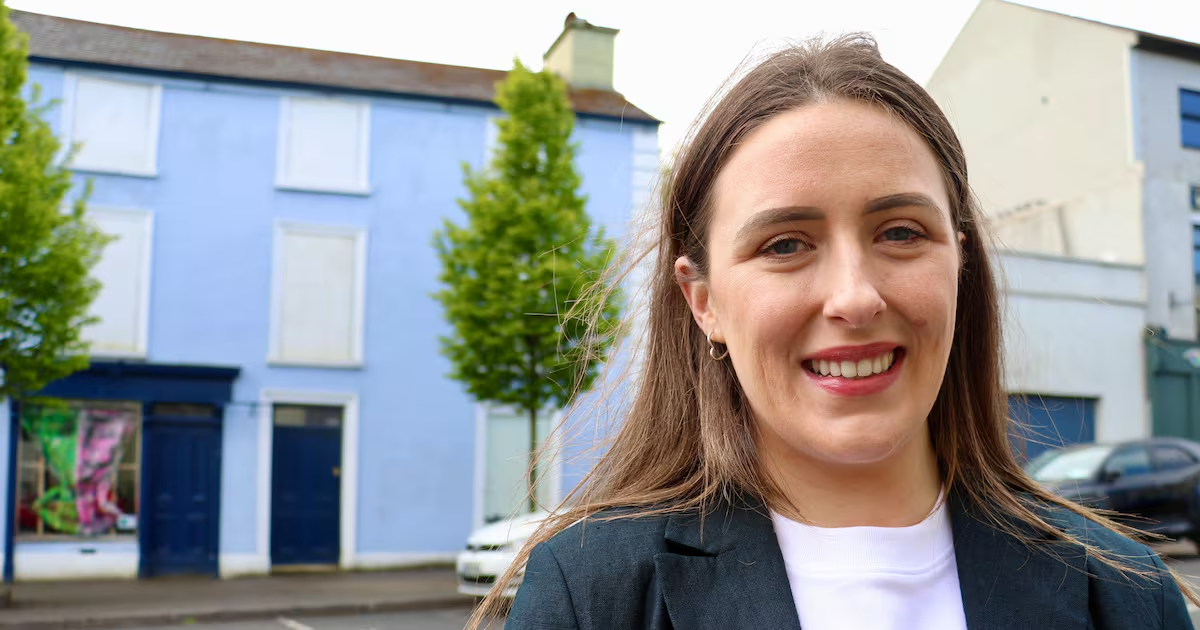
Last month the Government made two big announcements in response to the housing crisis. The first was allowing for the building of back garden cabins as accommodation up to a size of 45sq m without planning permission. The second was a scheme to provide up to €135,000 for the conversion of above-the-shop vacant space into housing units. The former announcement attracted a huge degree of scrutiny and criticism, with the Opposition accusing the Government of legislating for a “beds in sheds” scheme. But the latter announcement may turn out, though, to be the more significant one. Living above the shop was habitual until the 1960s and 1970s in Ireland when families were sold the suburban dream of semidetached houses with gardens and driveways. A shift in retail business to suburban shopping centres was another nail in the coffin of town-centre dwelling.As a consequence there are tens of thousands of empty above-the-shop premises that could be converted into housing. The Government announced a grant of up to €95,000 for one unit, €115,000 for two units and up to €135,000 for three or more units created in vacant space above commercial premises. An expert advice grant of up to €5,000 is also available to help property owners with guidance on converting buildings into homes. The caveat is the ground floor must be used for commercial purposes. “The implications of this are massive. This has huge potential,” said Martin Markey, chief executive of Hardware Association Ireland (HAI), the national representative body for hardware/DIY retailers and builders merchants. He estimated that 30,000 properties could be converted over the next six years at 5,000 units a year. “There are many that are not suitable, but there are just so many of them that could be suitable. There’s just so many properties,” Markey said.Last year the HAI commissioned a survey of owners of above-the-shop properties. It also spoke to estate agents and auctioneers involved in commercial property. Of the “above-the-shop” properties, 16 per cent of buildings are completely empty. In half the cases the upper floors are empty. Only 30 per cent of the upper floors are used for storage, so overall less than a third of properties have upper floors with any current usage.The HAI did an impromptu survey of Main Street in Wexford town, its longest street. It found 120 above-the-shop premises of which about 20 are occupied. Of the 100 that were left, 60 had no independent access except through the shop, ruling them out.Of the 40 remaining, it estimated about 16 would be tied up in legal wrangles based on a similar experience with the vacant property grant for single dwellings. That left 24 that could be converted into apartments. That would still yield between 48 and 72 apartments on a single street based on these being converted into either two or three housing units. A Dublin City Council report published this month suggested that up to 40 per cent of its housing targets could be met by converting commercial buildings and above-the-shop vacant premises into homes. It envisaged the creation of 16,000 new homes. A recent survey of Ballybay, Co Monaghan, a mid-size market town of just 1,500 people, found an estimated 80 above-the-shop vacant properties. Many of these properties can be converted without planning permission under the new Development Act provided that these are not listed buildings. This should speed up the process of bringing them back into use. The above-the-shop scheme is modelled on the Government’s successful vacant properties refurbishment grant, which has been going since 2022. So far the Government has paid out €112 million to bring more than 2,000 vacant properties back into use at an average cost to the State of €56,000 for each property. Of the 12,500 applications to date, 8,652 applications have been approved. To date Cork County Council (€8,220,217) and Donegal County Council (€7,451,941) have paid out the most. On a per-capita basis, Donegal is the most successful county in Ireland with 811 dwellings brought back into use through the grant. At the time that the grant was extended to above-the-shop properties in April, Minister for Housing James Browne said people were “understandably frustrated, I am frustrated, when we see properties on our main streets and in our town centres lying idle”. Ciara O'Neill inside the property she bought two years ago in Kells, Co Meath. Photograph: Ronan McGreevy He said: “We are in a housing crisis, and in reacting to that, we have to pull every lever to unlock housing. We want living towns and cities that are bustling with people and families, who shop, gather and socialise in their local areas.”The grant announcement was the catalyst for Ciara O’Neill, who owns a coffee shop in Oldcastle, Co Meath, to bring a property she recently purchased back into use. Two years ago she bought a handsome three-storey property in John Street, Kells, Co Meath, dating to the early 1900s. It was previously a butcher’s shop and an abattoir, but has been derelict for years. Behind its facade, it was a wreck from flooring to ceiling. She now plans to turn it into a coffee shop with two two-bedroom apartments upstairs. “I’m living in Kells and I would like to expand into the town. At the end of last year we heard there would be an over-the-shop grant, so we decided to hold off until then,” she said. “It definitely would not be viable without the grants. It would sit here derelict without it.”Kells, a busy town within an hour’s drive of Dublin, had just a single place to rent listed on Daft.ie – a four-bedroom house on the market for €3,000 a month. Maggie McGahan, the senior retrofit sales consultant of Kore Retrofit, based in Co Cavan, said property owners could avail of grants of up to €25,000 from the Sustainable Energy Authority of Ireland for each housing unit if they insulated the floors, walls and ceilings and installed a heat pump and solar panels. She estimated that the cost of returning the John Street property into use could be €300,000 to €500,000 depending on what structural issues turn up. Potential Government grants of up to €160,000 are a game-changer for many smaller property owners such as O’Neill, she said. While “there is loads of potential” with the scheme, McGahan said it would be more costly if the building was a protected structure for historical or archaeological reasons. “You always have to comply with building regulations, but you also have to comply with fire safety and access and then you’re talking about massive money. What you end up getting in grants, ends up in professional fees. In that case, it will only be up to big developers to use it,” she said.However, McGahan said: “There’s great interest in it [the funding scheme]. We have people like Ciara who have these buildings, but haven’t had the capital to invest in it. I had a woman last week who has a building 30 years and she said to us, ‘It’s time I did something with it. Now’s the time.’”
Housing crisis: Grants to turn space above shops into homes could be ‘game changer’
Government hopes grants of up to €165,000 will mean thousands of vacant properties return to use
1,175 words~5 min read