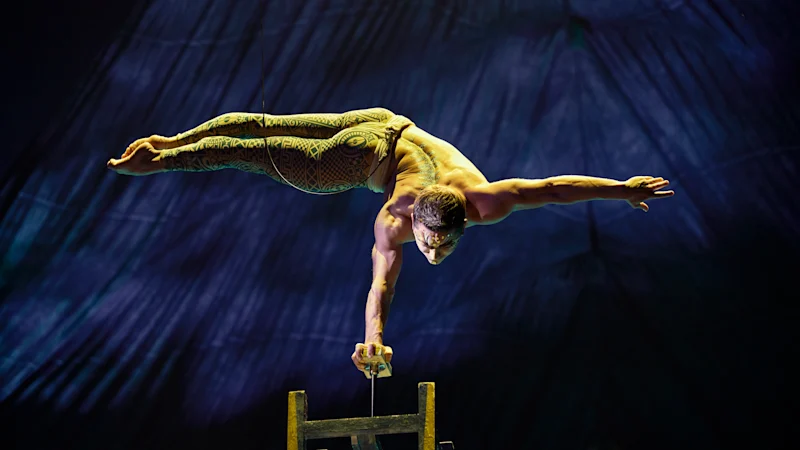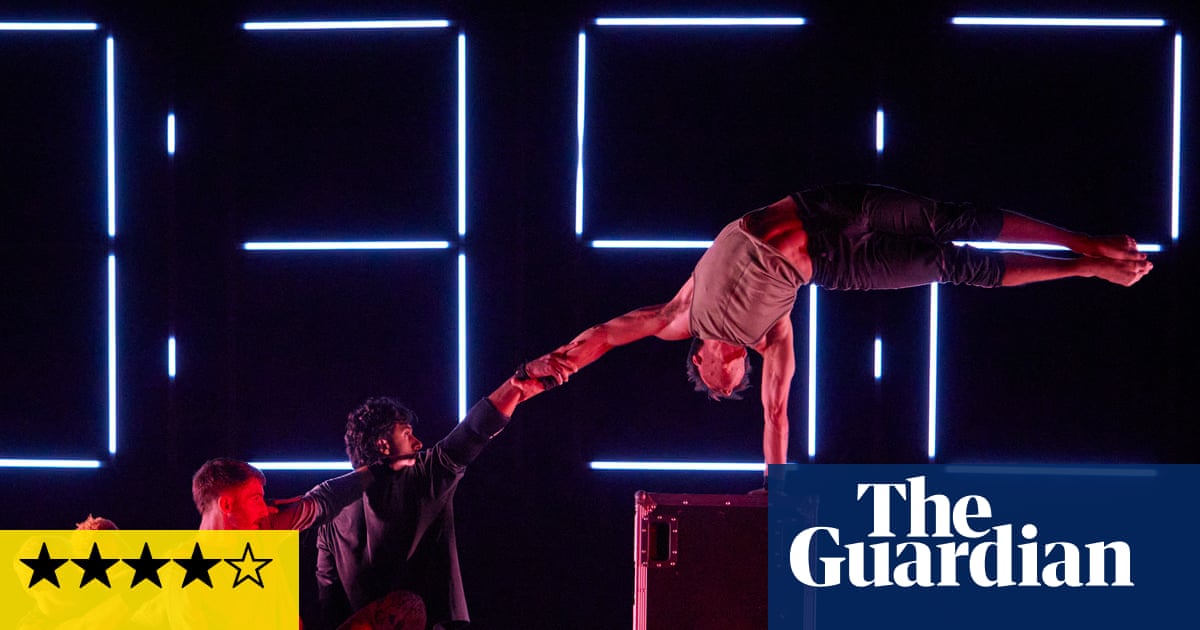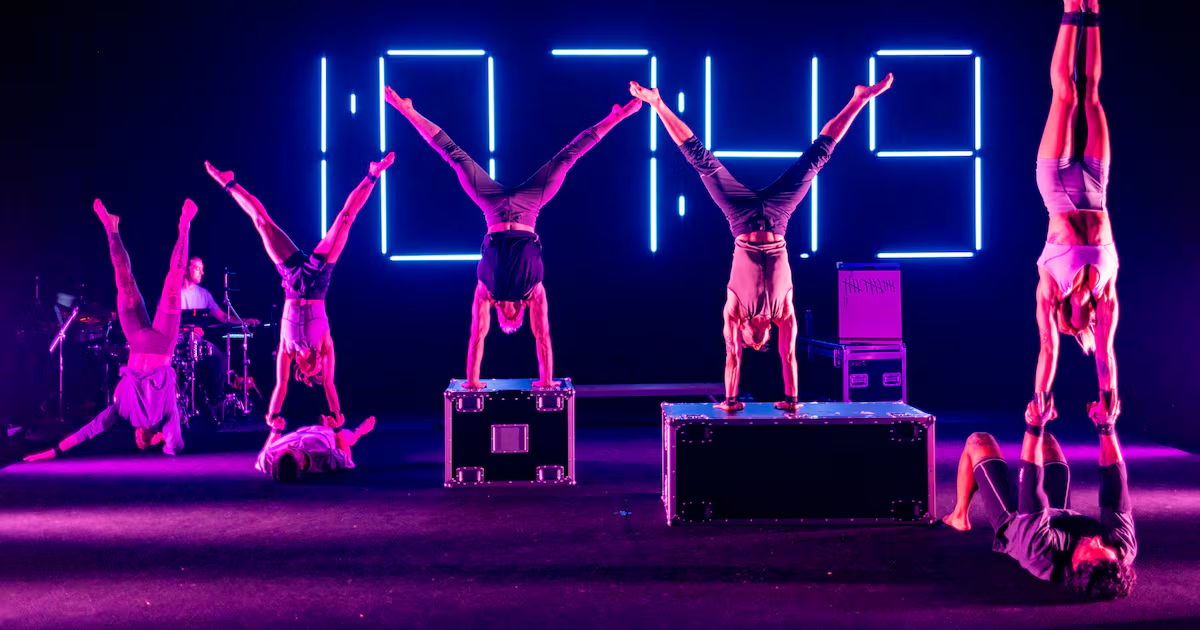
When Angus McKean meets someone in passing, does he tell them what he does?“I usually don’t mention it,” he says. “Undoubtedly it does come up after a while, and the reaction is split. It’s either ‘You’re lying’ or ‘That’s the coolest thing I’ve ever heard’.”McKean, who has been playing drums since he was four, is a jazz musician travelling the world with a contemporary circus. Gravity & Other Myths, the Australian company he works with, are currently touring Ten Thousand Hours, a show in which eight acrobats compress a lifetime of discipline into 60 minutes.The title comes from the theory that mastery demands 10,000 hours of work, and everybody I speak to on the team started training as a child.McKean’s role extends beyond simply soundtracking the show. Before joining the company he taught himself the deeper technical side of Ableton Live, the performance software used to manipulate recordings, trigger sounds and control entire audio systems from a mixing board.During performances he is a musician, sound technician and problem solver, reacting to whatever unfolds onstage. Because elements of the show are improvised, no two performances are identical. A trick may fail, or land unexpectedly. The music has to shift instinctively around whatever happens in the moment.Touring internationally has also meant preparing for situations where things can break without warning and without help nearby. In one recent show an acrobat sustained an injury, so they brought in a ninth performer to help with certain tricks.“There is nothing like this show,” McKean says. “It’s one of those lightning-in-a-bottle-type shows. It’s entirely self-contained. We don’t need lighting tech. We don’t need semi-trucks. If we’ve got our van and the set, it can run. But if something happened in the backwoods and there was no internet, I needed to know how to fix it myself.”He and the rest of the company have only recently returned to Europe after a month touring North America. I’m meeting them in Sweden, in advance of their arrival in Ireland for Cork Midsummer Festival next month.Gravity & Other Myths: 'None of it works without complete trust.' Photograph: Millissa Martin Right now we’re sitting inside Stora Teatern, or Great Theatre, a beautiful 19th-century opera house in Gothenburg with ornamental painted ceilings, chandeliers and red-velvet booths. It’s empty and dark apart from the stage lights and a faint glow running along the aisles.Onstage, eight acrobats are warming up before the show. The atmosphere is loose and playful: one mock-wrestles another on to the floor while somebody nearby does a handstand. A few of them sit in a circle, stretching and chatting. A Bluetooth speaker nearby plays Kendrick Lamar.“They’re all giggly now,” McKean says. “But as soon as we’re, like, ‘Let’s go,’ you’ll see. They are absolute professionals. This show doesn’t happen without trust. It just doesn’t happen. We live with each other for 300 days a year. We eat together, sit beside each other on planes and trains, spend every day together. We know each other inside out. And with the tricks they’re doing up there, none of it works without complete trust.”Later in the evening the performers show exactly what he means. Bodies are thrown through the air into other people’s arms. Acrobats fall backwards from great heights without looking, trusting somebody else to catch them at the last second. Human towers bend and somehow hold. At one point an acrobat is flung up and across the stage, to be caught mid-air by her wrists. It’s anxiety-inducing, but the ultimate effect is incredibly moving.What might strike a visitor most is the intensity of the lifestyle, the unreality of it, how far removed it feels from most people’s understanding of work. They might ask mundane questions in an attempt to make it more comprehensible. What do they eat? Where do they do their laundry? Who does the driving? How do the visas even work?McKean is the newest addition to the company; since January, when he joined, the team have flown more than 35,000km, spending more than two full days in the air. In an average year, he says, they’ll spend close to 300 nights in hotel rooms. There’s no such thing as a sick day unless you’re hospitalised. Beds change nightly. Wifi quality varies. There was never really a moment where we consciously decided this would become our livesIt’s impossible to keep any semblance of routine. Even basic things – whether the tap water is drinkable, whether the room has a kettle, whether the mattress will destroy your back – are unknowable until you arrive.“You have to develop a zen-like detachment,” McKean says.These are only the smaller inconveniences. The lifestyle has larger sacrifices too.“I was supposed to be best man at my best mate’s wedding three weeks ago. The wedding had been planned for years, and I couldn’t go. So I recorded a speech and they played it during the reception. I missed my sister’s 21st as well. And if a funeral comes up, God forbid, that’s a hard conversation.”Yet he doesn’t speak about any of it with bitterness. If anything, there’s disbelief, a sense of fortune.“I’m aware that I’m in f**king Sweden playing in a circus,” he says. “So actively making sure that feeling never wears off is important.”If this is what McKean has experienced in less than half a year, what does the lifestyle look like from the perspective of Jacob Randell, one of the company’s founders, who has spent 12 years touring almost continuously?Randell tells me that Gravity & Other Myths began 15 years ago as a group of friends doing circus together after school in Adelaide. After ageing out of a youth programme, they created a small independent show and eventually set themselves the goal of bringing a production to Edinburgh Festival Fringe in 2013.What was initially supposed to be a temporary break from university turned into a full-time touring career after the group met a German agent at the festival who offered them a year of international work. One year became two, then five, until the dream became a profession.“There was never really a moment where we consciously decided this would become our lives,” Randell says. “It just kept growing. At a certain point we thought, Why not just keep going?”Does he ever feel disoriented?“All the time. I wake up in the night to p**s and it’s, like, ‘Wait, where’s the bathroom?’ It’s those little things. I literally walk into walls going, ‘F**ck, that was the hotel before.’ But with that comes new cities and cultures and restaurants and people, all the things that far outweigh the sacrifices. In this job there is no normal. The only routine is the idea that everything changes.“It’s not for everyone. But I talk to people living normal lives, and I wouldn’t trade a thing. All my friends in Adelaide have a wife, kids, a house. And they’re happy. I wouldn’t be as happy, I don’t think. I’ve missed all the milestones. My partner and I just bought a house, but I’ve never really had a home before. I’m 33 now, and I’m excited for that next part of life.”For years, Randell says, touring felt fundamentally incompatible with ordinary dating. Seeing somebody back home in Australia could mean spending only a month together each year. Even relationships formed while touring quickly became difficult under the reality of constant movement: two nights in one city, then a flight somewhere else, then trains, hotels, airports. Romance shrivels under logistics.Randell suspects the reason he’s the only remaining acrobat from the company’s founding group is partly because he was the only one who ended up with a partner who understood the lifestyle from the inside. Six years ago the company hired the woman who is now that partner, Alyssa Moore, and the two have been touring together ever since.“We fell in love doing the show,” he says. “Sharing meals. The s**t-talking on travel days. Making each other laugh. There’s so few people who get to do what they love, travel the world, and do it with their partner. As far as I’m concerned I’ve won the lottery.”The troupe has another couple: Lachlan Harper, the tour manager and rehearsal co-ordinator, and his girlfriend, Annalise Moore, who manages the company’s social media. Earlier this year the pair bought a house on Queensland’s Sunshine Coast, near Brisbane, close to the beach.“We can see ourselves sitting on the deck looking out at the palm trees and the ocean,” Harper says. For now, though, he jokes that they are still effectively homeless.One of the stranger economic realities of circus touring is that, for a certain stretch of years, normal expenses almost disappear. Flights, hotels and food are covered by the company. There’s no rent and very little opportunity to spend money. Accumulating possessions becomes pointless when you’re moving cities every few days. Many performers emerge from a decade of touring financially stable enough to buy property but not wealthy enough to stop working.Harper has been touring for 10 years, long enough that the end is beginning to appear somewhere on the horizon.“You stop touring and then what?” he says. “It almost feels like a hard reset. Suddenly you’re a beginner again, which is exciting but also terrifying.”Part of travelling so constantly, he explains, is that every city briefly becomes a possible future. Touring turns you into somebody perpetually scouting for life after the company. A few days in Berlin and you imagine yourself living there. A stay in Barcelona and you begin looking at apartments online.Others in Gravity & Other Myths are already thinking about second careers. Chase Levy, who joined the troupe in August 2024, has started building a parallel life in film-making alongside performing. He shoots and edits videos for the circus, but he’s also working on independent projects of his own. Partly it’s creative curiosity; partly it’s practicality. Circus careers are short. Bodies stop withstanding this level of strain.“I see myself touring for another 10 years, hopefully,” Levy says. “But film feels more futureproof.”Half an hour before doors, there’s a noticeable shift backstage. The acrobats who were joking around onstage earlier are suddenly quiet and focused, dusting themselves with talcum powder, wrapping wrists, stretching shoulders and hips, preparing their bodies for impact. Outside the Stora Teatern, the evening sunlight has turned gold and people are drinking along the riverbank. A queue is beginning to form at the entrance. One mother stands holding her child’s hand while he bounces impatiently on the spot, craning upwards every few seconds to try to get a look inside. The child keeps tugging at her sleeve, trying to hurry her inside.Gravity & Other Myths perform Ten Thousand Hours at Cork City Hall from Friday, June 19th, until Sunday, June 21st, as part of Cork Midsummer Festival
Behind the scenes at Gravity & Other Myths: ‘So few people get to do what they love. I’ve won the lottery’
The Australian contemporary circus troupe are on their way to Cork Midsummer Festival. What’s it like to be on the road 300 days a year?
1,784 words~8 min read