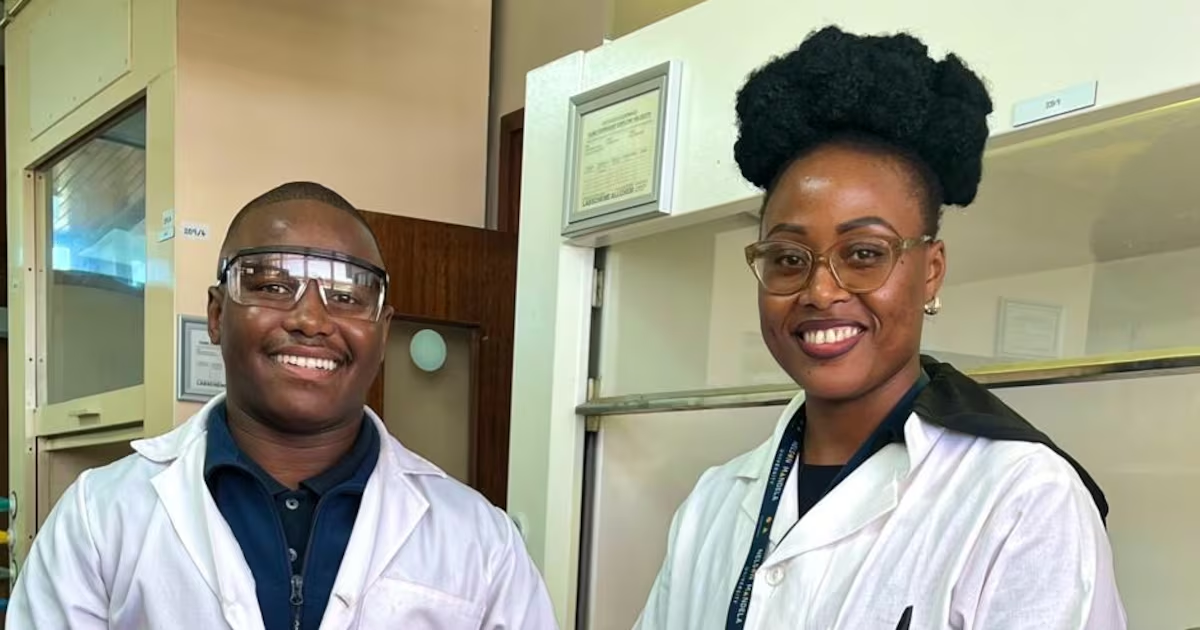
Hypertension, or high blood pressure, is a major problem on my maternal side; everyone suffers from this disease, which is the underlying driver of heart disease and strokes and the biggest killer worldwide.This was a significant motivator for my master of science in chemistry, for which I chose to develop a better, more cost-effective method to produce enalapril, which lowers blood pressure and is one of the most prescribed drugs in hypertension treatment, listed as a World Health Organisation (WHO) essential medicine.My goal is to develop something with local and global impact, and I am committed to helping people with hypertension. It would also fill me with pride to be able to help my family and community. I have a phrase that resonates with communities of colour, which is “umjita wase kasi”. It directly translates to “a guy from the township”. I’m from Zwide township in Gqeberha, and I hope I can inspire other township learners to study hard and get a degree.I graduated with my master’s degree in April, and I am now continuing with my doctorate. I’ve been at Nelson Mandela University since my BSc degree, followed by my honours in the department of chemistry. For my master’s I was accepted into the university’s South African research chair initiative in microfluidic bio/chemical processing, headed by Prof Paul Watts, who is my supervisor and a phenomenal scientist.Watts and our team of 20 postgraduates and two postdoctoral researchers are at the stage where we are ready to start manufacturing pharmaceutical drugs at scale for a range of critical illnesses in our lab. Just as I’m working on hypertension, others are working on drugs for Aids, TB, malaria, cancer and diabetes, as well as for common illnesses including influenza.Medication costs are often highlighted as one of the biggest direct contributors to insufficient treatment of critical illnesses. To reduce the total cost of drug procurement for hypertension and other drugs in South Africa and throughout Africa, we need to locally manufacture the active pharmaceutical ingredients (APIs), which is the principal component in pharmaceutical drugs. Medication costs are often highlighted as one of the biggest direct contributors to insufficient treatment of critical illnesses.We can do this with a technology we are using in our research chair/programme called continuous flow synthesis, which could reduce the cost of these drugs by 20% to 30%.In any pharmaceutical drug, about 70% of the cost of the drug is the API. The other 30% is to formulate the APIs into tablets or “finished drugs”. Our team is looking to partner with pharmaceutical companies to produce the finished drugs, and there are a number of pharmaceutical companies in South Africa that can do this.Currently, South Africa imports most APIs from China and India. South Africa’s import of pharmaceutical products is over $2.42bn, according to the UN Comtrade 2024 database on international trade.Using continuous flow synthesis, we are already able to produce smaller quantities of enalapril and other drugs, but to upscale production, we are waiting for the completion of a new state-of-the-art laboratory the university is currently constructing for us.Establishing pharmaceutical manufacturing capacity at scale is complex, and the chair has committed over 12 years of research into developing continuous flow synthesis technology to manufacture the APIs. The technology would also significantly reduce the time taken in conventional batch procedures to produce the drugs.For my doctorate, I am staying in the same field of hypertension medicine but focusing on another drug essential for its treatment — a diuretic called indapamide. Hypertension requires what we call triple combination therapy, including drugs like enalapril (which are angiotensin-converting enzyme inhibitors — commonly called Ace inhibitors), in combination with diuretics and statins.I’m fortunate to be funded by the National Research Foundation, as I am passionate about academia and research. After my PhD my goal is to continue with postdoctoral research.I’m so appreciative of my family, who have been very supportive of my academic career. My mother, Thabiso Kota, who raised me, continually encouraged me to study hard, which fortunately came naturally to me. I was always interested in physical science, and when I was introduced to organic chemistry in grade 12, I just loved it. The fact that everything around us is chemistry, especially organic chemistry, fascinated me. I was intrigued that a pharmaceutical drug could have a specific effect on the body, and I knew I wanted to do something in this field.This led to my BSc from 2020 to 2022, followed by my honours in the department of chemistry, funded by a postgraduate research scholarship from the university. In my honours year I met Watts, and from the moment he introduced me to flow chemistry, I knew I wanted to work with him in this whole new world. He inspires the whole team to achieve at the highest level, and we cannot wait for the new lab to be up and running, because then things will get even more interesting as we start manufacturing at scale.•Siphosethu Kota is a master of science graduate at Nelson Mandela University.
Township scientist targets cheaper hypertension drugs for Africa
Research into flow chemistry could lower drug prices and boost local manufacturing
836 words~4 min read