SINGAPORE – Singapore maintained its projection for economic growth in 2026 within the 2 per cent to 4 per cent range, even as downside risks because of the Iran war continue to rise.Explaining this, the Ministry of Trade and Industry (MTI) said that although this year’s economic outlook has weakened, the economy performed better than expected in the first quarter.In the first quarter of 2026, the Singapore economy grew 6 per cent year on year, extending the 5.7 per cent expansion in the previous quarter. This is higher than MTI’s earlier estimate of the 4.6 per cent growth announced in April.Many analysts had expected Singapore to lower its growth forecast for the year. Slower growth would have meant dampening the outlook for jobs and wage increases as businesses cut back on expenses to manage the higher costs of energy and raw materials.Growth this year will still be lower than the 5 per cent pace achieved in 2025.MTI, in its economic survey report for the first quarter, said growth was driven by strong performance of the wholesale trade, manufacturing, and finance and insurance sectors.In particular, robust AI-related demand led to growth in the machinery, equipment and supplies segment of the wholesale trade sector, as well as the electronics and precision engineering clusters within the manufacturing sector.On a quarter-on-quarter seasonally adjusted basis, the economy expanded by 1 per cent in the first three months of 2026, easing from the 1.3 per cent growth in the preceding quarter, though better than the 0.3 per cent contraction announced in April.However, the outbreak of war in the Middle East led to higher prices of, and shortages in, crude oil and petroleum products, such as petrol and diesel refined from these, contributing to contractions in the fuels and chemicals segment of the wholesale trade sector and the chemicals cluster of the manufacturing sector.Since the outbreak of war, oil prices have surged and supply chains are in disarray with the closure of the Strait of Hormuz – through which 20 per cent of the world’s oil consumption passes – dampening the outlook for trade-dependent economies across Asia, including Singapore.MTI said the conflict has also affected the global economic outlook, with disruptions to the supply of energy and other key inputs, such as fertiliser and aluminium, amid the blockade of the strait.This has driven up inflationary pressures, which are “expected to erode real incomes and dampen consumption, as well as cause a tightening in global financial conditions”, said MTI.Global merchandise trade volume growth is projected to slow to 1.9 per cent in 2026 from 4.6 per cent in 2025, said the World Trade Organization in March. In April, the International Monetary Fund lowered its forecast for 2026 global economic growth to 3.1 per cent, from an earlier estimate of 3.3 per cent.Still, MTI said, demand related to artificial intelligence has remained robust and should continue to support the growth of regional economies throughout the year. The outlook for US tariffs is also broadly unchanged.“Sustained global AI-related capital spending should continue to be a key driver of growth for the electronics and precision engineering clusters within the manufacturing sector. In particular, demand for AI-related semiconductors such as networking and memory chips from the data centre end-market is expected to remain robust for the rest of 2026.”Nonetheless, downside risks to Singapore’s economic outlook have risen significantly. MTI said it will continue to monitor developments closely and adjust the gross domestic product growth forecast over the course of the year if necessary.Ovais Subhani is senior business correspondent at The Straits Times. He writes stories that demystify the latest economics, trade and finance news.
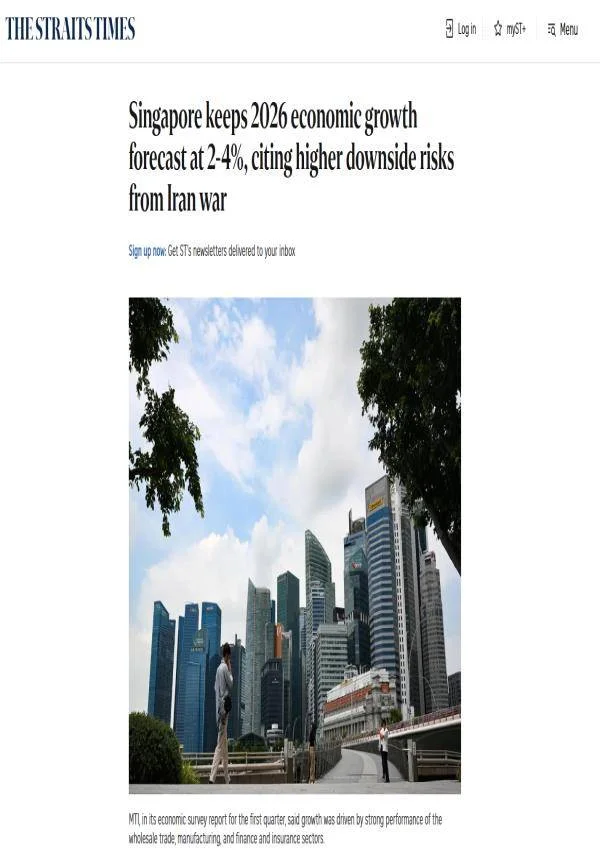
Singapore keeps 2026 economic growth forecast at 2-4% despite higher downside risks from Iran war
While MTI’s assessment for this year’s outlook has weakened, the economy performed better than expected in Q1. Read more at straitstimes.com. Read more at straitstimes.com.
TL;DRAI
Singapore maintained its 2026 GDP growth forecast at 2-4% despite Iran war pressures, after Q1 came in at 6% YoY — above the 4.6% April estimate — driven by wholesale trade, manufacturing, and finance. AI-related semiconductor demand (networking and memory chips for data centres) remains a key growth driver, but Strait of Hormuz disruptions and rising inflation represent material downside risks for trade-dependent supply chains and energy-intensive budgets.
602 words~3 min read