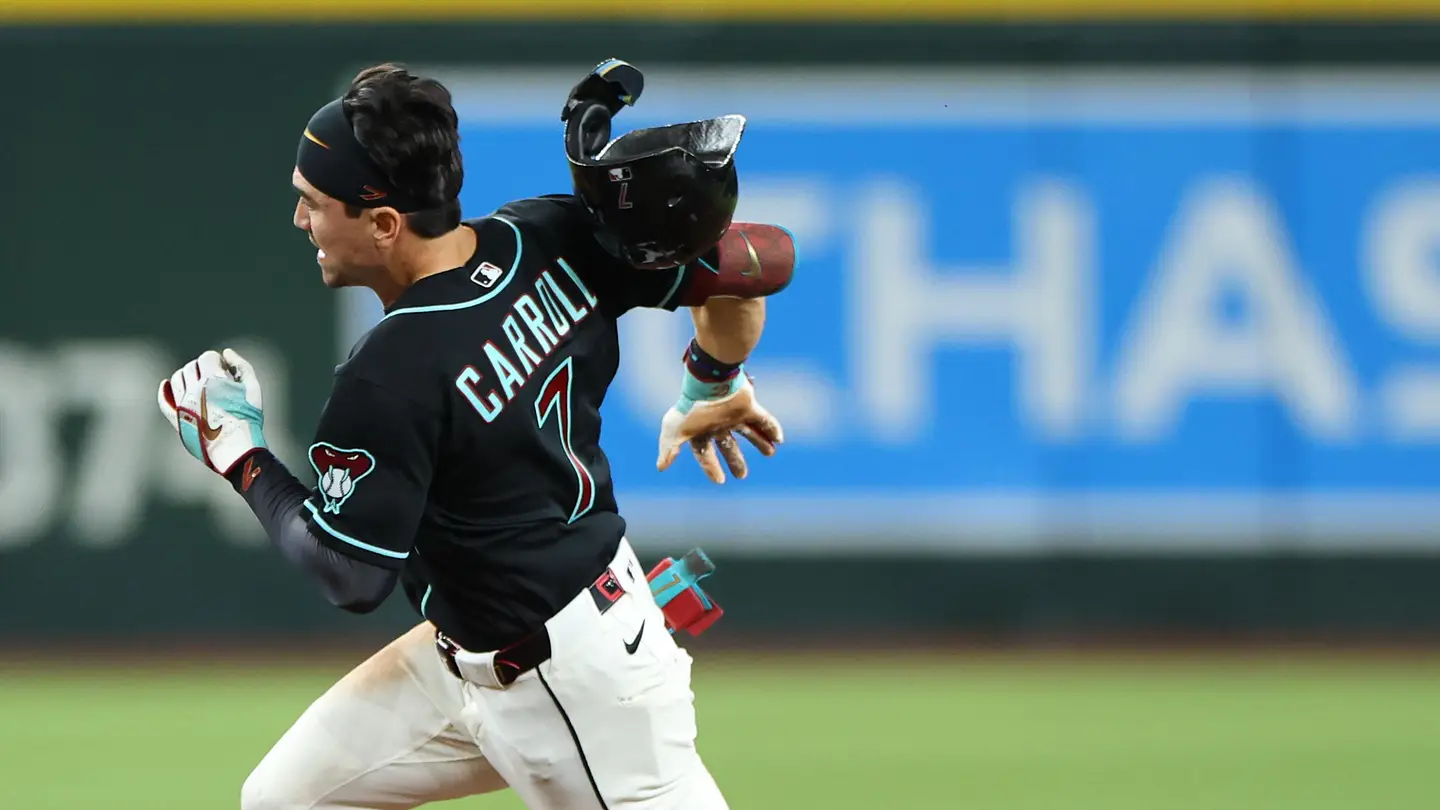
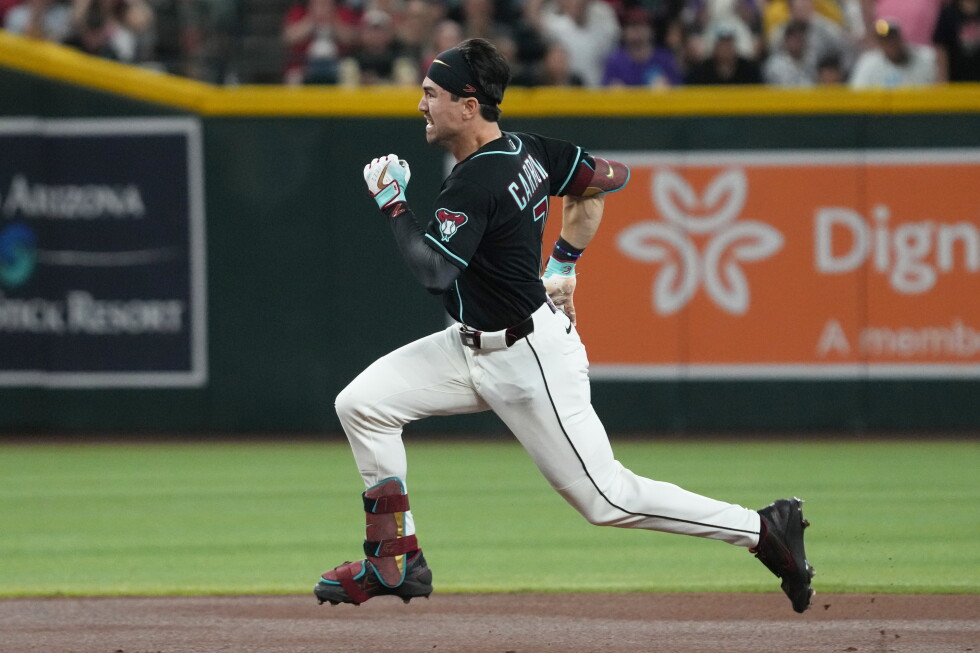
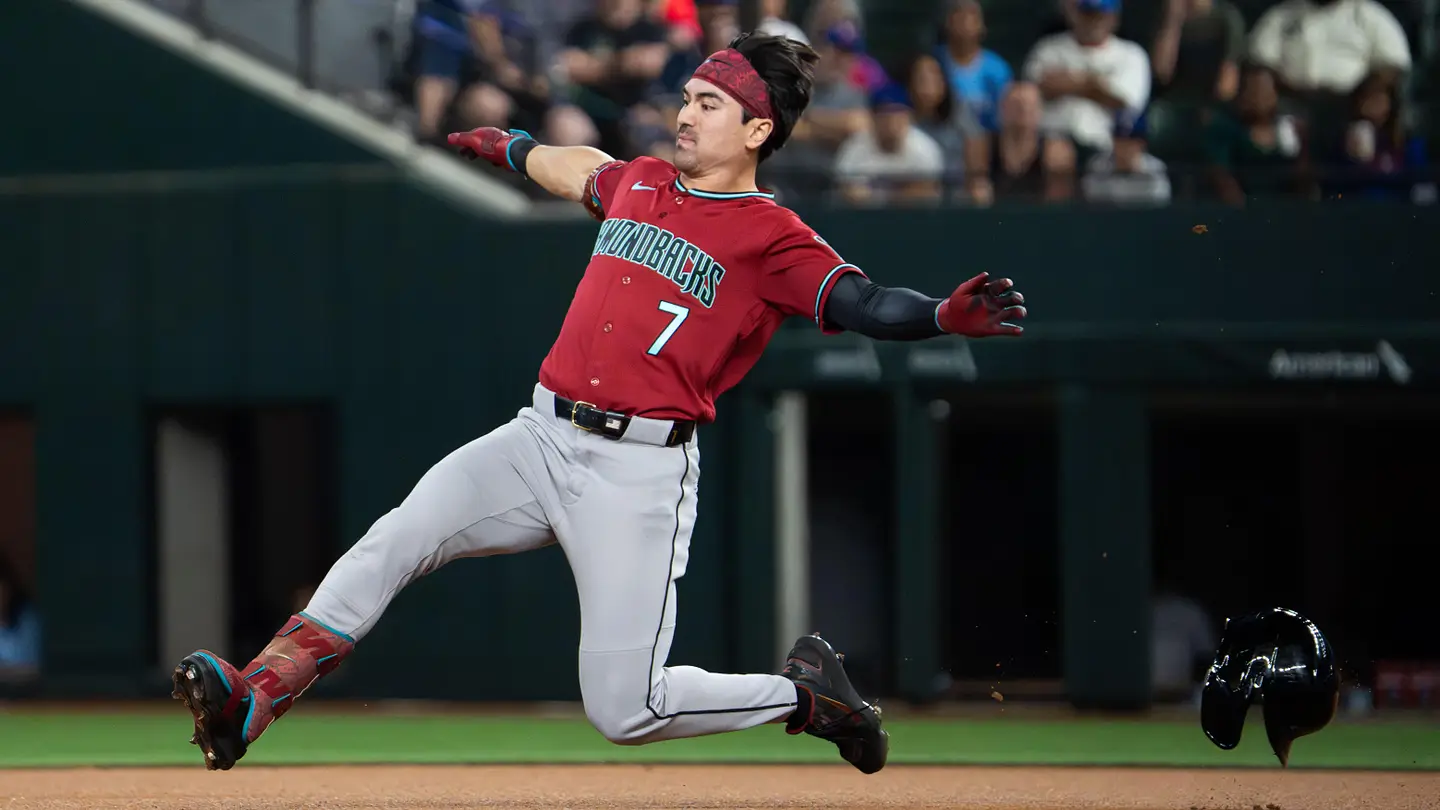
PHOENIX — George Brett had a question: “How long has Corbin been in the big leagues? Is this his fourth year?” he said on the phone.We were discussing Corbin Carroll. The Arizona Diamondbacks outfielder has led the National League in triples the past three seasons and is on pace to do so again. His two Sunday against the Colorado Rockies gave him a league-high eight, twice as many as any other major-league player.A Hall of Famer who once flirted with hitting .400, Brett led the American League in triples three times — in 1975, 1976 and 1979.Yes, I told Brett, this is Carroll’s fourth full season.Brett explained that he has a house in Arizona that he stays in during the winter. He golfs with buddies at Whisper Rock Golf Club in Scottsdale, and years ago, they were telling him about this kid Carroll and how good he would be. Brett had never heard of him.
50 of 'em. pic.twitter.com/s91BlUfhAq
— Arizona Diamondbacks (@Dbacks) May 24, 2026That changed quickly. Carroll was an All-Star as a rookie and turned into one of the game’s more exciting players. And Brett realized something. Carroll reminded him … of him.“Because he doesn’t take anything for granted,” Brett said. “He hits the ball and he runs. He runs hard to first on ground balls to shortstop, to the second baseman, he knows he’s out. I had a little game I played. I knew I was out, I just wanted to see how close I could make it. From what I understand, he does the same thing.”A few years back, before a spring-training game, Brett said he told then-Kansas City Royals infielder Whit Merrifield that if he smacked a base hit that afternoon, he should try to stretch it into a double. Sure enough, Merrifield laced a ball into the outfield. But instead of trying for two, he rounded first and headed back to the bag.“Why didn’t you go for two?” Brett said he later asked him, recalling the conversation.“I would’ve been out by 10 feet,” Merrifield said.“So what?” Brett said. “It’s spring training. Guess what? They’re going to know you’re that type of (aggressive) player. Now you hit that same ball during the season and they’re going to come in, and they may get a short hop or an in-between hop, and now it’s a double.”Brett’s point — extra bases start with a mentality. And that mentality can make outfielders nervous. He suggested I go back and watch his old Kansas City teammate Hal McRae in Game 4 of the 1980 World Series against the Philadelphia Phillies. In his first at-bat, McRae smoked a single to center. Center fielder Garry Maddox dropped to one knee to field the ball, noticing too late that McRae had not slowed after rounding first; he had accelerated. The Royals’ designated hitter slid safely into second, a surprise double.“We already had scored three runs that inning, and that was the biggest roar of the crowd, when he stretched a single into a double,” Brett said. “When you do that stuff, fans go freaking nuts.”Like Brett, Lance Johnson also had a question: “How many triples did he hit last year?” he said, referring to Carroll.During his 14-year career, Johnson had led the American League in triples four times with the Chicago White Sox (from 1991-94) and led the National League once with the New York Mets (1996). He nearly had a sixth title, but Kenny Lofton stroked a triple on his last at-bat of the 1995 regular season to beat him out.I told him Carroll hit a team-record 17 last season.“OK, he’s a legitimate triple hitter,” Johnson said on the phone. “When you get up to around 15 or 17, those are legitimate people to be reckoned with.”Much goes into this. Ballpark is certainly a factor. When I asked Carroll about triples recently at his locker, Chase Field was the first thing he mentioned. Opened in 1998, the stadium features corners with odd angles and gaps that stretch 413 feet from home plate. It’s not a coincidence that eight Arizona players have led the league in triples (or shared the league title) over the last 11 years.Corbin Carroll slides into third for a triple earlier this month at Chase Field, a triple-friendly park that has helped many Diamondbacks lead the league. (Joe Camporeale / Imagn Images)When I had talked to Brett, he had guessed that 65-70 percent of his triples had come at Royals Stadium, another triples-friendly park. He was right on the money — 70.8 percent came at home. Over his four-plus seasons, Carroll has hit 66.7 percent of his triples in Phoenix.But sometimes a player is simply born to round second. Johnson grew up in Cincinnati watching Pete Rose dive head-first into third. “Watching guys like that rubs off on you,” Johnson said. Throughout his entire career, he thought “triple” as soon as the ball dropped in the outfield grass, full-throttle until someone stopped him. Johnson never set a goal to lead the league in triples, it just happened because that’s how he approached the game.This mentality followed him into retirement, in ways he did not expect.“You want to hear something funny?” Johnson said. “I had re-married after I was done playing, and my wife didn’t have any kids. So I said, ‘Well, OK, I’ll try to hit a single, right?’ Can you believe I ended up having triplets? Triplets, man. When I called my agent and told him, he said, ‘I don’t know why you’re surprised.'”Before a recent game at Chase Field, I told Diamondbacks manager Torey Lovullo what it was like watching star receiver Larry Fitzgerald play football for the Arizona Cardinals. When Fitzgerald caught a pass and broke into the open field, it was like he lifted the energy of the entire building. Not just on the sideline, but everywhere.I asked Lovullo if he ever felt similar energy when Carroll rounded second.“I can say that with 100 percent certainty,” the manager said.Normally, Lovullo added, when a ball is hit into the gap, he watches how the defense positions its cut-off men. But with Carroll, the manager keeps his eyes locked on the speedy outfielder. He said that at that point, he becomes a baseball fan.Among the sport’s fastest players, the 25-year-old Carroll said he decides a few steps before second base whether to go for three. If the ball is behind him in the right-field corner, he glances at third-base coach J.R. House. Anything he can see, he decides on his own.Corbin Carroll celebrates after a triple in 2025. In just his fourth full season, he’s already close to the Arizona franchise record for triples in a career. (Christian Petersen / Getty Images)I asked Brett Butler about this. Over his 17-year career, he had led the NL in triples three times (1983, 1994-95) and the AL once (1986). He told me a story about trusting speed.“I’m in Atlanta and Dal Maxvill is our third-base coach,” Butler said on the phone. “Joe Torre was my manager. Say I was on first and the ball was hit to right-center — I’m scoring, I don’t care.“There were four or five times my rookie year when Dal held me up and I (kept running and) scored, and Joe would call me in the office. He’d say, ‘Listen, when Dal Maxvill stops you, you stop.’“And my line to him was, ‘All due respect, Joe, he doesn’t know my speed. I know my speed. If I got called out, I could see you calling me in here. But until I get thrown out, I know my speed better than anybody else.'”Instincts are a powerful force.House, the third-base coach, previously held the same position in Cincinnati, where he coached another of the game’s young stars, Elly De La Cruz. Like Carroll, De La Cruz is an elite athlete. The biggest difference is height — De La Cruz is 6-foot-6, Carroll is 5-10.House told me De La Cruz running the bases reminds him of former NFL superstar Randy Moss, leaning into banked turns like a race car. Carroll, he said, is more like Sonic the Hedgehog, the animated character zooming at supersonic speed. Vrooooom!As Carroll runs, his face tightens, his eyebrows lift, his helmet flies off. In 2023, then-teammate Alek Thomas said in a radio interview that Carroll looks constipated as he flies around the bases. David Dellucci, a 13-year outfielder who led the NL in triples in 1998 (with the Diamondbacks, in their first season), described the moment more eloquently.“The adrenaline is just through the roof, man,” he said of heading to third. “Because you know you’re trying to outrun a throw. You know that throw is in the air. It’s you against the ball.”Diamondbacks broadcaster Steve Berthiaume is not a fan of catch-phrases, but watching Carroll makes him think of the Cake song, “The Distance.” Every now and then, Berthiaume will throw out a couple lyrics as he watches Carroll motor for third.He’s going the distance, he’s going for speed.Entering Monday’s contest at San Francisco, Carroll has 51 career triples, one short of the Diamondbacks’ career mark held by Stephen Drew. Among active players, he ranks third, just four behind leaders Starling Marte (in his 15th season) and Mike Trout (in his 16th). Both have at least 4,000 more plate appearances than Carroll.How long this lasts is anyone’s guess. Triples favor the young. Like Carroll, former shortstop Garry Templeton once led the NL in triples during his first three full major league seasons, hitting 18, 13 and 19, respectively, from 1977-79. Then he started having trouble with his knees — “I think I had seven or eight knee surgeries,” he said in an interview — and never reached double digits again.After hitting 12 triples as a rookie, Dellucci said he was told he needed to focus more on power. This made him more selective at the plate, looking for pitches he could drive over the wall. Ray Lankford, who led the NL in triples in 1991 with 15, said once he matured and developed as a hitter, defenses played him deeper, which reduced triple opportunities.Then there’s the obvious. Players slow down. As hard as it is to imagine this happening to Carroll, the game always takes a toll.“You’re playing 162 games,” Brett said. “The younger you are, you feel great every day you go to the ballpark. The older you get, you have aches and pains every day. So tell Corbin the next time you see him to take advantage of his youth (because there will come a time when) he’s going to be happy with a double. And he’ll say to himself, ‘God, I remember when that was a triple.'”