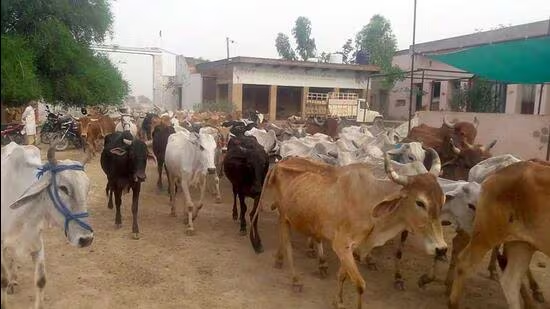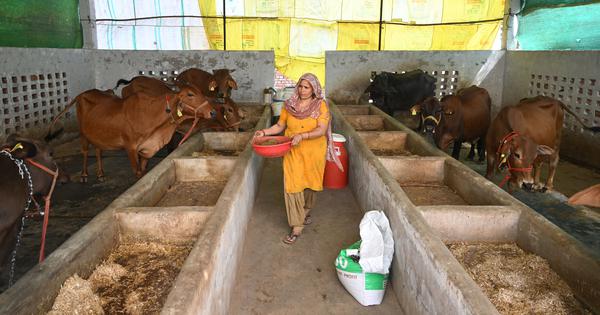
Jagdish Agrahari, a resident of Sultanpur in Ayodhya district, Uttar Pradesh, started rearing cattle in August 2025 and selling milk to supplement his income. He has four jersey cows, one Holstein Friesian, and three buffaloes. Agrahari’s jersey cows fell sick during the weather-changing season in March, as they failed to adjust to the sudden increase in temperature. The treatment bill came to Rs 20,000. He can manage the costs, he says, only because he and his two brothers also run a scrap shop. But most of the 80 million rural households that rely on cattle rearing and dairy for their livelihood have limited capacity to bear rising costs.These farmers have played an important role in the growth of India’s dairy sector over the last two decades. During this period, milk production increased from around 80 million tonnes in 2000 to 239 million tonnes in 2023.However, these gains are now under growing pressure as climate change begins to disrupt India’s cattle economy. A recent study by the New Delhi-based think tank, Council on Energy, Environment and Water, says that more than half (54%) of buffalo rearers reported climate-related impacts on their animals. The study claims that half of those rearing crossbred or exotic cattle and 41% of Indigenous rearers report similar impacts.The impact of climate change ranges from increased disease rates, restlessness, and mortality among bovines to reduced productivity and threats to the livelihoods and nutritional security of cattle rearers, it says.Shorter lactation periods, fewer productive days, and earlier animal retirement are contributing to India’s growing stray cattle problem. And in Uttar Pradesh, the state that leads the nation in milk production, the stakes are particularly high. Mongabay-India reported from several districts of Uttar Pradesh to explore the impact of climate change on the bovine population.A privately run animal shelter on the outskirts of Noida, is home to around 800 cattle recovered from highways after being deserted by owners. A new study finds that extreme weather is affecting cattle and their rearers by way of increased disease rates, restlessness, mortality, and reduced productivity. Image by Himanshu Arya.Heat on the bodyVeterinarians and cattle owners across Uttar Pradesh describe similar experiences. High temperatures reduce milk production, increase calf mortality, and lead to more frequent skin infections and infertility.Buffaloes are especially prone. Their thicker, darker skin absorbs more solar radiation, and they have fewer sweat glands, both of which limit their ability to regulate body temperature, according to the report by the Council on Energy, Environment and Water. Anil Tyagi, who runs a dairy cooperative in Mahavatpur, Agra district, supplying milk to Parag, a major private dairy company, says that during peak summer, buffaloes that usually give four to five litres a day fall to about three litres. Cows producing four litres see a reduction of about one litre.For Nipendra Kumar, 38, a member of Banas Dairy, a cooperative of 70 members supplying milk to Amul, the losses are severe. Kumar owns 15 animals in Moradabad and says his dairy yield drops by at least four litres per animal per day during peak summer. Fat content in the milk rises, affecting quality. “Sometimes, traces of blood appear in the milk,” he says, “and heatwaves have led to cases of sour milk and other health issues, including breathlessness among the animals.”The financial blow is direct. “During summer months, my investment in procuring fodder, nutrition, and care rises, but milk yield is less,” Kumar says. “If in winters I make a profit of Rs 50,000, it comes down to Rs 25,000 during the summer months.”A National Dairy Research Institute study confirms that extended summer heatwaves in northwestern India are lowering milk productivity per animal and increasing costs for cattle rearers.Bishwa Bhaskar Choudhary, a scientist of agricultural economics, ICAR’s Indian Grassland and Fodder Research Institute, Jhansi, and the author of the study, told Mongabay-India, “effective adaptation to heat stress necessitates improved feeding practices, access to quality fodder, balanced nutrition, and heat-alleviating infrastructure such as cooling and shade facilities. However, such adaptive measures are more feasible for farmers with larger herd sizes and greater financial capacity. In contrast, small and marginal livestock rearers often operate under constrained economic conditions, limiting their ability to adopt climate-resilient dairy management practices and thereby increasing their vulnerability to recurrent and prolonged heatwaves.”When fodder runs outHeat stress is compounded by a fodder crisis. During summer, green fodder becomes scarce, and cattle owners shift to dry husk. Kumar uses sugarcane husk – fibrous and low-cost, but low in protein and digestibility. Around 48% of cattle-rearing households in Uttar Pradesh say green fodder is unaffordable, above the national average of 42%. Dry fodder is the most acute cost issue: about 70% of households report it as unaffordable, says the CEEW study.The loss of open grazing land compounds the problem. Dhananjay Goutam, 30, a cattle rearer from Ghazipur district, says the disappearance of common lands has left animals more exposed to heat and with fewer places to cool off. “Over the past decade, many open areas and water bodies where buffaloes would cool off have dried up or disappeared,” he says. “Common lands are being encroached upon. The land we once used for grazing has been taken for projects like the Purvanchal Expressway.”About 33% of households in Uttar Pradesh report being unable to access land for fodder cultivation (more than double the national average), the CEEW study flags. Without common land, cattle are increasingly kept inside brick structures that often lack electricity, with cement or tin roofs that trap heat, Goutam says. “Grass-based thatches used to regulate the weather better.”The heat’s effects extend beyond individual farms. Rahul Kumar, a milk procurement officer from Amroha, collects milk from 190 dairy suppliers each day, travelling 50 km one way to bring cans to a Banas dairy, Asia’s largest milk producers cooperative, chilling plant. During summer, average daily collection from his route drops from 35,000 litres to 20,000 litres. To protect what little is collected, each can is covered with wet jute bags, routes are redesigned to cut transit time, and unloading — normally a 10-minute task – is pushed to under seven minutes.Ceiling fans have been installed inside this tin-roofed cattle shed by dairy farmer Nipendra Kumar, to shield his cattle from extreme heat. Without access to common lands, cattle must be increasingly kept inside such structures with cement or tin roofs that trap heat. Image by Himanshu Arya.A disrupted reproductive cycleHeat stress is also undermining reproduction. Farmers across Ghazipur and beyond describe mounting difficulties with cattle pregnancies. “I had to breed my cow two or three times for it to be successful,” Goutam says. A complaint that echoes across the region. A typical cow’s gestation period lasts 280 days.While breeding can occur year-round, Dr Satya Prakash of Ghazipur GAAI government hospital recommends summer breeding for cows and winter breeding for buffaloes, in line with the traditional cycles observed in Indian weather. Yet, both heatwaves and coldwaves are now altering these traditional cycles, disrupting established breeding patterns. Earlier studies have found that heat stress adversely affects fertility in both cows and buffaloes by disrupting hormonal balance, reducing conception rates, and increasing early embryonic losses.One key mechanism is “silent heat”, a condition in which animals undergo normal ovulation but, due to high temperatures, stop displaying the usual behavioural signs that indicate they are ready to breed. Buffaloes grunt, cows mount other cattle and produce vaginal discharge – all signals that farmers rely on to time artificial insemination. Heat suppresses these signs, making accurate timing of insemination nearly impossible. The problem is worse for buffaloes, which show almost no visible signs between April and September, explains Ashutosh Tripathi, Assistant Professor at Sardar Vallabhbhai Patel University of Agriculture and Technology, Meerut.The growing adoption of artificial insemination in cattle is being driven by both economic necessity and climatic vulnerabilities, which are emerging as the primary challenges hindering the full potential of livestock resources, as per the Department of Animal Husbandry and Dairying (DAHD), which comes under the Union Ministry of Fisheries, Animal Husbandry, and Dairying.While climate-driven crop failures pose a major risk to rural households, livestock serves as a vital insurance and buffer against them, the DAHD report underlines. Choudhary says the livestock sector’s growth rate now outpaces that of crop agriculture. For many small and marginal farmers, livestock contributes not only to income diversification but also to regular cash flow and livelihood security. “Goats, sheep, and buffaloes can be quickly sold in the market during periods of financial distress,” he says. “Unlike seasonal crop income from the kharif and rabi harvests, livestock generates more continuous returns through the sale of milk and other animal products even under conditions of crop failure and climatic uncertainty.But that safety net has a breaking point, when animals can no longer produce due to heat and age. The Uttar Pradesh government is promoting artificial insemination for other purposes as well, such as reducing the burden of stray cattle. It feels artificial insemination can alter the population at the reproductive stage and allow the production of high-quality female calves.In Uttar Pradesh, almost all (94%) cattle rearers know about artificial insemination, but fewer (48%) actually use it, according to a CEEW study.Tripathi recommends scheduling insemination during the coolest parts of the day, early morning or late evening. But as night-time temperatures rise, even those windows are narrowing. His broader recommendation is a shift toward Indigenous cow breeds, which have greater disease resistance and have built climate resilience over generations. “I have been able to get my Indigenous cattle conceived even in May and June, which is not possible in Holstein Friesian cows,” he says. His mantra: average milk yield with average resources, sustained over a lifetime rather than chasing peak output from breeds that demand costly interventions to survive Indian summers.Adapting on the groundUttar Pradesh is among 23 heatwave-prone states identified by the India Meteorological Department. While Heat Action Plans have been developed in collaboration with national disaster authorities, implementation remains uneven: only two of the state’s 75 districts have district-based climate action plans, and 44 have district-level heat action plans or advisories, according to an analysis by the Vasudha Foundation.The pressures are only expected to intensify. India Meteorological Department Director General Mrutyunjay Mohapatra has warned of more heatwave days in May and June, and the anticipated onset of El Niño could disrupt monsoon rains, prolonging heat stress.These heatwaves and droughts severely affect the bovine population. In 2022, more than 69,000 livestock animals were killed in India due to extreme weather events, according to the Centre for Science and Environment.The long-term projections are stark. By 2100, up to 75% of global livestock could be exposed to dangerous heat conditions, according to a joint assessment by the Food and Agriculture Organization and the World Meteorological Organisation. A Lancet study projects that rising temperatures could slash milk production by 25% in India’s arid and semi-arid regions by 2085.For India, which has led the world in milk production since 1998, the warming is not an abstract threat. Farmers are already feeling the heat on the ground.When Mongabay-India first spoke to Jagdish Agrahari in the first week of April, he was still trying to save his ailing Jersey cow, spending nearly Rs 20,000 on the treatment. By the final week of the month, as this story entered its last phase of production, Agrahari called back with the news he had been dreading: the cow had died.Himanshu Arya is a mentee of the Climate Change Media Hub at the Asian College of Journalism. The programme is supported by Interlink Academy, Germany.This article was first published on Mongabay.
UP dairy farmers face losses as summer takes a toll on cattle
Animals are producing less milk and are more prone to diseases due to the weather.
1,937 words~9 min read