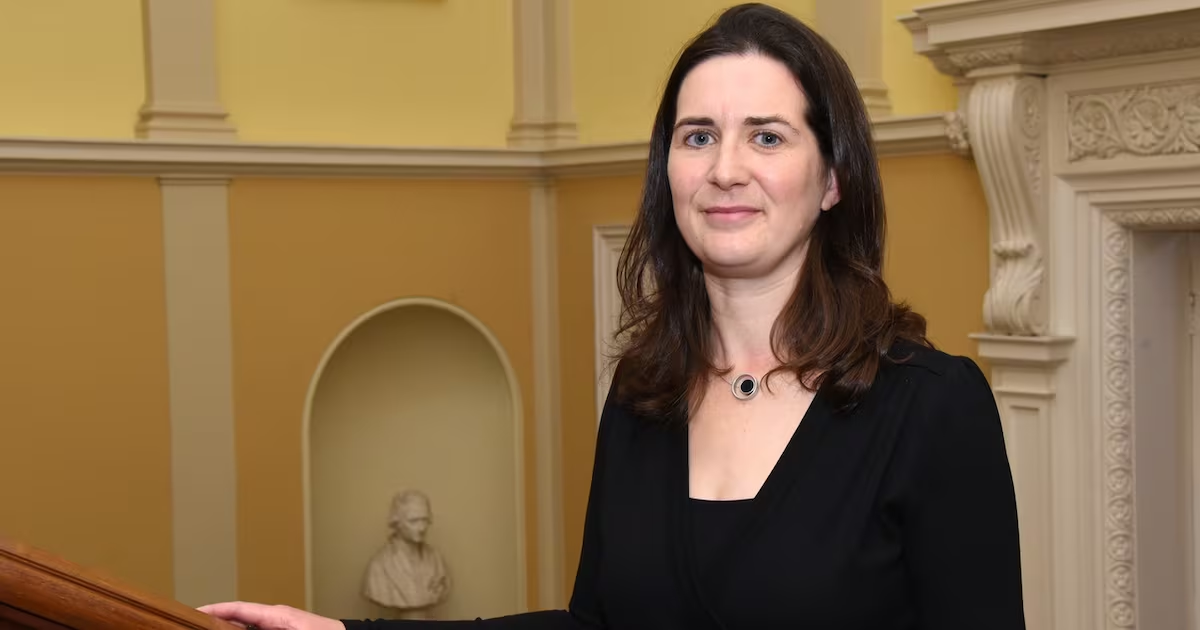
The images are everywhere on social media: casually dressed Irish healthcare workers, lounging on Australia’s white sandy beaches, or on their morning runs with a luminous yellow sky rising in the background.It has become a “rite of passage” for many graduate doctors who, after many years working and studying to earn their degree, decide to relocate, with Australia and New Zealand being popular locations.But this is creating concerns for the health service, as the State grapples with a shortage of doctors amid an increasing and ageing population that places additional pressure on the health system.Recognising this issue, Minister for Higher Education James Lawless has suggested a new State-backed loan offered on the condition recipients go on to work in the Irish health service.Lawless says he is considering “incentives” to try to keep Irish medical graduates in Ireland, because of “a concern that we lose a lot of our best graduates overseas”.[ One in five doctors registered in Ireland opting to work abroad or not at allOpens in new window ]The Minister is considering providing such a loan to graduate entry medicine (GEM) students – roughly a third of doctor graduates each year – on a pilot basis, before possibly expanding it to other medical disciplines if it is popular.Some countries impose obligations on medical graduates to work in the state health service for a period of time. However, it tends to apply in poorer countries – in Albania, for example, graduates must work for three years in the national service. The idea has never taken hold in Ireland and has been staunchly opposed by unions when discussions have arisen in the past.The issue is complicated by the fact medical schools here have a mix of fee structures, with Irish school-leavers having tuition heavily subsidised but international students – who make up a significant proportion of our medical students – paying a higher rate.The closest thing to tied service relates to a training scheme for physician associates, who assist doctors and surgeons by taking medical histories, performing examinations, making diagnoses and analysing test results, under the supervision of a consultant. The HSE has paid for 36 such students to complete a two-year master’s degree in exchange for service since the scheme was introduced in 2024, though the hiring of many into the health system was paused amid an independent review into their role.Regarding Lawless’s loan proposal, many people in the sector say this would not be enough to stem the tide of recent graduates wanting to emigrate.A report from the HSE’s National Doctors Training and Planning sector, published earlier this month, found 60 per cent of the 2024 interns were not working in the health service in 2025. In many cases, these individuals do return, with the same report finding 77 per cent of the 2016 to 2020 interns went on to further training in Ireland by 2025, with the number rising to 87 per cent when looking specifically at Irish-trained doctors of Irish nationality.“There are two notable trends in this report, firstly a higher proportion of interns are going abroad after the intern year, increasing from 47 per cent in 2015 to 60 per cent in 2023,” the report stated.“Secondly, there are indications that these interns are taking longer to commence further training in Ireland. The proportion of interns not in Ireland two years after completing internship has increased from 36 per cent in 2015 to 58 per cent in 2023.”It added: “While it appears likely that interns still return for training, albeit with a longer gap before returning than previously, it will be important to monitor these trends.” [ Report finds most doctors who go to Australia return to Ireland to train and workOpens in new window ]Training these individuals comes at a cost to the State. The Department of Higher and Further Education says it provides a grant to higher education institutes of between €11,920 and €22,280 per medical student, per year for undergraduate degrees, and €15,480 to €16,930 per student, per year for graduate entry medicine (GEM). This is separate to student fees.Dr Niamh Humphries, head of research at the graduate school of healthcare management at the Royal College of Surgeons in Ireland, says doctor emigration to Australia in particular is “only going in one direction”.Last year, 630 Irish doctors received visas to work in Australia, with the number standing at 437 this year so far. Of those 630, some 560 were non-consultant hospital doctors, and most went to Perth.“We train about 750 per year. That’s a problem when we’re thinking of workforce planning. On an individual level, everyone should be able to do what they want, but it causes issues for workforce planning,” she says. “Many of these graduates fully intend to be there for a year or two, but then they meet someone or they get a great offer and then it becomes a permanent move.”Humphries, who has studied this issue for more than two decades, says emigration is about more than just debt write-off.“Return of service needs to have a wider policy. Working conditions are a huge piece. Many are reluctant to come back when it hasn’t been fixed. You can’t force people to stay. You have to attempt to address the problems they have rather than ignore them.”Prof Gabrielle Colleran: It is 'penny-wise and pound-foolish' to try to tie doctors into mandatory service rather than fixing the problems that push them away Prof Gabrielle Colleran, president of the Irish Hospital Consultants’ Association, says surveys have shown a decision to emigrate is more often linked to working conditions.“Long working hours in our hospitals, inadequate staffing levels, burnout and poor wellbeing, alongside a dissatisfaction with the quality of care delivered to patients, are among the reasons why doctors decide to go abroad to work and potentially defer their return,” she says.“It is penny-wise and pound-foolish to focus on trying to tie doctors into mandatory service for a short period rather than fixing the problems that push them to stay away.”This is something Dr Rachel McNamara, vice-president of the Irish Medical Organisation also notes, but says there is also a “cultural” push.“Practically speaking, it’s a good time to do it,” she says due to their stage in life, but they “find it’s a well-supported structure and see that this is what it could be like”.GEM is a particularly expensive route for studying medicine, with fees as high as €19,260 in some institutions. Designed as a “second chance” route for individuals who did not get a place immediately after the Leaving Cert, its students have already obtained an undergraduate degree in a different field and undertake an accelerated four-year study of medicine, rather than the typical five- or six-year programme.A report conducted by UCD’s Students’ Union earlier this year noted it is promoted as a route “to widen access to medicine and help secure the State’s future medical workforce”, but suggested the funding model “may be undermining those ambitions”.“A system cannot credibly claim to widen access if the ability to take up that opportunity depends so heavily on who can afford to withstand that cost.”McNamara says there is a “major issue” with debt for GEM, and the cost has become a “runaway train”.“We have heard of non-consultant hospital doctors with six-figure loans after training. And we have heard of GEM students who go to Australia because salaries are higher. Any sort of proposal to help GEM ... would be welcome but the devil is in the detail,” she says.The doctor added that the union is against indentured service, and it would be about the “fine print”.Sophie Bannon, who completed the undergraduate medicine degree in Trinity College Dublin in 2024, was one of a small minority of her class who decided to stay in Ireland.“I was in a bit of a rush to start my career. Sometimes if you go to Australia it can stagnate. The vast majority of my class went. Those who stayed did so for specific reasons; they got a place on a training scheme or they had responsibilities here or for family,” she says.[ Almost a third of newly qualified doctors from Irish universities move abroadOpens in new window ]“I do understand the pull. I went to visit friends recently and they’re able to go for coffees or walks by 4pm.”Bannon says for many people, emigrating is almost like a “gap year”.“After college you have to do your intern year, which has a lot of overtime, night [shifts], long hours. A lot of people tend to take three months of travel and then go on to Australia where they have a job lined up,” she says. “For a lot of people, I don’t think finances are what’s influencing their decisions.”Prof Colin Doherty, head of the school of medicine in Trinity College Dublin, says emigration has always been a facet of doctor training, and many go abroad to work in specialised centres to upskill before returning home and bringing those skills to the HSE.“I was a migrant worker. I qualified in 1991 and in 1998 I went to Boston for five years. That’s changed now, there are more opportunities for people not to leave. People don’t need to go away as often, but that depends on the speciality,” he says.Doherty says instead of later-stage emigration, now young doctors move “for a quality of life and experience”.His school doesn’t have a graduate entry medicine course, though it is something they are in the process of establishing. These students are typically older and not necessarily wanting to move to Australia or New Zealand, he says. “Most GEM students are 28, 29, 30 and are looking to get into work,” he added.Despite this, he believes the Government’s proposal is “imaginative” and “not a bad thing”, but says: “If he’s trying to stop GEM from leaving because of finances ... why not just pay their fees?”[ Seeing the GP in Australia: ‘It’s dispiriting how utterly luxurious it feels’Opens in new window ]The migration of healthcare workers isn’t only in one direction. Ireland continues to rely heavily on migrant doctors to deliver healthcare, with 43 per cent of those on the Irish medical register being internationally trained.This reliance poses ethical concerns, with the World Health Organisation global code of practice stating countries are obliged to be self-sufficient in their production of healthcare workers.Humphries says there is no way to “train our way out of this” situation as the numbers leaving are “off the charts”.Instead, she says: “We need to give them something to come back to. There is an inherent risk to emigration without a pathway to return.”
‘You can’t force people to stay’: How to stop the exodus of Irish medical graduates?
Last year, 630 Irish doctors got visas to work in Australia, this year so far it’s 437. A senior medic says the numbers leaving are ‘off the charts’
1,758 words~8 min read