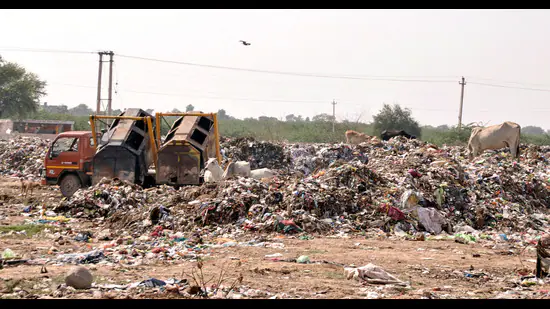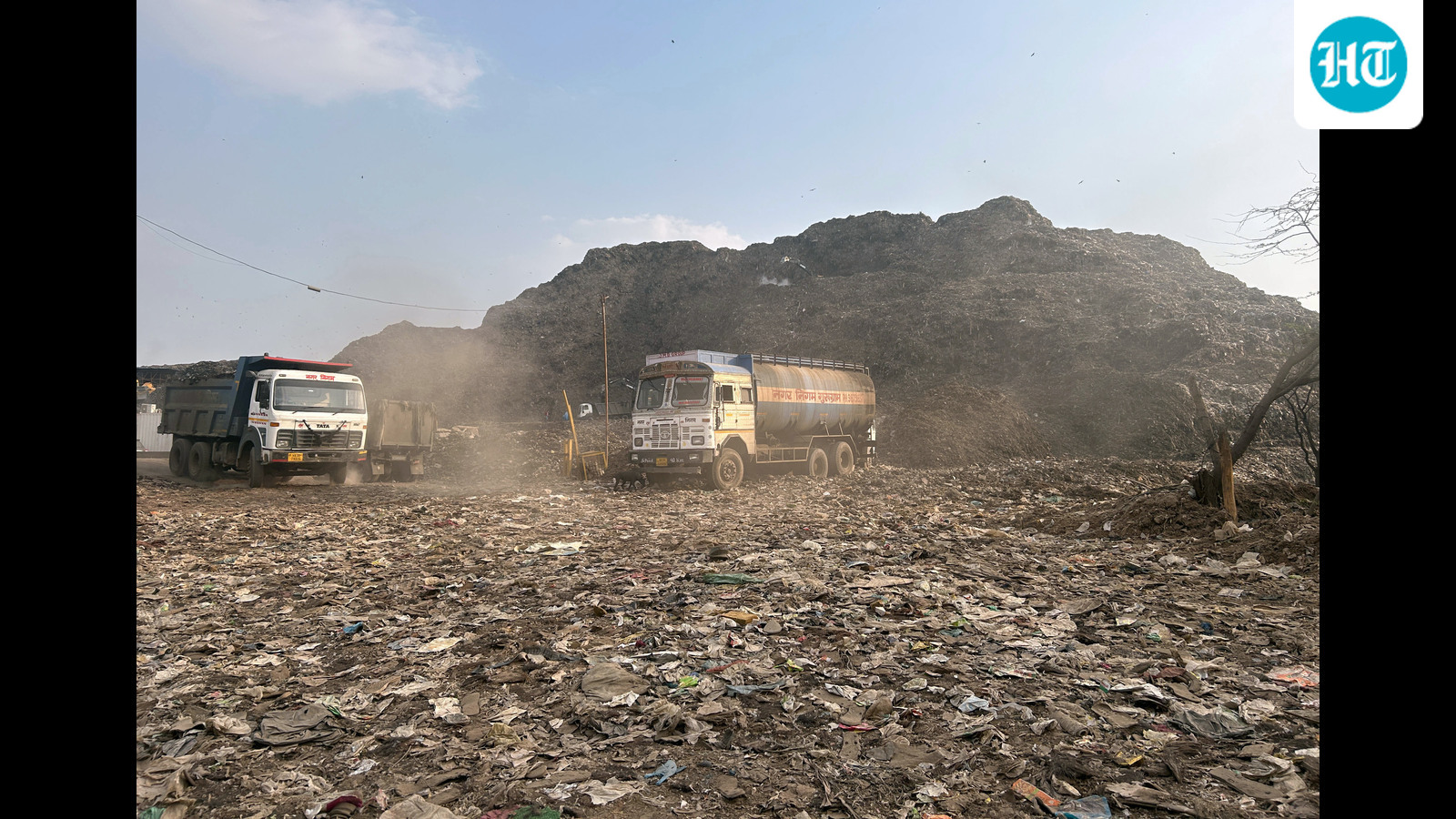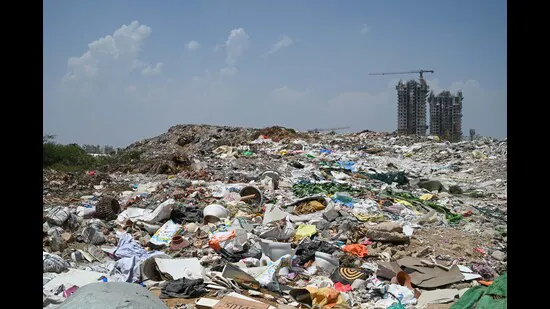
Southern Haryana districts, especially Gurugram, Faridabad, Rewari, and Nuh, among others, generated the highest amount of unprocessed waste in the state between July and December last year, according to a report submitted before the National Green Tribunal (NGT) on Thursday.The report said legacy waste at the landfill increased to 1.38 million tonnes between July and December last year. (Parveen Kumar/HT)Ahead of NGT’s review hearing before its principal bench on Friday, the fifth half-yearly report prepared by the Haryana State Pollution Control Board (HSPCB) found a processing gap of 3,055 tonnes per day (TPD) against the total waste generation of 6,927 TPD during the period.The report said that 2,765.1 TPD of unprocessed waste was concentrated in southern Haryana’s 20 urban local bodies (ULBs) and 289.9 TPD was attributed to 12 other ULBs across the state.Gurugram recorded the biggest gap, processing only 49.67 of 1,787.67 TPD of waste generated. Faridabad reported a gap of 550 of 1,000 TPD, Nuh of 46.2 TPD, and Rewari of 143.84 TPD – both with zero disposals during the six months.Other southern districts with major gaps were Rewari (153.7 TPD), Jhajjar (143.84 TPD), Mahendergarh (90 TPD), and Bhiwani (42.5 TPD). Only Palwal and Charkhi Dadri had no such gaps, according to the report.The state’s ULB department told HT that tenders for waste processing projects have been allotted for Sohna, Tauru, Bawal, Dharuhera, Rewari, Meham and Sampla, while tendering in other municipalities is at advanced stages.The report also highlighted a rise in legacy waste at Bhandwari landfill to 1.38 million tonne from 1.10 million tonne between July and December in 2025.Officials said 1,500 MT of daily waste transported to the landfill will be cleared by February 2027. Waste accumulation continued in Faridabad (1.01 lakh MT), Nuh (18,022 MT), however, it declined substantially in Jhajjar (54,625 MT from 158,836 MT), Rohtak (4,333 MT from 64,787 MT), Charkhi Dadri (11,000 MT to 5,204 MT). It largely remained the same in Rewari (279,052 MT) and Manhendargarh (72,425 MT).The ULB expenditure on door-to-door collection, transportation, processing and road sweeping in waste-accumulating districts rose between 2024 and 2025, with around ₹22 crores in Faridabad, ₹32.41 crores in Jhajjar, ₹33 lakh in Rewari. It declined by almost ₹142 crore in Gurugram and ₹2.73 crore in Nuh. Around 2,067 waste pickup vehicles were deployed in all five districts during the period.The NGT had earlier directed the ULB to set apart ₹1124.64 crore of “non-lapsable” funds for solid waste management; however, the department reiterated its stance of relying on municipal expenditures.“We have adequate financial provisioning to tackle daily waste generated. Therefore, it was felt that the creation of a separate ring-fenced account for the said purpose may not be required at this stage,” it said.The report also emphasised that the legacy waste at 14 dumping sites was disposed of, resulting in the reclamation of 40.7 acres of land. The NGT’s principal bench is likely to hear the issue in the coming weeks after reviewing the report, with the next hearing scheduled for July 1.
Gurugram tops S Hry districts in unprocessed waste generation: HSPCB tells NGT
The HSPCB report found southern Haryana accounted for most of the state’s waste processing gap, with Gurugram recording the highest deficit.
498 words~2 min read