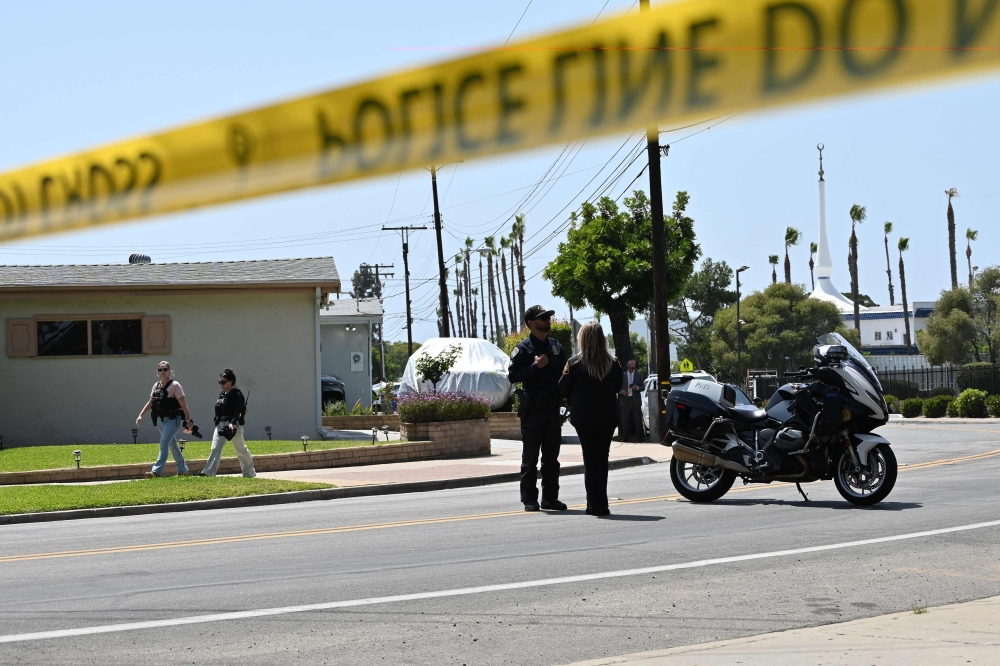
(New users only) It's tax relief season! Get up to RM300 when you save with Versa! Plus, enjoy an additional FREE RM10 when you sign up using code VERSAMM10 with a min. cash-in of RM100 today. T&Cs apply. Saturday, 23 May 2026 8:37 AM MYT MAY 23 — Something is happening with young men. Since 2020, there has been an increase in mass casualty attacks perpetrated by youth, with the majority of attackers being male. Female perpetrators constitute only a minority of cases. These attacks frequently exhibit profound hatred, directed either toward themselves or others, as evidenced by writings discovered at crime scenes or on personal devices. Many attackers demonstrated signs of self-harm or suicidal ideation well before committing these acts. In numerous cases, ideological motivations appear to emerge after the development of personal grievances, rather than preceding them.As we try to understand the recent shooting at the Islamic Centre of San Diego, which resulted in three fatalities, the appropriate diagnosis is essential, particularly as the term “nihilism” has entered regional security discourse in its aftermath. The tendency to assign labels is understandable, as it helps in interpreting such tragedies. There is no doubt this was a hate crime. However, mislabelling can have significant consequences. The increasing application of the term nihilistic violent extremism warrants careful appraisal to avoid reducing it to imprecise buzzwords like “self-radicalisation”, “salad bar extremism”, and “lone wolf”. Law enforcement and emergency services respond to a shooting at the Islamic Centre of San Diego (ICSD) in San Diego May 18, 2026. — Getty Images/AFP pic Understanding how researchers have defined these categories helps explain why. The term True Crime Communities, or TCC, gained prominence following the SMAN72 school attack in Jakarta, after Densus 88 determined that the 17-year-old perpetrator was influenced by exposure to the macabre subculture of TCC, which can best be understood as a fandom organised around mass killers. TCC is often associated with participatory memetic violent extremism (PMVE) and misanthropic and nihilistic violent extremism (M/NVE). However, these terms are not synonymous and should not be used interchangeably. While there are overlaps between themes and characteristics, conflating these categories risks undermining analytical clarity.Put simply, PMVE is characterised by the participatory and performative nature of the attack, including intent, mimicry, and aesthetics. In contrast, M/NVE is defined by ideology, which may be misanthropic, nihilistic, or a combination of both, with the aim of expediting societal breakdown through destabilisation. These categories may overlap, but they are not the same. Both, however, can be situated within a broader analytical framework designed to explain the transmission of violent sentiments from digital environments to kinetic actions.The San Diego mosque shooting does not conform to the NVE framework. Operating as a dyad, the attackers were motivated by Islamophobia and an accelerationist white supremacist ideology, intertwined with incel identity and explicitly modelled on the blueprint established by Brenton Tarrant in the 2019 Christchurch attack. This lineage places the incident outside the scope of TCC and within a far-right philosophical logic, encompassing concepts of belonging, racial hierarchy, demographic anxiety, and perceived civilisational threat. The primary objective that animated the San Diego attack was to facilitate and accelerate societal collapse in order to establish a new order predicated on white dominance. If violence is communication, this was the intended message, and the attack was orchestrated for a specific audience. Interpreting this act as nihilism flattens the distinction and misattributes the underlying motive.Nihilistic perpetrators are primarily driven by a desire for notoriety, often preferring infamy in death over obscurity in life. Accelerationists, in contrast, are grounded in Neo-Nazi beliefs and seek to collapse what they perceive as a fundamentally corrupt society to enable the construction of a post-apocalyptic white utopia. Regardless of how these incidents are categorised, the taxonomic debate should not distract us from the critical puzzle.Young men worldwide are experiencing a crisis, and the shared characteristics are getting harder to ignore. A past attempt by a youth in Singapore to replicate the Christchurch attack shows that performative violence can proliferate, and geographic distance does not guarantee insulation. Before we turn to solutions like banning platforms, blaming video games, blocking content, or expanding surveillance, we should first ask a harder question: what attracts these young men to these online communities, and what do they find there that fuels their grievance?* Munira Mustaffa is the founder and Executive Director of Chasseur Group, a boutique security research and analytical consulting firm based in Kuala Lumpur, where she serves as principal consultant specialising in emerging security threats, and conducts threat assessment and attack attribution. She is a Senior Fellow at Verve Research and a 2023 Visiting Fellow at the International Centre for Counter-Terrorism (ICCT) Hague.** This is the personal opinion of the writer or publication and does not necessarily represent the views of Malay Mail.
Getting the attack diagnosis right — Munira Mustaffa
MAY 23 — Something is happening with young men. Since 2020, there has been an increase in mass casualty attacks perpetrated by youth, with the majority of attackers being...
799 words~4 min read