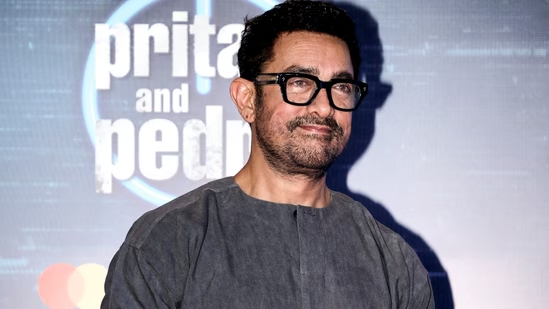
Aamir Khan has opened up about how deeply film failures affect him emotionally, admitting that he goes into a phase of “depression” for months whenever one of his projects does not connect with audiences.Speaking in a recent conversation with Zee Music Company, the actor said he becomes emotionally shattered when a film underperforms because he treats every project like his own child.The remarks come shortly after Ek Din, starring Junaid Khan and Sai Pallavi, struggled commercially despite receiving positive reviews from critics.‘When a film flops, it feels like losing a child’Aamir said audience disappointment hits him hard because filmmaking, for him, is an intensely personal process.“It breaks my heart when a film flops,” he said.“At the end of the day, we make a film for our audience. When they buy a ticket and come to theatres to have a good time, and when they don’t like a film, then there is a flaw in your work.”The actor stressed that audiences never intentionally go to watch a bad film, and if viewers leave disappointed, filmmakers must take responsibility.“I go into depression for two to three months when a film doesn’t work. A film is like your child. When it doesn’t work or gets rejected, it is very painful,” he added.According to Aamir, grieving over failures is necessary before moving forward creatively.“I feel it’s important to mourn your losses. When your film doesn’t work, it is like losing a child, so you should cry over it, give it time, so that it is out of your system and helps you move on.”Aamir recalls struggling with early cuts of his filmsThe actor also spoke about moments during filmmaking when he realised something was not working.“Sometimes on a set you figure out a film is not going to work,” he said, adding that he always tries to judge his films honestly rather than emotionally.“When I see a film’s first cut, I never fool myself; I look at it objectively. If I don’t like it, there is something wrong with it.”Aamir revealed that several of his successful films initially had disappointing early edits before being reworked extensively.He specifically mentioned Delhi Belly, saying its first cut “was not nice at all” and had to be heavily revised before release.He also said films such as Taare Zameen Par, Delhi Belly and Laapataa Ladies went through major editing struggles before reaching their final versions.‘Filmmaking is communication’Aamir explained that he strongly believes in audience testing and honest feedback during post-production.“Filmmaking is communication; if you receive a different message, then I need to change my communication,” he said.The actor shared that test screenings help him understand whether the intended emotions are reaching viewers correctly.“I believe a lot in testing the film, so we call the audience and ask them how they liked the film. Based on their feedback and reaction, we gauge if the film is working.”For Aamir, true success is not just box office numbers but successfully creating the film he originally imagined.“For me, real success is to manage to make what you set out to make,” he added.Ek Din struggles at the box officeAccording to reports cited by The Times of India (TOI), Ek Din failed to generate strong box office numbers despite favourable critical reactions.As per Sacnilk data mentioned in the report, the film reportedly earned around Rs 1 crore on its opening day and collected approximately Rs 4.25 crore in India within 11 days. Its worldwide collection stood at around Rs 5.44 crore.Inputs from TOI
'Feels like losing a child': Aamir Khan shares how film failures feel as Junaid Khan–Sai Pallavi's 'Ek Din' struggles at box office
Aamir Khan revealed that film failures leave him emotionally devastated for months, saying he views every project like his own child. The actor said audience disappointment reflects a flaw in the filmmakers work and stressed the importance of accepting failures honestly. He also spoke about mourning setbacks, relying on genuine audience feedback and using test screenings to better understand whether a film is communicating the intended emotions to viewers.
579 words~3 min read