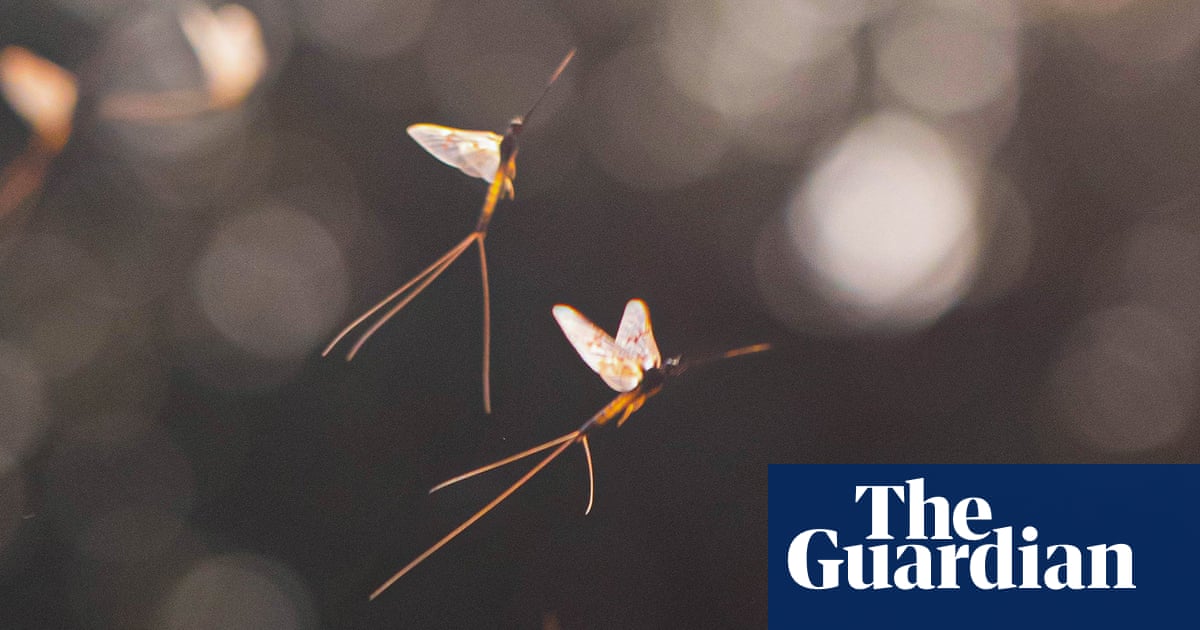
If you don’t fish and you’re not a regular on one of our big western limestone lakes – the likes of Lough Corrib, Mask, Carra, Sheelin and Derg – the excitement around “the mayfly” might seem a bit baffling. Think of it this way: it’s a sunny May evening, and a bunch of kids are happily playing in a playground, when suddenly someone bursts open a huge piñata and sweets rain down everywhere. The place erupts and the kids go into a frenzy, clambering over each other to grab as much as they can before the sweets disappear. That’s more or less what happens to trout during a big mayfly hatch. And if my WhatsApp is anything to go by, the hatch on Lough Corrib this year has been one of the heaviest in decades. For trout, it’s like the sky is raining food. Fish that seemed invisible or languid suddenly become reckless, rising through the water to gorge themselves on these tiny, abundant nuggets of protein. Swallows swoop to feed on them too. Amid the commotion, the trout will often mistake the angler’s imitation mayfly for the real thing. The mayflies clouding over Corrib this month are essentially unchanged for 320 million years. Mayflies are ancient creatures, older than the dinosaurs by about 80 million years. Their explosion every May, sometimes in clouds so thick they can obscure the view across the water, is one of the oldest recurring spectacles in the natural world. The 3,000 or so species worldwide are part of Order Ephemeroptera, from the Greek ephemeros, lasting a day, which is the lifespan of an adult mayfly. For years, they exist underwater as nymphs before emerging above water as mouthless adults with no digestive system whose purpose is to find a mate and reproduce. Within days – sometimes hours – they die. If you sit beside a river or lake one of these evenings and try to watch what the mayfly is doing, you’ll notice it isn’t flying around randomly. It flies straight up, stops flapping, then falls straight back down again, on repeat. Over and over like a tiny yo-yo. This is the male mayfly dance. He’s waiting for a female, and when he finds one, he breaks his vertical movements and shoots out horizontally to mate with her mid-air. The fact is, male mayflies will attempt to mate with virtually anything that passes horizontally above them, whatever the object is, be it a small dark object or another insect. Males are so indiscriminate that they’ll even try to mate with floating debris. So, given there are so many of them, why aren’t the males constantly trying to mate with each other? How do they find the females? And what is it about this particular way that they fly – up and down, not hovering or circling – that leads to success?Scientists from Imperial College London and Oxford have recently discovered the answer: the dance is a kind of password system for males. Using stereo high-speed cameras at up to 1,000 frames per second and 3D reconstruction, they found that males climb and descend in the air at nearly identical speeds, in a movement that is purely vertical. If a mayfly is moving vertically, it’s a male, so ignore him; if it’s moving horizontally, it’s a female, so chase her to mate. There is no central co-ordination here. It works because of hundreds of millions of years of evolution, and every male follows the same simple rule. When one male is at the top of his flight, and the other is at the bottom, they don’t see each other as a mating target because they are moving vertically, not horizontally, and they pass through their field of vision as a kind of vertical blur – the trigger never fires. When males are flying downwards, they don’t pursue anything below them. Mayfly adults don’t feed, so they have a very limited amount of energy to live off before they die. The male flight is energetically expensive; the downward drift, like floating with a parachute, saves energy.The moment a female arrives, flying horizontally across the swarm, she triggers it. Every male below her sees exactly what he has been waiting for: a female with whom he can mate. The minute he spots her, his flight path follows what aerospace engineers call “proportional navigation”, which is the same mathematical law used in heat-seeking missiles. He doesn’t fly to where she is at that exact moment; rather, he flies towards where she will be, changing his speed, using his hind wings to slow down before turning at the exact point where she will be. In Ireland, we have about 150 species of mayflies, the most spectacular one being the Green Drake, a large, pale-winged fly. They need what all our other native aquatic species need: cool, clean, well-oxygenated water and silt-free lake and river beds free from nutrient pollution, which suffocates the nymphs. On too many of our lakes and rivers, mayflies are disappearing. A heavy mayfly hatch isn’t just good news for anglers; it’s one of the clearest signs a lake or river is still alive in the old way, and the water is good.
Ireland’s mayflies are ancient creatures - older than dinosaurs by 80 million years
Ella McSweeney: In Ireland, we have about 150 species of mayflies
867 words~4 min read