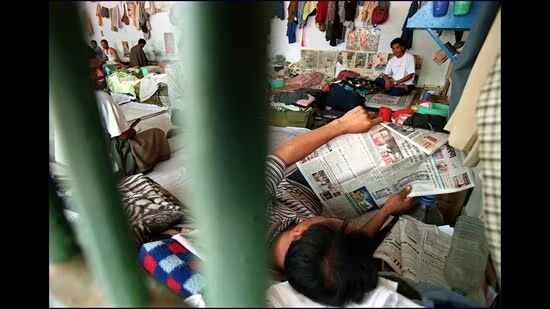
To write a prison diary is an act of defiance in its own right. In Unsilenced: The Jail Diary of an Activist, Seema Azad transforms confinement into record, and record into resistance. A prison cell is meant to shrink the world, to reduce a life to an accusation, a body to a number. A diary does the opposite. It insists on detail. It preserves voices. It refuses erasure. Azad’s memoir carries this insistence on every page, from her persistent demand for a newspaper inside jail, to her reading aloud of fellow inmates’ letters, often love letters, turning private longing into shared warmth within the barracks.Textured journeysWhat distinguishes Unsilenced from the growing corpus of prison writing is not only what it documents, but how. Azad writes with wit, candour and an almost laser-sharp clarity. Social prejudice does not dissolve at the prison gate; caste sentiment, religious practice, superstition and economic deprivation walk in with the women who carry them. Yet her pen refuses grimness as the only register available. She renders the lives of undertrial and convicted women not as drab institutional footnotes but as textured journeys into their minds and hearts. So much so that, standing before a packed audience at the Press Club of India, she could declare, with infectious insurgent laughter, that prison is a livable place. The laughter does not trivialise confinement. It unsettles it. It is this same tone that she carries throughout the book. In troubled times such as ours, Unsilenced offers a rare record of incarceration that is at once sharp, humane, and hopeful.Azad’s most startling achievement lies in the intimacy with which she renders the women’s barracks. “There is an incredible flow of life inside those walls,” she observes – an insistence that unsettles every monochrome image we carry of prison. The details are tender and almost domestic, with women picking lice from each other’s hair, shaping eyebrows with improvised precision, staining palms with henna, assembling make-up from what little is available. Grooming becomes a ritual. It is care, leisure, and companionship braided together. In these gestures, the body, so relentlessly regulated by the institution, reclaims selfhood. Azad notes, with quiet irony, that many of these women would never have had the time or energy for such acts outside. As wives and daughters-in-law, their days were consumed by unending household labour. Inside prison, where movement is restricted and surveillance constant, a different kind of time opens up. The routines of grooming and conversation amid sunbathing are not trivial; they are pauses in lives otherwise defined by the never-ending drudgery of unpaid care labour disguised as duty and love.The paradox deepens. While prison restricts physical freedom of movement, it unexpectedly expands the worldviews of women. The intricacies of legal cases draw these women into conversations about law, state, and rights. It rehumanises them in a way. Court visits become windows outward. Words once distant enter their vocabulary. The world, in fragments, comes closer to them. Azad suggests that in the very space meant to discipline them, women begin to recognise themselves beyond family roles, beyond the immediate shadow of male authority. Jail does not erase patriarchy; it is shaped by it. But it also creates intervals where individuality finds gaps to surface. There is, in this, a stinging commentary on the society outside. That women might find a measure of intellectual or personal expansion within prison walls is less an indictment of the jail than of the homes they came from. Unsilenced does not romanticise confinement. It simply reveals a disquieting truth: that when domestic life offers so little room for selfhood, even the narrow corridors of a prison can feel unexpectedly wide for women.Troubling stillnessAnd yet, alongside this vitality, Azad registers something far more unsettling. She is deeply pained by what she reads as a lack of self-respect among many of the women, an internalised resignation that she understands as patriarchy’s most enduring imprint. The women do not even flinch at the casual humiliation by constables, the shouted insults, the routine indignities. Their stillness troubled Azad more than the abuse itself. It prompts a piercing question: how long will it take for democracy to seep into the intimate fabric of our society, into homes and habits, into the way women perceive themselves?For prison, in a strange inversion, removes certain violences even as it imposes others. Within its high walls, many women no longer endure the mental and physical abuse inflicted by husbands or in-laws. Certain patriarchal rituals fall away. There are evenings when they sing and dance, crossing the carefully policed boundaries of “decency” that once governed their movements. Youthful discontent surfaces without apology. Once, a woman confides that prison is not bad at all, if only the food were more appetising. The remark is half jest, half indictment. What emerges is a bitter truth: that the very expansiveness of women’s lives inside prison only confirms how constricted they were outside it. That confinement can feel like a reprieve speaks less of the benevolence of jail than of the suffocating architecture of gender beyond its gates.Azad also gathers a fund of anecdotes that reveal prison not only as an institution of discipline, but as a complex social terrain. Romances spark during mulaqats, those tightly monitored meetings with the outside world. Court appearances become, unexpectedly, occasions of quiet display. Women dress carefully, colour their hair, shape their eyebrows, preparing for the brief visibility that comes with being produced before a judge. In a place designed to strip individuality, these acts of preparation are small assertions of presence.Azad also notes how love inside prison is rarely the indulgence of passion. It is often practical, even painful. Women whose families never visit them enter into relationships to ease the sharp edges of incarceration. A lover might send essentials like oil, soap, and a few vegetables to temper the blandness of prison food. Onion, tomato, and green chillies become precious commodities. Survival requires supplementation; the rations provided by the state are not enough to sustain a life with dignity. Those without support from home navigate this scarcity in two ways: by working for wealthier inmates or by seeking attachment. Younger women frequently choose the latter. Through these arrangements, they secure not only small material comforts but also a measure of protection. Since physical contact is forbidden, intimacy remains contained within the constraints of the institution.Azad also notes instances of constables developing attachments to prisoners, complicating the already fraught terrain of authority and vulnerability. What emerges is neither romance nor scandal, but a sobering recognition: for many incarcerated women, love and intimacy become strategies of survival. They soften isolation, redistribute scarce resources, and make the harshness of prison marginally bearable. In tracing these entanglements, Azad does not sensationalise them. She shows, instead, how even behind bars, women craft networks of care and negotiation – imperfect, fragile, but necessary.In the end, Unsilenced: The Jail Diary of an Activist is not simply a record of incarceration. It is an unsettling mirror held up to the society beyond the prison gates. Through wit, tenderness and unsparing observation, Seema Azad reveals that the walls of a jail do not create inequality; they concentrate it. And yet, within those walls, women continue to think, to groom, to sing, to fall in love, to analyse their cases, to expand their vocabularies and their sense of self. That prison can sometimes feel less suffocating than home is a truth that indicts patriarchy more than it redeems confinement. Unsilenced does not offer easy consolation. Instead, it compels us to confront a disquieting reality, that for many women, confinement is not an aberration but a continuum. Unsilenced: The Jail Diary of an Activist, Seema Azad, translated from the Hindi by Shailza Sharma, Speaking Tiger Books.
‘Unsilenced’: In Seema Azad’s memoir, prison is not a monochrome space but complex social terrain
Azad suggests that women begin to recognise themselves beyond family roles in the very place meant to discipline them.
1,297 words~6 min read