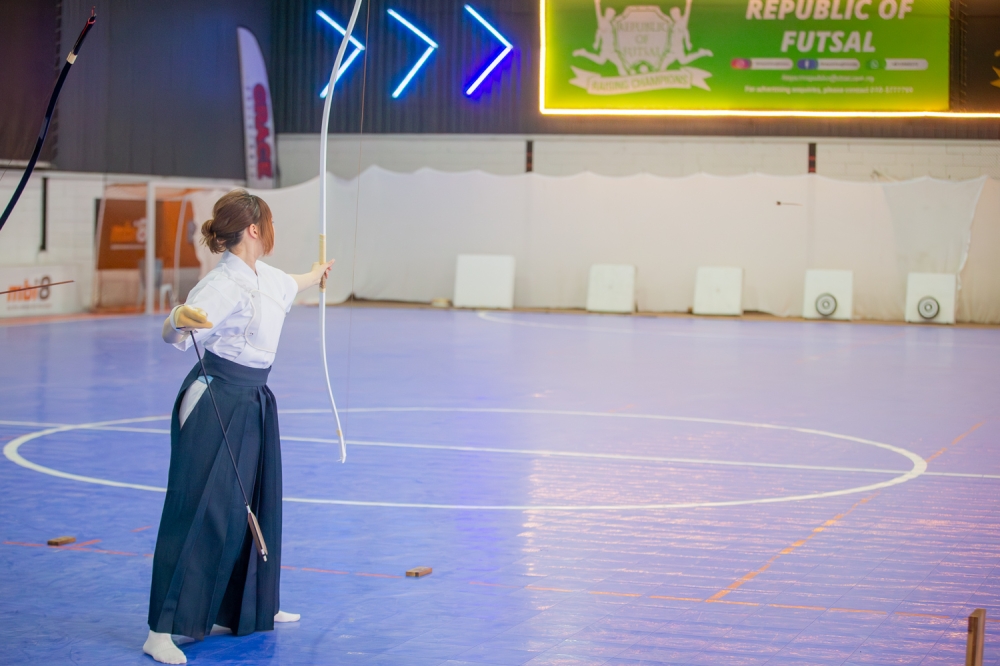
(New users only) It's tax relief season! Get up to RM300 when you save with Versa! Plus, enjoy an additional FREE RM10 when you sign up using code VERSAMM10 with a min. cash-in of RM100 today. T&Cs apply. KUALA LUMPUR, May 23 — Silence descended across a rented sports hall in Petaling Jaya as more than 40 curious visitors gathered to watch members of the Kuala Lumpur Selangor Kyudo Club practice Japan’s ancient martial art of archery.Inside the hall, as heavy rain poured onto the thin zinc roof, causing a huge roar to reverberate through the arena, young Malaysians lined up alongside foreigners from countries including Russia, Syria and Taiwan, all dressed in flowing hakama trousers and white keikogi tops as they prepared for the afternoon’s demonstration.The crowd quietened almost instantly once the ceremony began.Members moved carefully in synchronisation during an opening ceremonial performance before senior practitioner Ng Jim Teng stepped forward for the main showcase, drawing a towering asymmetrical bow in one smooth motion before releasing an arrow that cracked sharply against the target board 28 metres away.The sound echoed across the hall.There were no loud commands, no thumping music and none of the aggression often associated with combat sports.No technical calculations nor complicated equipment. Only the shuffle of feet, the creaking tension of the bowstring and the soft rustle of traditional uniforms breaking the silence. Silence descended across a rented sports hall in Petaling Jaya as more than 40 curious visitors gathered to watch members of the Kuala Lumpur Selangor Kyudo Club practice Japan’s ancient martial art of archery. — Picture by Raymond Manuel For many attending the club’s open day, it was their first encounter with kyudo — literally translated as “the way of the bow” — a traditional Japanese martial art that prioritises discipline, posture, breathing and ritual over simply hitting a target.Even off the shooting line, Ng appeared to embody the quiet restraint the martial art demands.Soft-spoken and impeccably mannered throughout the interview, the 41-year-old repeatedly bowed his head politely while speaking and barely broke character until training ended and he finally removed his shooting attire.Ng said the club first began informally around 2014 with just six or seven enthusiasts practicing under the sun at public fields.“We were just interested people gathering together,” he recalled.“At first, we practiced on football fields every Sunday because we didn’t have a proper place yet. Slowly we started finding indoor spaces because outside was too hot and not very safe.”Ng first discovered kyudo while studying the Japanese language and searching online for traditional martial arts.“I was looking at kendo first because I was interested in Japanese culture and the whole Budo way,” he said.“However kendo felt a bit too aggressive for me. Kyudo felt very different. It was simple — just the bow, the arrow and your body.” Kyudo practitioner Ng Jim Teng, 41, guides a participant on proper hand placement and grip during a hands‑on martial arts demonstration in Petaling Jaya, May 3, 2026. — Picture by Raymond Manuel Unlike modern archery, which relies heavily on sights and stabilisers, kyudo strips the practice down to movement, form and repetition.“There’s nothing fancy,” Ng said.“It’s just your body posture, the way you grip, the way you move and release the arrow. The Japanese developed this through years and years of practice without modern science or equipment.“I found that very interesting because it feels ancient but very refined.”The discipline required extends far beyond shooting.Higher-level examinations are judged not only on accuracy, but synchronisation, posture, timing and ceremonial movements performed alongside other practitioners.“When your dan ranking gets higher, they become very particular,” Ng explained.“Your movements, your posture, your timing with the other people — everything must synchronise perfectly.“It’s not only about hitting the target. The form itself matters.”The club now has around 34 active members and meets every Sunday, with roughly 20 regular practitioners attending weekly sessions.Club president Shereen Dulau said interest in kyudo has steadily grown over recent years, especially among younger Malaysians exposed to Japanese pop culture. Shereen Dulau, club president, speaks during an interview at a traditional Japanese archery demonstration. — Picture by Raymond Manuel For example, the Japanese anime series Tsurune: Kazemai High School Kyudo Club follows a group of high school kyudo practitioners and has developed a following among fans of Japanese culture and martial arts.“A lot of people discover kyudo through anime like Tsurune but after they join, they realise it’s much deeper than anime,” Shereen added.“A lot of members stay because of the mental focus, the calmness and the community itself.”That diversity was evident throughout the hall.Some members arrived through anime fandom. Others came through martial arts, travel, stress relief or simple curiosity.Olivia Chen Ching Wun, 31, first encountered kyudo while studying in Manchester during a stressful final year pursuing a degree in politics, philosophy and economics.Speaking animatedly about anime recommendations — including Tsurune, Frieren, Kimetsu no Yaiba and volleyball series Haikyuu!! — Chen said kyudo eventually became a way to manage overthinking and perfectionism.“I was very stressed during university,” she said.“My sister randomly found kyudo when we were searching for weekend activities and that’s how I started.“What I like is that once you step into kyudo, you just follow the sequence and the form. You don’t have to think too much outside of that.”She said the practice slowly changed the way she approached failure and self-improvement.“I’m a perfectionist by nature but kyudo teaches you that you cannot become perfect immediately. You cannot force it.“You need time, repetition and patience. If you overdo it, you actually spoil your form.”Chen said one of the things that fascinated her most in Britain was seeing elderly practitioners continuing the sport well into their seventies.“You could see their hands trembling sometimes,” she said with a laugh.“Then the moment they entered the stance before shooting, suddenly everything became stable.“That was very beautiful to watch because you realise they are still learning after 10 or 20 years.”For 23-year-old marketing executive Syafiqah Dayana Borhan, the attraction started much earlier through anime and childhood fascination with archery characters. Syafiqah Dayana Borhan, 23, speaks during an interview at a traditional Japanese archery demonstration. — Picture by Raymond Manuel “Ever since I was young, I always liked those characters using bows and arrows,” she said.“Then I watched Tsurune and I thought, ‘Okay, I really want to try this properly.’”What surprised her most, however, was how physically and mentally demanding kyudo turned out to be.“It looks calm when you watch it, but when you actually do it, it’s difficult,” she said.“You need to control your breathing, your posture and your focus at the same time.“Because it’s so structured, it feels almost like meditation.”Russian expatriate Anastasiia Bychkova, 25, offered yet another perspective.A former gymnast who moved to Malaysia with her husband two years ago, Anastasiia said she was initially introduced to kyudo through her husband, who practices kendo and iaido. Participant Anastasiia Bychkova, 25, at the traditional Japanese archery demonstration in Petaling Jaya. — Picture by Raymond Manuel “For me, kendo looked too aggressive compared to kyudo, this felt peaceful.”Fresh off her first session with the club, Bychkova described the experience as unlike any other sport she had tried before.“I do a lot of sports — gymnastics, volleyball, football — but this one feels very unusual,” she said.“When you stand there, you only concentrate on the bow, the arrow and yourself.“It becomes very quiet in your mind.”Not everyone who arrived at the club came through anime or Japanese pop culture.For Kok Jun Sern, 44, kyudo offered a slower and more sustainable alternative after years of sports injuries and back problems.The first-time participant, who had spent nearly a year observing the club online before finally attending a session, said the martial art immediately appealed to him because of its calmness and discipline. Kok Jun Sern speaks during an interview at a traditional Japanese archery demonstration. — Picture by Raymond Manuel “I used to play all kinds of sports, only after my spinal injury and slipped disc problems, high-impact activities became difficult.“With kyudo, there’s no heavy impact on the body. You mainly work on posture, upper body strength and focus.”Kok said he had always been fascinated by bows and arrows since childhood, recalling how he used to fashion makeshift toy weapons using rubber bands and bits of wood.“I always liked aiming and shooting things,” he said with a laugh.“However what attracted me here wasn’t just the archery part.“This feels more like a way of life rather than a competitive sport.”He said one of the club’s biggest attractions was its unusually close-knit community despite members coming from vastly different backgrounds.“You have people from different walks of life here,” he said.“You can be a CEO, a student or working adult outside, but once you step into the dojo, everybody is just here because they love the art.“There’s something very peaceful about that.”Despite the serenity associated with the martial art, kyudo is not necessarily cheap.A complete setup involving the bow, arrows, traditional uniform and glove can easily cost more than RM3,000, while handcrafted bamboo bows from Japan can stretch well beyond RM10,000 with waiting periods lasting years. Traditional Japanese archery equipment, including asymmetric ‘yumi’ (bows) and feathered ‘ya’ (arrows), laid out before a kyudo martial arts demonstration. — Picture by Raymond Manuel Still, Ng stressed that newcomers should not feel intimidated by the cost.“The club already has beginner equipment people can borrow first,” he said.“You don’t need to rush and buy everything immediately.”Of all the equipment, however, Ng said the most important item was the glove used to draw the bowstring — traditionally made from deerskin.“The glove is very personal,” he explained while carefully holding up his own well-worn pair.“It slowly shapes itself to your hand and your shooting style over time.“You cannot simply use somebody else’s glove comfortably because every person’s grip and draw is different.”Some practitioners even custom-order gloves from Japan using exact hand measurements. Spectators and fellow practitioners watch attentively as an archer prepares to shoot during a kyudo martial arts demonstration in Petaling Jaya. — Picture by Raymond Manuel As the afternoon wound down, members packed away targets and bows while newcomers lingered nearby, quietly discussing the experience they had just witnessed.So if you’ve ever wanted to try something new, step into a warm futsal hall in the Klang Valley, and for a few quiet hours, let modern-day life yield to the measured rhythm of an ancient Japanese bow.
Arrows whisper through Klang Valley futsal hall as Malaysians embrace Japan’s ancient kyudo
KUALA LUMPUR, May 23 — Silence descended across a rented sports hall in Petaling Jaya as more than 40 curious visitors gathered to watch members of the Kuala Lumpur Selangor...
1,731 words~8 min read