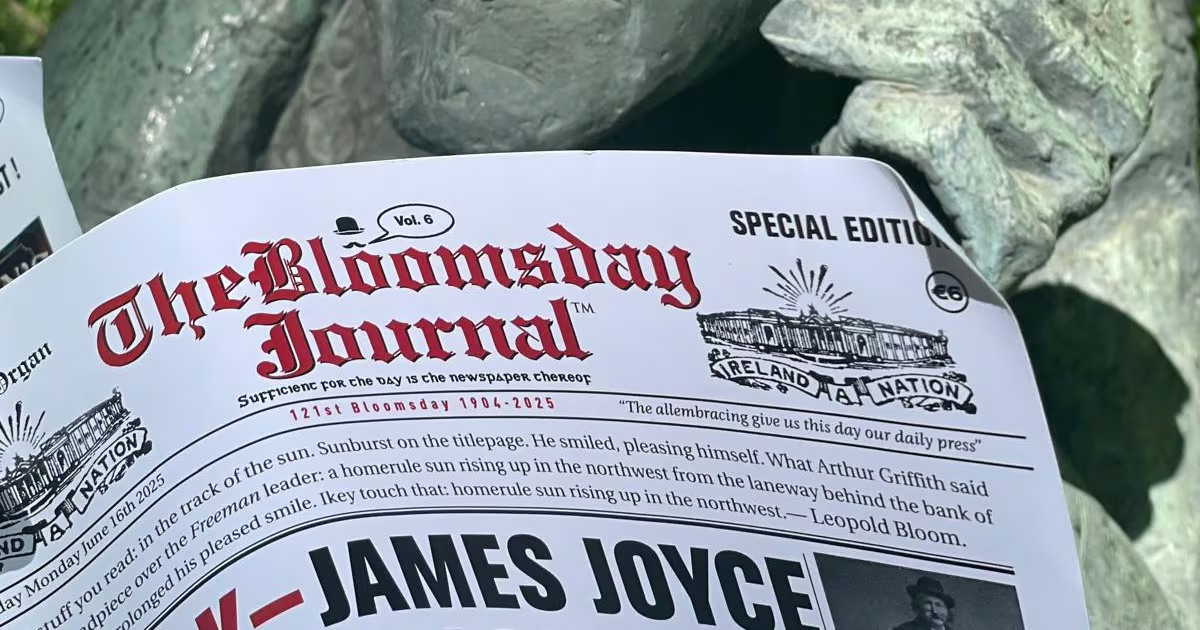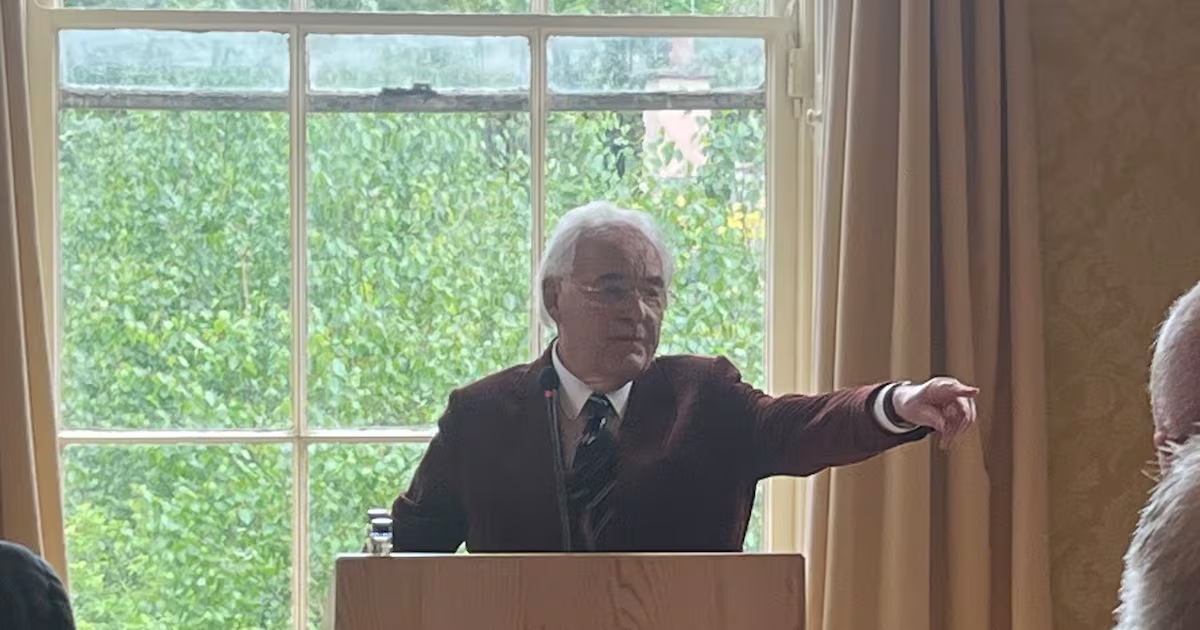
Dublin was this week hosting an event called New Perspectives on Irish English, a biennial conference first held in UCD in 2010 and since then hosted by various countries including Norway, Spain and Austria. It’s like a smaller version of the Joycean Olympics (officially the James Joyce Symposium), the torch for which left Glasgow two years ago and will arrive in Krakow next month for the latest gathering of some of the world’s leading intellectual athletes. The ninth instalment of the Irish English conference brought a select group of linguists to Dublin’s Marino Institute to discuss such topics as “G’way you gomie: Subversive humour, taboo language and the humorous deployment of Limerick-English”.The question of “What makes Cork English sound so Cork?” was also debated. And speaking of “so”, there was a paper devoted to the many uses in Irish-English of that indispensable little word, used both at the start and end of sentences, as well as in between. I now realise there is also the “Seamus Heaney so”, an Ulster variant in which the word constitutes a full sentence, uttered in agreement with whatever a previous speaker has said.Somewhat mysteriously, I had been invited to take part in an eve-of-conference workshop on “Irish-English in the real world”. Convener Karen Corrigan, professor of linguistics in Newcastle University, had noticed my ongoing interest in the curious ways Irish people speak, and thought I could contribute.The word “panel” featured somewhere in her emails. But the key thing I took from them was that, despite it being a “workshop”, there was no work involved, or at least preparation.So I turned up and, not knowing anyone, sat at the back of the room with the rest of the audience, awaiting enlightenment. Then, at the front, Prof Corrigan began to introduce a group of nine or 10 experts, mostly academics, who had taken their seats alongside her. It was while scanning their names on the big screen that I realised someone called “Frank McNally” was supposed to be among them. Which, now I noticed it, explained the empty chair.[ All Well and Good – Frank McNally on the holy (and unholy) waters of KilmainhamOpens in new window ]Somewhat to the amusement of the audience, I left my seat at the back and, sheepishly interrupting the professor, said: “I just realised I’m on the panel.” Poor Karen had to reassure everyone: “I did invite him.” Which was true (or as Heaney would say: “So.”) I just need to read my emails more carefully.***It wasn’t quite like the scene in The Third Man, where the bumbling Holly Martins, writer of cowboy novels, finds himself bundled into a car and driven at speed through the dark streets of wartime Vienna, thinking he’s about to be murdered by gangsters.This turns out to be a comic twist on the well-known fear of public speaking, which for some is said to rival that of death. Because Martins is not being kidnapped. He’s being driven to the local literature appreciation society, for a talk he’s forgotten agreeing to give about James Joyce: a subject on which he knows nothing.The film then cuts to later in the evening, where it’s clear that Martins is dying on stage and in the process boring his audience to death too.Happily, all I had to do in Marino was briefly explain my interest in Irish-English, then join a conversation on the subject. Once started, I found, the biggest challenge was to shut up.***With Bloomsday and the Joycean Olympics still a month away, there was a warm-up event at the Museum of Literature Ireland (MoLI) on Thursday. But really, for the protagonists, the launch of James Joyce – A Life in Books: the Desmond J Green Collection, was an end in itself.Green is an Athlone-born engineer and businessman who, quietly over decades, assembled the world’s greatest collection of Joyce manuscripts, publications, correspondence and photographs, now on loan to MoLI. For many years – as the book’s author, Joycean academic Luca Crispi, told the audience – the inevitable but mysterious buyer of big-ticket items at Joyce auctions was referred to only as “the Irishman”. More recently, Green sought Crispi’s advice in filling in the “lacunae” of his collection which, now lacuna-free, ranges from all first editions of Ulysses to such ephemera as the programme for an 1898 school musical in which a teenage Joyce performed.In an introduction to the story of his collection, Green describes how he first found “my tribe” when joining UCD’s Literary & Historical Society in the late 1950s. That’s when he caught the Joyce bug too, and a milder dose of the related condition, Flannorakism. He recalls a rowdy meeting in 1960s UCD at which “Brian O’Nuailláin, aka Flann O’Brien, joining late and unsteadily, gave a riotous ten-minute dissertation arguing that he had written Ulysses, not Joyce”. That claim is somewhat disputed by scholars. O’Brien does, however, get a cameo in the Green collection, via his official debut novel At Swim-Two-Birds and a 1940 letter from Joyce referring to the positive reception in Paris for the “livre de M[onsieur] O’Brien.”
Surprise(d) guest: Frank McNally on the mysteries of Irish-English and the story behind the world’s greatest collection of Joyceana
Invited to join a conversation on Irish-English, I found my biggest challenge was to shut up
844 words~4 min read