CHICAGO -- Patients with advanced prostate cancer treated with enzalutamide (Xtandi) had a significantly greater decline in cognitive function compared with those who received darolutamide (Nubeqa), according to results from a phase II trial.
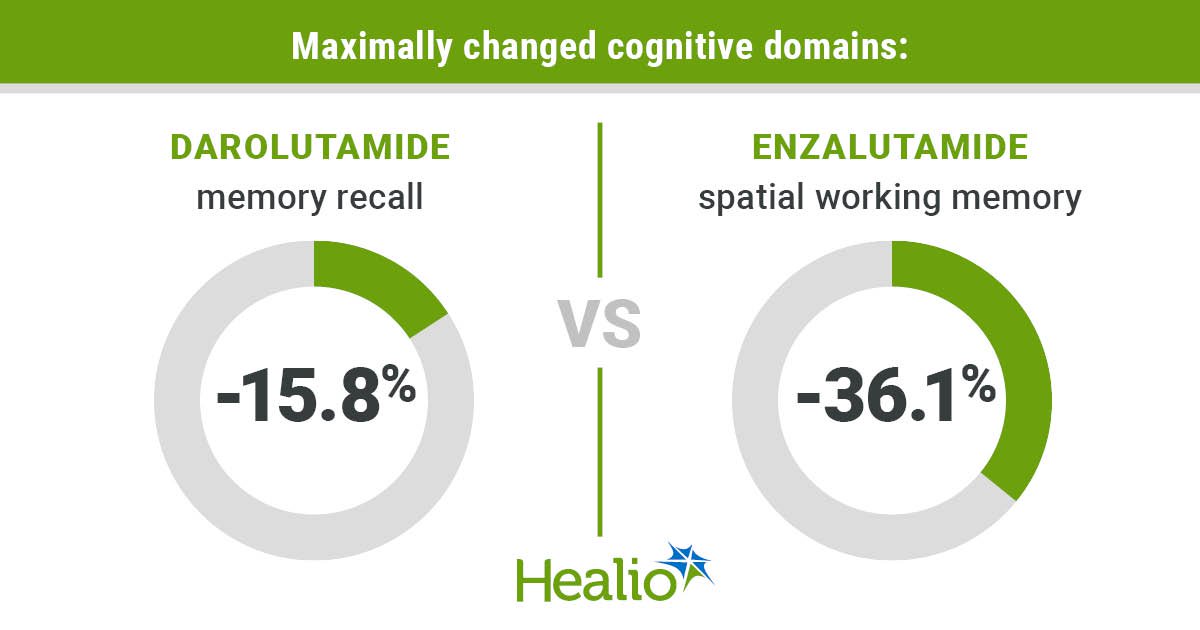
Median cognitive change in the maximally changed cognitive domain (MCCD) from baseline to 24 weeks was -15.8% for those receiving darolutamide versus -36.1% for those receiving enzalutamide (P=0.009), reported Alicia Morgans, MD, MPH, of the Dana-Farber Cancer Institute and Harvard Medical School in Boston.
The primary endpoint was assessed using the Cambridge Neuropsychological Test Automated Battery (CANTAB), which includes tests for executive function, visual memory, attention, and working memory.
"I think that this is informative of practice, but it doesn't draw a black line here and say none of this drug and only that drug," Morgans said during a press briefing in advance of the American Society of Clinical Oncology (ASCO) annual meeting. "I think that's a very important take-home message. There's also the take-home message that none of these patients -- actually no one on trial, even at 48 weeks follow-up -- has been diagnosed with dementia. These are cognitive changes on a cognitive test that is not diagnostic of any true clinical disorder."