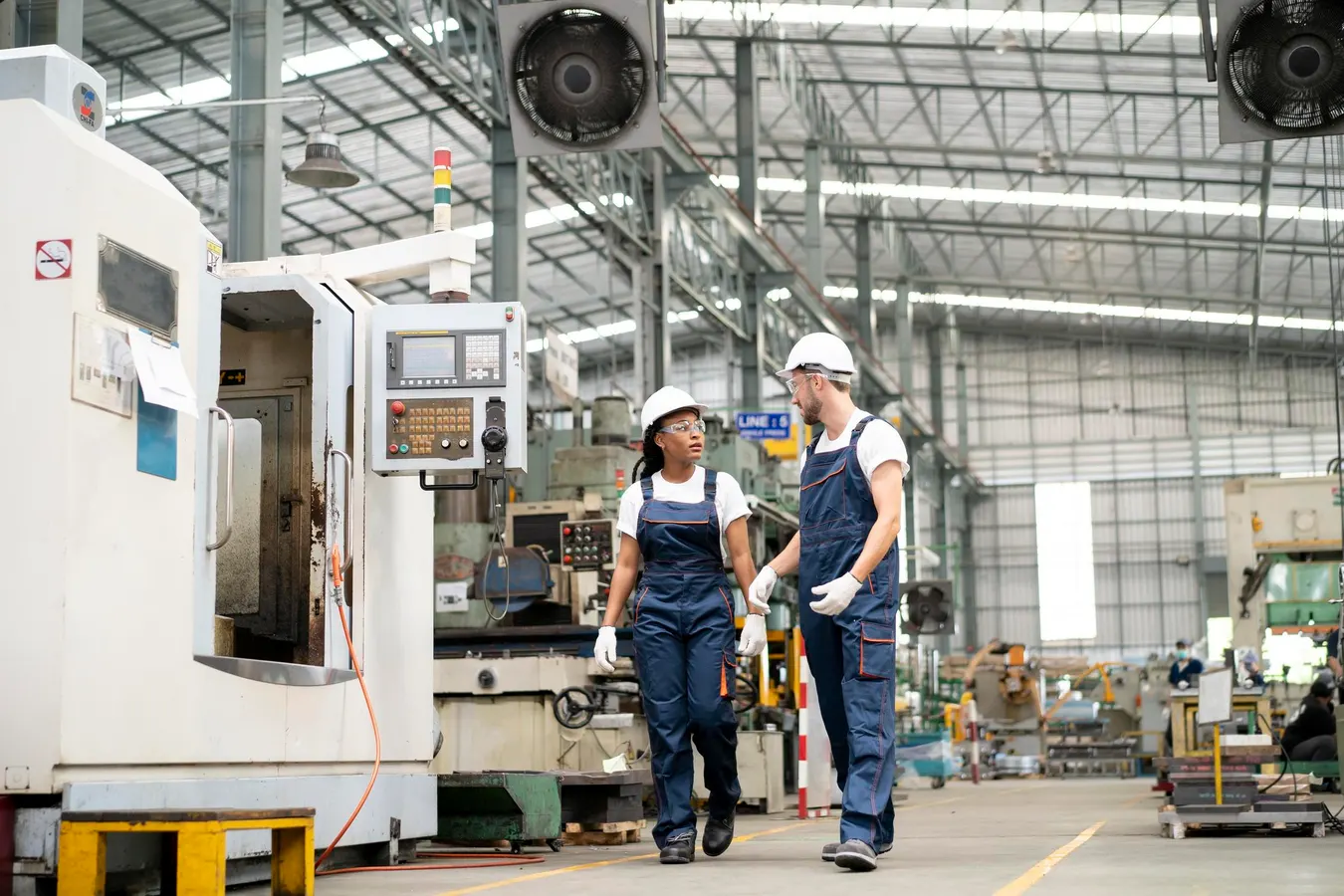
BEIJING, May 22 (Xinhua) -- China's manufacturing sector is embracing a sweeping digital transformation, with intelligent manufacturing emerging as a core engine to reshape the country's industrial future. Powered by artificial intelligence, 5G, and big data, "Made in China" is rapidly evolving into "Intelligently Made in China," driving factories toward unprecedented levels of efficiency, flexibility, and innovation.China has built over 35,000 basic-level, more than 8,200 advanced-level, over 500 excellence-level and 15 flagship smart factories nationwide by the end of 2025, and has become the world's largest intelligent manufacturing application base, according to the Ministry of Industry and Information Technology (MIIT). Yet the more revealing story lies not in the headline numbers, but in the changes unfolding on the factory floor. Across the nation, smart factories are becoming the new norm.An employee works on the production line in a smart factory of Noblelift, a manufacturer and service provider of material handling equipment and logistics solutions, in Changxing County of Huzhou City, east China's Zhejiang Province, March 16, 2026. (Photo by Tan Yunfeng/Xinhua)Intelligent manufacturing equipment operate at a coil factory of Harbin Electric Machinery Company Limited in Harbin, northeast China's Heilongjiang Province, Feb. 26, 2026. (Xinhua/Wang Song)An employee works on the production line at an automated workshop of Inovance Group in Jiangning District of Nanjing, east China's Jiangsu Province, March 17, 2026. (Xinhua/ Li Bo)This photo taken on Jan. 21, 2026 shows an automated production line of a water purification smart factory of Haier in Qingdao, east China's Shandong Province. (Xinhua/Li Ziheng)A staff member introduces a production equipment condition management model at a factory of Hisense Visual Technology in Qingdao, east China's Shandong Province, Jan. 13, 2026. Hisense Visual Technology has developed an AI-based large model that can generate comprehensive process plans. Combined with application of industrial robots, this advancement has enhanced production efficiency and quality. (Xinhua/Li Ziheng)Comprising Shanghai and the provinces of Jiangsu, Zhejiang and Anhui, the Yangtze River Delta is one of China's intelligent manufacturing powerhouses, with the robotic industry emerging as a pivotal driver. Leveraging the advantages of industrial clusters, the region's robotic sector has seen robust growth. Cities across the region are accelerating innovation in robotic technologies and their practical applications, continuously enhancing the core competitiveness of the industry.A technician debugs a humanoid robot for industrial applications at Ningbo Puzhi Future Robotics Co., Ltd. in Ningbo, east China's Zhejiang Province, March 24, 2026. (Xinhua/Huang Zongzhi)The humanoid robot "Bolt" is pictured at the Humanoid Robert Innovation Research Institute of Hangzhou Global Scientific and Technological Innovation Center in Zhejiang University, east China's Zhejiang Province, March 9, 2026. (Xinhua)An AGV (Automated Guided Vehicle) transports a robot in a workshop of Inovance Group in Jiangning District of Nanjing, east China's Jiangsu Province, on March 17, 2026. (Xinhua/Ji Chunpeng)In other regions of China, smart manufacturing is also gaining momentum. Driven by national top-level strategies and supported by local governments, enterprises across the country are actively exploring new pathways to break down industrial barriers and reshape the manufacturing landscape.The 1 millionth AITO new energy vehicle rolls off a production line at Seres Group's super factory in Liangjiang New Area, southwest China's Chongqing, Jan. 13, 2026. (Photo by Wang Jiaxi/Xinhua)Industrial robots carry out welding operations at a workshop of a new energy technology company in Chifeng City, north China's Inner Mongolia Autonomous Region, May 19, 2026. (Xinhua/Bei He)A trainer supervises the training of a humanoid robot in an industrial patrol scenario at a public training center for embodied AI in Qingdao, east China's Shandong Province, April 22, 2026. (Xinhua/Li Ziheng)In Beijing's Yizhuang District, Xiaomi's super factory is able to produce a new energy vehicle every 76 seconds, with self-developed AI quality inspection replacing manual inspection and achieving dozens of times higher efficiency.Robots work at Xiaomi's super factory in Beijing, capital of China, March 17, 2026. (Xiaomi/Handout via Xinhua)Robots work at Xiaomi's super factory in Beijing, capital of China, March 17, 2026. (Xiaomi/Handout via Xinhua)China's home appliance giant Haier's Washing Machine Interconnected Factory, located in the West Coast New Area of Qingdao, is a full-scenario 5.5G demonstration lighthouse factory. Leveraging 130 advanced technologies, including 5.5G, advanced algorithms, and lightweight digital twins, the factory has further optimized its products and services.A production line is seen at the Haier Qingdao Washing Machine Interconnected Factory in Qingdao, east China's Shandong Province, May 12, 2026. (Xinhua/Li Ziheng)A production line is seen at the Haier Qingdao Washing Machine Interconnected Factory in Qingdao, east China's Shandong Province, May 12, 2026. (Xinhua/Li Ziheng)Apart from these leading sectors, the future factory is also taking shape in traditional industries across the country. From smart factories to intelligence-powered production lines, traditional manufacturers are driving a robust industrial revival through sweeping digital transformation.China unveiled a set of guidelines on deeply implementing the AI Plus initiative in August 2025, proposing to promote the intelligent transformation of all factors of production across industries, and helping to upgrade and transform traditional sectors.Staff members monitor the production condition at a chemical plant of China National Offshore Oil Corporation in Tianjin, north China, April 15, 2026. (Xinhua/Zhao Zishuo)A staff member inspects the operation of automated production equipment at the resin workshop of a coating company in Tianjin, north China, April 15, 2026. (Xinhua/Zhao Zishuo)This photo taken on March 25, 2026 shows a view of an intelligent workshop at Jiangsu Yueda Textile Group Co., Ltd. in Yancheng City, east China's Jiangsu Province. (Xinhua/Li Bo)In central China's Changsha, Sany's intelligent heavy truck industrial park produces a new energy heavy truck every six minutes. Over a hundred welding robots operate with high precision, while more than 700 automated guided vehicles (AGVs) shuttle efficiently around the workshop. Welding robots weld a heavy truck cab at an industrial park of Sany, China's leading heavy equipment manufacturer, in Changsha, central China's Hunan Province, May 12, 2026. (Xinhua/Xue Yuge)Industrial robots are pictured at an industrial park of Sany, China's leading heavy equipment manufacturer, in Changsha, central China's Hunan Province, May 12, 2026. (Xinhua/Xue Yuge)Meanwhile, in the northeastern region, Harbin Electric Machinery Company Limited, a key state-owned enterprise in the core equipment manufacturing sector, has actively promoted digital production and intelligent equipment. In the first quarter of this year, its industrial output value increased by 7.38 percent year on year, while product output rose by 39.28 percent. An AGV (Automated Guided Vehicle) is pictured at a digital workshop of Harbin Electric Machinery Company Limited in Harbin, northeast China's Heilongjiang Province, March 11, 2026. (Xinhua/Wang Song)A technician maintains computing power equipment at Harbin Electric Machinery Company Limited in Harbin, northeast China's Heilongjiang Province, March 11, 2026. (Xinhua/Wang Song)Intelligent manufacturing is more than a technological overhaul. It signifies China's strategic move toward high-quality growth. By fostering a new generation of skilled engineers and data-driven ecosystems, China is positioning itself at the forefront of global industrial innovation. As these future factories multiply, they are set to reinforce China's role as a stabilizer and trailblazer in the world's manufacturing landscape.■
Online Gallery | Intelligent Manufacturing Unlocks Future Factories
Online Gallery | Intelligent Manufacturing Unlocks Future Factories-
1,146 words~5 min read