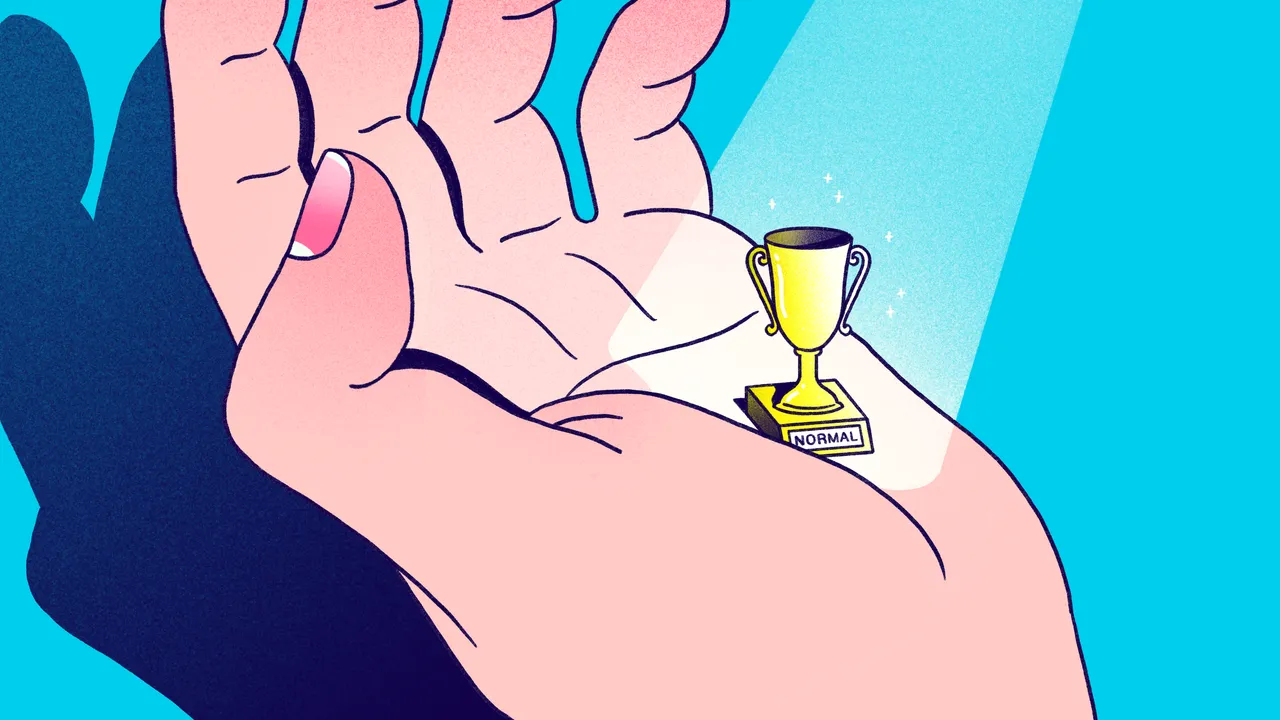
It’s what most of us are, most of the time. Shouldn’t it be enough?May 22, 2026Illustration by Josie NortonMy son’s Little League season started not long ago. A few games in, a sign appeared, mounted to a chain-link fence at the ballpark. Under the heading “Please Remember,” it offered a five-point list:These are KIDS.This is a GAME.Coaches are VOLUNTEERS.Umpires are HUMAN.No scholarships will be handed out today.The sign concluded, “Thank you”—without, I noticed, a chipper exclamation point. Grownups at the games I’d attended had been uniformly decorous, but youth sports, as everyone knows, can be out of control—expensive, time-consuming, and marred by parental derangement. I could guess why the league had put up the sign.The heavy vibes of Little League have many causes. They’re often rooted, though, in a single question: How serious are youth sports supposed to be? Professional athletes have to pursue excellence; they’re paid to take sports seriously. But kids aren’t professionals—many aren’t even amateurs, since they play not for love of the game but because their parents sign them up. On my son’s team, ambitious young athletes determined to excel share the dugout with reluctant participants and kids who just want to throw a ball around with their friends. For every player who breaks down crying when he strikes out, there’s someone who has fun no matter what. Recently, after a bad defeat, my happy-go-lucky son, Peter, ambled over to another player, who was stone-faced with frustration and shame. “What’s wrong?” Peter asked. “We lost!” the other boy exclaimed, his voice ragged. Peter looked at me, surprised, and said, “We did?”What’s true for Little League holds for the rest of life. In some contexts, at some times, we strive for excellence, pushing ourselves. Elsewhere, we shrug, accepting our own ordinariness or mediocrity. The excellent and the ordinary coexist, but have an uneasy relationship. With phrases like “you win some, you lose some,” we acknowledge how, on an ordinary day, in an ordinary life, events cluster around a medium level of quality; in theory, we could be happy in the range between not-so-bad and pretty-good. Yet, for many people, it becomes difficult to find satisfaction in what’s regular. The excellent starts to shame the ordinary, leaving it worse off. We want to play winning seasons, not average ones. Having dunked once, we’d like to keep doing it. We’d prefer “great” weekends and vacations. On the largest scales, we oscillate between wanting to lead extraordinary lives and embracing the “merely” ordinary.Society as a whole is shaped by the relentless pursuit of excellence in every domain. Cars and houses get bigger and bigger. Grades inflate forever. Kids join travel teams, spending hours driving to competitions with other mini-athletes, and parents become super-parents, spending more hours with their children than in previous generations. “There’s a lot of talk in society of ‘That’s amazing! That’s genius!’ ” the comedian Maria Bamford says. As a result, there’s no room left for “a two-star experience.” Against the backdrop of constant progress, ordinariness feels like backsliding. Recently, for fun, I made an album of drifty music, based on recordings of my mother-in-law’s harp. It’s decent—which means that, when I listen to it, I can’t enjoy it. I think only of what I might improve.Without improvement, we get nowhere; without excellence, we wallow. And yet many of us might be trapped in loops of what the philosopher Avram Alpert calls “greatness thinking.” An obsession with being great begins “as a meaningful response to the fact that life is imperfect,” Alpert writes. But it easily spirals out of control, for the obvious reason that, simply as a matter of statistics, the extraordinary is rare. Veering between striving and settling, a person caught in the greatness trap struggles to admire the best without making everything else seem worse.“Why does everything have to be so good?” Bamford asks. One answer is that philosophers have spent millennia arguing on behalf of excellence, and we’ve internalized their arguments. Aristotle, in his influential account, used a term, aretê, expressing the notion of maximized potential. A given thing’s aretê reflected its particular nature: a knife possessed aretê by cutting well. Since morality and rationality distinguished human beings from animals, a person achieved aretê by being as moral and rational as she could be. It was bracing to see excellence as defined by nature, not society. Your good looks and possessions might earn you admiration, but not aretê, which could come only from developing your inner potential. Alpert, in his book “The Good-Enough Life,” quotes Aristotle urging us to “strain every nerve to live in accordance with the best thing in us.”Aristotelian excellence is scalar. The better you are, the better you have to be. For an ordinary schoolkid on a baseball diamond, having aretê might amount to paying attention, being a team player, and trying hard. For a gifted athlete, it might mean training, imagination, and discipline. None of that’s unreasonable. The problem is that Aristotle’s is only one of many convincing arguments for the pursuit of excellence. You might also agree with Immanuel Kant, who believed that we have something like a duty to be as great as possible. (Wouldn’t society fail if we stopped upholding high standards?) You might think, with Friedrich Nietzsche, that an important part of being a person is achieving great things by overcoming your limitations—that is, by defeating the base version of yourself. (“Man is a rope stretched between the animal and the Superman,” he wrote.) Like the existentialists, you might sense that there’s something inherently bad about undertaking any activity halfheartedly, since going through the motions amounts to not taking responsibility for your own life. (It was living in “bad faith,” Jean-Paul Sartre suggested.)These arguments, and others, can combine to outweigh the competing intuition that ordinary life is valuable and meaningful. They are joined by the inevitable psychological and familial pressures. (In Thomas Mann’s “Buddenbrooks,” a father tells his daughter that the members of a family are “links in a chain” of multigenerational achievement.) And then, of course, there’s social and economic competition—neoliberalism, late capitalism, creative destruction, whatever you want to call it. The sum of all this is a way of life, Alpert writes, “that takes our talents and turns them into a desire to win our spot at the top of competitive hierarchies.” This tendency is “at the heart of much that is wrong in our world.”Alpert’s book imagines a reconfigured reality in which the desire to be exceptional, or “great,” has been replaced with the aim of being “good enough.” A good-enough life, in Alpert’s view, is characterized by “decency and sufficiency.” It incorporates the idea of limitation—both in the sense that we’re all limited, and in the sense that others’ limitations are opportunities for mutual aid and connection. You might wonder if society could actually be reoriented in this way—and if the outcomes of the change would be desirable. Can people be motivated by an idea like good-enoughness? Won’t they cease to do exceptional work if being exceptional is no longer the goal? If a good-enough society seems unrealistic, Alpert argues, that might only be because we’ve deluded ourselves into thinking that the pursuit of greatness is in our self-interest: “Ultimately, what is unrealistic is not the hope that we might live in a world that is good-enough for all, but rather the belief that we can keep surviving in our greatness culture, with all the hatred, inequality, and destruction that tear us apart.”“I’m good enough, I’m smart enough, and doggone it, people like me,” Stuart Smalley, the self-help guru played by Al Franken on “Saturday Night Live,” used to say. Smalley stood in for those writers who suggest embracing good-enoughness on a purely personal level, as a strategy for happiness and success. Yet those kinds of changes—adopting, say, “the subtle art of not giving a fuck,” as advised by the writer Mark Manson—are of limited value, Alpert thinks, both because they are often greatness thinking in disguise (they are secretly designed to get us to the top) and because they are “too incompatible with social pressures.” The ideology of greatness is deeply ingrained, he suggests, and hard to set aside. Contemplating global poverty, for instance, many people find it natural to worry about the problem of “lost Einsteins”—the many geniuses who never get to develop their talents. In doing so, Alpert writes, they embrace a theory of trickle-down greatness, according to which everyone benefits when the very best people are empowered. Alpert doesn’t want to diminish the value of genius, but the broader reality, he argues, is that “there are almost always many more talented and qualified people for a job than the number of available positions.” The systems we have in place fail at “harnessing the abilities of 7.7 billion good-enough human beings.” Why not turn the whole arrangement on its head?“The Good-Enough Life” contains all sorts of ideas about how we might dislodge greatness from our minds, our relationships, and civilization at large. (Being a good-enough friend—without worrying about whether you’re “best friends with the best person,” or experiencing “the best possible kind of best-friend relationship”—might open you up to more kinds of connections.) In general, Alpert follows Donald W. Winnicott, the psychoanalyst who proposed the notion of the “good-enough mother,” in seeing ordinariness as “both relaxing and difficult.” In some ways, it might be easier to go all-out, aiming for a level of individual greatness that you’ll probably never achieve, and harder to think of yourself as an ordinary person among many other ordinary people. Bamford jokes that no one admires “the energy that it takes to not improve.” She’s talking about a deli she goes to, which is “hot, dusty, dark . . . invariably unfriendly, and only sometimes open.” But being ordinary in a responsible way is different. It does take energy to turn from furthering your own aims to figuring out how your efforts might dovetail with everyone else’s.Is there a positive case for being ordinary—a reason to actively pursue ordinariness, regardless of whether being great is overrated? It can be hard to discern partly because, in art and literature, ordinary life is so infrequently represented. The problem is likely that it’s boring. In Leo Tolstoy’s novel “Anna Karenina,” it’s fascinating to read about Anna’s messed-up life, and less fun to watch as Levin, the novel’s other protagonist, assembles the components of his happy but mundane existence. (Work, wife, kids, prayer.) It’s almost as though Tolstoy combined the two stories in order to make Levin’s interesting. Most storytellers don’t go to the trouble; the result is that although we live ordinary life, we rarely see it.Broadly speaking, two types of narrative do focus on the ordinary: comedy and literary realism. In “Seinfeld,” we see regular people hanging out, eating, shopping, and talking about nothing; we delight in the show’s atmosphere of heightened triviality, in which coincidences and small observations are magnified into drama. In “Madame Bovary” or “Ulysses,” by contrast, we zoom in on the often shabby details of everyday life: Charles Bovary’s ugly hat, or the way Leopold Bloom’s stomach feels after a big breakfast. Both kinds of narrative succeed in showing us the everyday, unremarkable, and ordinary. But they also twist it into something different. Maybe, to an extent, the built-in dynamics of narrative pull us toward “greatness thinking”: it’s hard to tell a story unless you have a hero who’s brought low.Both inside and outside of fiction, many forces actively obscure the virtues, and even the content, of ordinary life. In “Boyhood,” the third volume of “My Struggle,” Karl Ove Knausgaard reflects on how, when he remembers his early years, he thinks mainly of his father—a moody, difficult, often scary man—and has fewer memories of his mother. “All the things mothers do for their sons, she did for us,” he writes. “If there was someone there, at the bottom of the well that is my childhood, it was her.” Domestic labor is always undervalued; a mother’s care has been overshadowed by the histrionics of an overbearing dad. And yet Knausgaard’s impulse, now that he’s a father himself, is to keep his own role submerged. “If there is anyone I am happy to be taken for granted by, it is them,” he writes of his children. “Should they have completely forgotten I was there when they turn forty themselves, I will thank them.” It’s almost as though he wants to protect ordinariness by keeping it ordinary.When ordinariness is elevated, does it risk becoming extraordinary, and thereby losing its essential character? Here, there’s a paradox. If we value only the “best” experiences, then we might find ourselves looking askance at ordinary life. But, if we want to properly cherish the ordinary, we must do so without making it into something it isn’t—that is, into something extraordinary. (That would be greatness thinking.) To ground yourself in the ordinary, you might have to accept that life is made out of stuff you’ll forget. You may have to resolve the tension between ideas like “value” and “ordinary.” We ask ourselves questions like “Is this all there is?” and “Is this all I am?” The answer might be “yes.” ♦A scientist with a Ph.D. from Harvard fatally shot three of her colleagues. Then revelations about her family history came to light.
Why Is It So Hard to Be Ordinary?
We’ve been trained to strive for greatness at all times. Is there a positive case for being ordinary?
2,214 words~10 min read