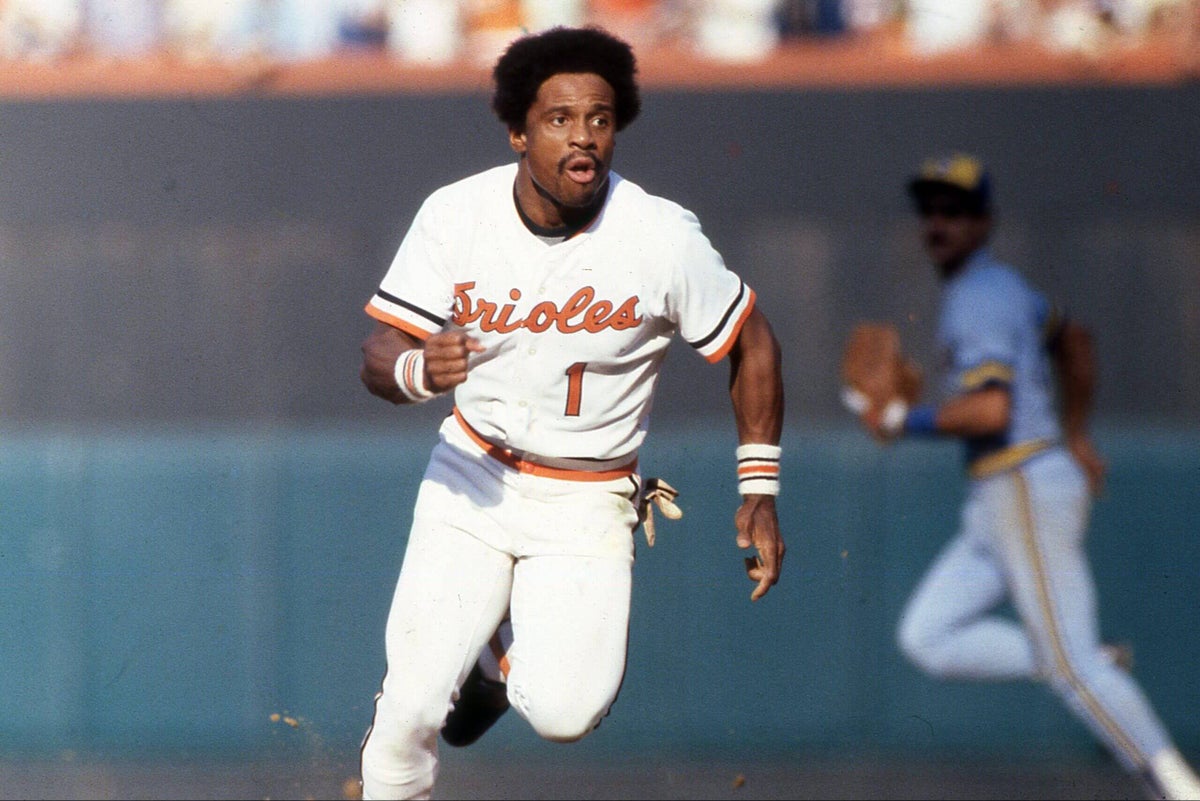
Welcome to Sliders, a weekly in-season MLB column that focuses on both the timely and timeless elements of the game.Al Bumbry was a speedster in the golden days of the Baltimore Orioles. Ken Singleton was a slow-footed slugger. They are former outfielders approaching 80 years old, golfing buddies and teammates for life. Singleton’s grandson is fast, but he cannot help him there. That’s a job for his best friend.“Al gave him a lesson on stealing bases, and Jaxson that summer stole 29 out of 32,” Singleton said by phone the other day. “And the first thing Al said to me was, ‘How’d he get caught three times?’”Singleton laughed. This is what they talk about, he said, baseball and grandchildren, with deep, underlying gratitude for what it took to earn a peaceful retirement. For Bumbry, that meant service in the Vietnam War for 11 months in 1969 and 1970. He was awarded a Bronze Star.“He doesn’t talk about his military experience very often, because he was over in Vietnam and I guess he didn’t want to share too much about it and what he had been through,” Singleton said. “But I’m glad he made it through and made it back, because he’s an awesome person. We’ve had some long talks over the years, and we just hope our grandkids don’t have to go through things like he did.”Baseball is not shy about honoring the military.Many teams single out a veteran at every home game, and last weekend all teams wore camouflage hats to recognize Armed Forces Day. Sometimes the meaning is unclear; Bumbry said he noticed that the Orioles were wearing the same style caps as their opponents, but did not know why.Bumbry, of course, wore the real thing on the battlefield, not the ballfield. And this Memorial Day weekend, as the Hall of Fame honors the military in its annual MLB alumni game, Bumbry will get the widespread recognition he rarely received during 14 seasons in the majors from 1972 to 1985.“I’m trying to think of when us veterans started to get some positive reaction to our military service, and I think when the country got hit by 9/11, that’s when it woke up a lot of the patriotism in the country,” said Bumbry, who spent his final season with the San Diego Padres after 13 in Baltimore.Bumbry waves to fans during a pregame ceremony at Camden Yards in August 2024. (AP Photo / Nick Wass)“From that point on, we started to get recognized,” Bumbry said. “We didn’t get it prior to then because, needless to say, no wars are generally good wars, so to speak, or popular wars, but Vietnam was probably the worst of all in terms of not being a popular war. And then when us veterans came back home, fortunately I was unscathed, but there were a lot that were not. There wasn’t very much attention paid to them.”Bumbry, 79, was in the Reserve Officers’ Training Corps at Virginia State College, where he mostly played basketball. He took a two-year deferment in 1966, reasoning that by 1968, his graduating year, the war in Vietnam would be over.“That thought didn’t work out,” he said, “and when those two years were up and I was about to graduate, I came down to the ROTC department and raised my right hand, took the oath. That’s how my military career started.”The Orioles selected Bumbry in the 11th round in 1968, and with his active duty set to begin in June 1969, they did not have the option of sending him to the short-season rookie league. Pushed ahead to Class A Stockton (Calif.), he batted just .178 in 35 games.Before long, Bumbry said, he was losing playing time in left field to a converted pitcher. Deployment didn’t look so bad, he thought; at least he would have something to do.“I was glad to leave baseball because I wasn’t playing,” Bumbry said. “And when I did play, I was playing so poorly, I wasn’t hitting. It’s no fun when you don’t hit. So in one sense, I did not lose any sleep on having to leave — other than when I was in Vietnam, I didn’t sleep very well over there.“But again, I had a commitment that I had said I would fulfill, and come what may, that’s what happened. My mother, she raised us to be a man, so to speak, and your word is your bond.”When Bumbry returned, moving quickly through the minors and earning the American League Rookie of the Year Award in 1973, his Vietnam tour became a biographical tidbit. In 1980 — the year Bumbry became the first Oriole with 200 hits in a season — “The Complete Handbook of Baseball” noted: “Refused to accompany his teammates to the movie ‘The Deer Hunter.’”Bumbry isn’t sure about that, but he did say he’s never cared to watch a Vietnam movie. He lived the harrowing reality as a second lieutenant, given these instructions, he said, from his commanding officer:“This war was going on before you got here, it will be going on after you leave, and your objective should be: ‘Do your job, but keep in mind that part of your job is to see that you and your 45 men get back home.’”It is often written that Bumbry never lost a man in his tank platoon, and that is what Singleton has always believed, too. Mention it to Bumbry, though, and he will add a detailed clarification.“Well, one man,” Bumbry said. “I lost one man. We were a tank platoon and they had a lot of monsoon seasons over there. We were out in the jungle — no roads, it’s all jungle, you make your own roads. And one of the cardinal sins was, you don’t drive down the path that you made the day before, or a couple of days before, because at night the Viet Cong would go out there and they’d set mines in the path that you had been down.“And I remember the day that we stopped to take lunch and I told my driver of the tank to parallel where we had gone the day before; don’t go down that (same) road. So we did that, and we pulled off to the side of that path that we had made, in that area of responsibility that we were covering. And we stopped to eat lunch and about five minutes later, as we pulled off, I heard ‘Boom! Boom! Boom!’
From Bronze Star in Vietnam to All-Star in Baltimore, Al Bumbry to be honored in Cooperstown
Plus 5 questions with MLB's first Slovakian-born player since 1961 and more timely and timeless elements of baseball.
3,089 words~14 min read