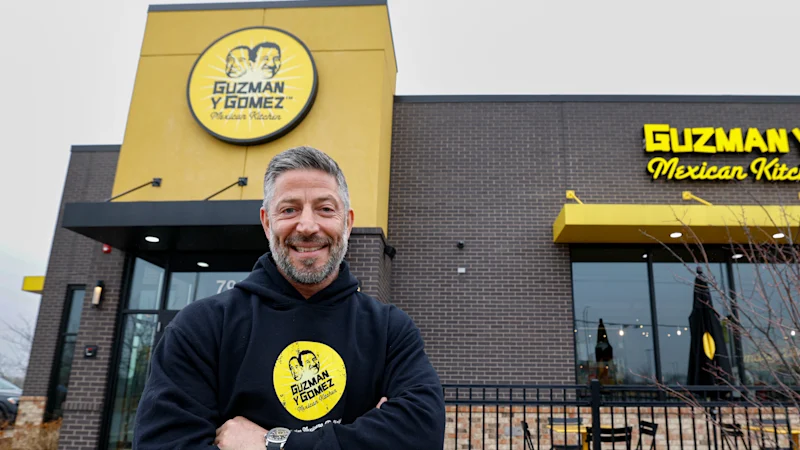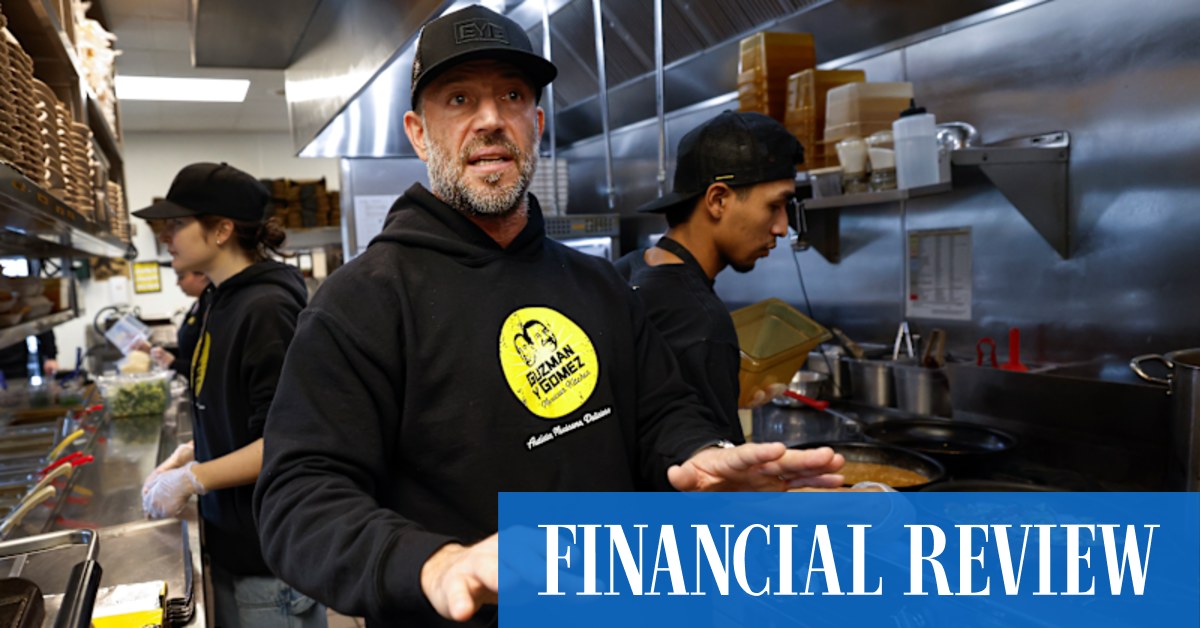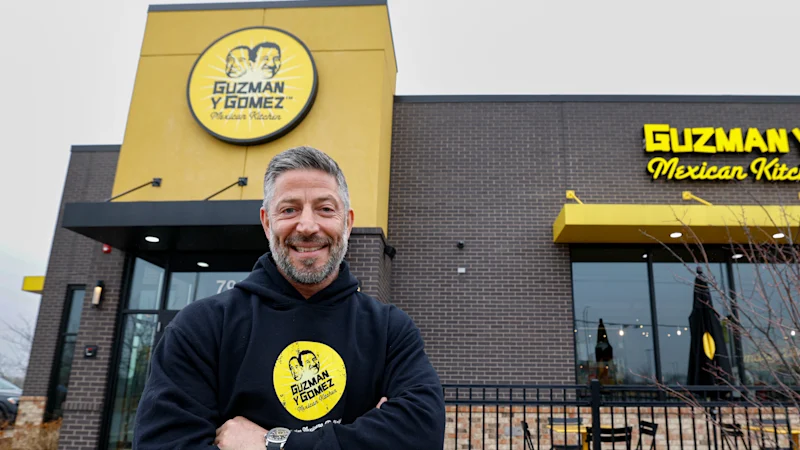
Updated May 22, 2026 — 5:15pm,first published May 22, 2026 — 9:31amGuzman y Gomez founder Steven Marks’ last-ditch attempt to turn around its struggling US business failed on Friday in a major blow to the chain’s hopes of becoming a truly global company with 1000 outlets around the world.But the move delighted shareholders who were relieved that the Australian company had cut its losses in the $400 billion market where it was not forecast to break even until 2037, sending GyG’s stock up about 9 per cent to $19.81.Steven Marks, pictured outside one of Guzman y Gomez’s outlets on the outskirts of Chicago in March, has pulled the plug on the expansion.Financial ReviewAs recently as late February, Guzman y Gomez co-chief executive Steven Marks was projecting unflinching optimism about turning around his eight unprofitable stores in Chicago, where he had arrived two weeks earlier.“That’s why I’m here for three months,” Marks told this masthead at the time. “Some people think you just open in another country, and it just works immediately.”He rattled off a list of green shoots: senior managers had been replaced; he had flown a handful of his best Australian restaurant operators to the US to motivate the team; operations were running more smoothly; food quality was improving; more younger customers were starting to trickle through.Marks, who grew up in New York, has always been adamant that Guzman y Gomez, the Mexican-inspired fast food chain he co-founded two decades ago, would be able to conquer the world’s biggest market.But financial backers and industry watchers have grown increasingly sceptical of his American dream. On Friday morning, they were vindicated when the $2 billion burrito maker suddenly announced it had called time on the US market and shut its eight Chicago stores after failing to hit sales targets. About 300 US staff will lose their jobs.Co-chief executive Steven Marks in the kitchen of Guzman y Gomez’s outlet in Schaumburg, Illinois, on March 5. All eight US stores have been shut down with immediate effect.Kamil Krzaczynski“It wasn’t easy,” Marks told investors in a snap call on Friday morning. “We’ve always said that we would remain disciplined in pursuing growth in the US, and have been transparent about the thresholds we would be targeting to validate our proof of concept.”The thriving Australian business – which has 242 stores and another 32 set to open before the current financial year ends – had been subsidising US losses, which are common for a business establishing itself in a new market, for years. Chief financial officer Erik Du Plessis, who said stores had to hit sales targets of $US60,000 ($84,000) a week per restaurant for the US expansion to succeed, said on Friday that the business was “underperforming our expectations”. In total, Guzman y Gomez has poured at least $115 million into the failed US expansion.Some believe it was a mistake for the Australian chain to attempt to crack the US fast food market – valued at $US420.5 billion by data firm IBISWorld – at all.“It’s the absolute reverse of Taco Bell trying to get into Australia,” said retail food consultant and Titanium Food director Suzee Brain, referencing Taco Bell’s failure to win over Australian customers in the face of Guzman y Gomez’ local popularity.“When you’re not the number 1 or 2 brand in that category, breaking in to a new country market is so difficult … I think GyG were arrogant to think people would like their product more.”Guzman y Gomez, which was worth just over $2 billion on Friday morning, expects the exit will result in a hit of up to $56 million to its annual results.Investors swiftly signalled their approval of the US exit. Guzman y Gomez’s share price soared more than 18 per cent in the morning, before paring back to 9.6 per cent in late afternoon to $19.81.RBC Capital Markets analyst Michael Toner said the US business had “very low prospects of being successful” and was not forecast to break even until 2037. “The sooner exit than anticipated is positive,” he wrote in a note to clients. Marks, a former Wall Street hedge fund manager, opened the first Guzman y Gomez store in the Sydney suburb of Newtown in 2006. He has claimed at various times that it was named after two of his Mexican childhood friends, and that the faces on its logo were inspired by a melange of men he met in his youth and did not resemble particular individuals.Australia, which remains the chain’s biggest market at 242 stores already, is performing strongly and continued to grow, it said.“We have a long runway ahead of us in Australia as we progress towards our long-term target of 1000 restaurants,” Marks said.Marks had long signalled ambitions to expand internationally, including selling Mexican food to Mexicans. ”We’ll take care of the US first, then move south,” the founder told this masthead in 2021, when he explained that he was “very tied to Mexico”, even though he wasn’t of Mexican descent.Guzman y Gomez opened its first Chicago outlet in 2020. There are also 24 stores in Singapore and five in Japan. The US exit was not a reflection on the chain’s American staff, whom Marks said had “delivered genuine progress”.The chain listed on the stock exchange in mid-2024 at a blockbuster float where burritos were served, Marks grew emotional and Guzman y Gomez’s market value soared above $3 billion. The company’s share price has been on a steady decline since.Market watchers believe that exiting the US, the biggest fast-food market in the world, will allow management to focus on Australia, Singapore and Japan.“GyG is one of the most shorted stocks on the ASX, meaning that investors had lost faith in the US story long before today,” eToro lead analyst Josh Gilbert said.Jason Pohl, a partner at ECP Asset Management, which has shares in Guzman y Gomez, said the US business was a “distraction”.“The Australian business has genuinely strong economics and a long growth runway in front of it,” Pohl said. “That’s where we see the value.”The Business Briefing newsletter delivers major stories, exclusive coverage and expert opinion. Sign up to get it every weekday morning.Jessica Yun is a business reporter covering retail and food for The Sydney Morning Herald and The Age.Connect via X or email.From our partners
Guzman founder moved to Chicago to save its US dream. It wasn’t enough
The Australian-founded Mexican chain has spent six years and more than $100 million on its US expansion, but on Friday announced it was shutting down all stores in the country.
1,046 words~5 min read