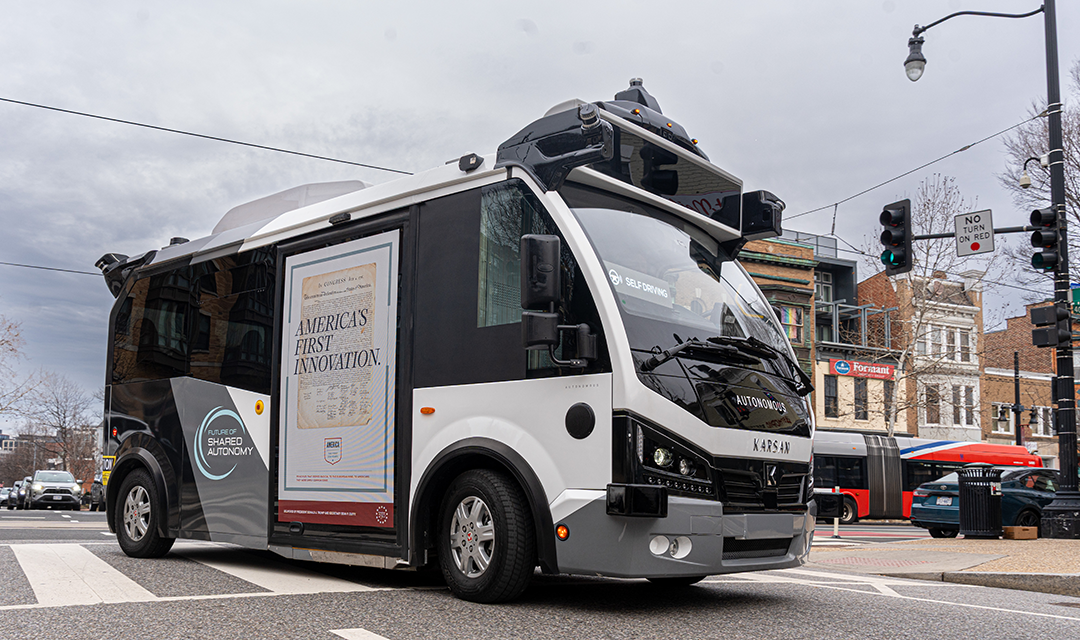
In honor of the nation’s 250th Anniversary, the U.S. Department of Transportation plans to deploy self-driving shuttle services in Washington DC this summer. As a precursor to the public launch, in January, the US DOT arranged for federal and local government and transportation officials to take test rides in an autonomous shuttle along a two-mile stretch between Navy Yard and Union Station in Washington DC. Researchers from Carnegie Mellon University’s Safety21, a USDOT National University Transportation Center (UTC), were an integral part of this pilot deployment to validate and ensure safety during testing and operations.
The Carnegie Mellon team, led by Raj Rajkumar, the director of Safety21 and professor of electrical and computer engineering, collaborated with US DOT and Beep, Inc., an autonomous mobility company, on a pilot program for autonomous public shuttles. During the DC test rides, the researchers gathered data from the vehicle’s sensors. CMU analyses and recommendations are helping inform how the shuttle bus will navigate safely and make intelligent, real-time decisions in a variety of traffic situations.
The shuttle demonstrations coincided with the Transportation Research Board (TRB) Annual Meeting, which was held on January 11–15, 2026 in the District of Columbia. Thousands of transportation professionals, including policymakers, convened at TRB to discuss advances in all modes of transportation. The deployment of autonomous vehicles (AVs), transportation corridors for AVs, and infrastructural support for AVs were emphasized.