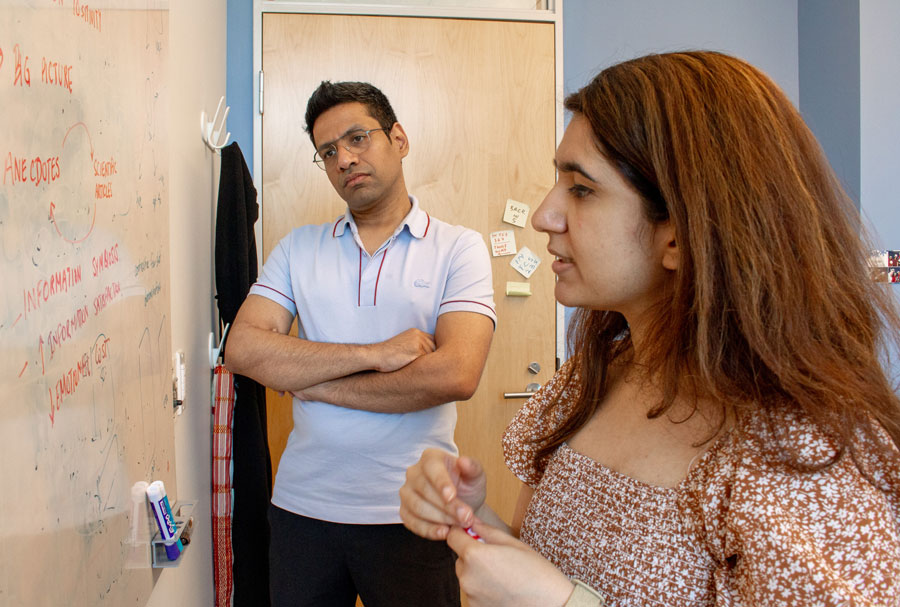
Reddit isn't a doctor, but that doesn't stop people from turning to it for medical questions. And since people won't change their behavior, researchers from Carnegie Mellon University's School of Computer Science developed a tool to keep them grounded.Evidotes is a Google Chrome extension that offers the anxious searcher a way to actually walk away from the keyboard feeling better. The tool combines scientific evidence with anecdotes to give users a more well-rounded information-gathering experience, tailored to what they need rather than a barrage of information.An SCS team developed a tool to keep anxious searchers grounded when they're looking for medical information on Reddit."People going online for medical information want to keep reading and searching because health decisions are some of the most important that they'll make, but they don't necessarily have the medical expertise to understand the information they're getting," said Shreya Bali, a Ph.D. student in the Human-Computer Interaction Institute (HCII). "Then they end up on places like Reddit, with peer stories that are often extreme, causing more questions and emotional concern. I wanted to create a tool to help people navigate this place of uncertainty."Bali knows about this problem first-hand. When she prepared for LASIK eye surgery, she saw stories online from other people who had the surgery. While she relied on her family of physicians to answer questions, she ultimately still felt unsatisfied and more anxious. After talking to others in her doctoral program, she found this feeling resonated with them, too.Evidotes serves as a checkpoint for people in this anxiety spiral. If you're on Reddit nervously reading post after post, the tool offers different perspectives to stop the endless searching.When a user opens a Reddit post, Evidotes adds a button next to the post that allows the user to select different lenses for viewing the information. "Dive Deeper" combines evidence from scientific articles and anecdotal Reddit posts to give the user a more complete picture, while the "Focus on Positivity" option provides uplifting information from science and peer posts on Reddit. Researchers said this option addresses the emotional impact of health posts and supports emotional regulation. The last option allows users to look at the "Big Picture," meaning they can step back from specific Reddit posts and see broader patterns and general management strategies related to a specific health condition.Researchers noted that Evidotes isn't simply about fact-checking."We could have created a filter on your social media that told you if something was right or wrong, or if a doctor said it was correct or incorrect," said Mayank Goel, an associate professor in the HCII and the Software and Society Systems Department (S3D). "But Evidotes takes aim at the idea that sometimes you don't want the scientifically validated information — you want your information to also offer comfort and understanding."Researchers studied participants who have chronic illnesses to determine how and what they hoped to find when they used Reddit for information about their health. Overall, researchers found that participants occupied a kind of middle space — knowing that scientific information was more reliable than patient stories or that an individual anecdote should be taken with a grain of salt — but they couldn't access the right information to manage their uncertainty."We found that, for the people doing this searching online, it wasn't about becoming an expert," said Sherry Tongshuang Wu, the Daniel P. Siewiorek Assistant Professor of Human-Computer Interaction. "It's more that users have some curiosities and they want to investigate, perhaps wondering what questions they need to ask the next time they visit their doctor. And some people are just too anxious and they need to reduce their anxiety. So everyone has their own information needs. That's what Evidotes is trying to do — to meet someone's information needs in the hope that it will reduce rabbit holes and their reliance on internet doctors."Researchers said they hope to make Evidotes publicly available soon. In the meantime, they're beginning to work with physicians to determine how to better share the expertise of medical professionals with patients.The Evidotes team presented their work at the recent Association for Computing Machinery Conference on Human Factors in Computing Systems (CHI 2026), where they earned an honorable mention award. Along with Bali, Wu and Goel, the HCII team included Ph.D. student Riku Arakawa and Peace Odiase, a student in the dual CMU and University of Pittsburgh M.D./Ph.D. program. This project received partial funding from the National Science Foundation.To learn more about Evidotes, read the team's CHI 2026 paper.
CMU Tool Prevents Anxiety Spirals When Searching for Medical Advice Online
Reddit isn't a doctor, but that doesn't stop people from turning to it for medical questions. And since people won't change their behavior, researchers from Carnegie Mellon University's School of Computer Science developed a tool to keep them grounded.Evidotes is a Google Chrome extension that offers the anxious searcher a way to actually walk away from the keyboard feeling better. The tool combines scientific evidence with anecdotes to give users a more well-rounded information-gathering experience, tailored to what they need rather than a barrage of information.An SCS team developed a tool to keep anxious searchers grounded when they're looking for medical information on Reddit."People going online for medical information want to keep reading and searching because health decisions are some of the most important that they'll make, but they don't necessarily have the medical expertise to understand the information they're getting," said Shreya Bali, a Ph.D. student in the Human-Computer Interaction Institute (HCII). "Then they end up on places like Reddit, with peer stories that are often extreme, causing more questions and emotional concern. I wanted to create a tool to help people navigate this place of uncertainty."Bali knows about this problem first-hand. When she prepared for LASIK eye surgery, she saw stories online from other people who had the surgery. While she relied on her family of physicians to answer questions, she ultimately still felt unsatisfied and more anxious. After talking to others in her doctoral program, she found this feeling resonated with them, too.Evidotes serves as a checkpoint for people in this anxiety spiral. If you're on Reddit nervously reading post after post, the tool offers different perspectives to stop the endless searching.When a user opens a Reddit post, Evidotes adds a button next to the post that allows the user to select different lenses for viewing the information. "Dive Deeper" combines evidence from scientific articles and anecdotal Reddit posts to give the user a more complete picture, while the "Focus on Positivity" option provides uplifting information from science and peer posts on Reddit. Researchers said this option addresses the emotional impact of health posts and supports emotional regulation. The last option allows users to look at the "Big Picture," meaning they can step back from specific Reddit posts and see broader patterns and general management strategies related to a specific health condition.Researchers noted that Evidotes isn't simply about fact-checking."We could have created a filter on your social media that told you if something was right or wrong, or if a doctor said it was correct or incorrect," said Mayank Goel, an associate professor in the HCII and the Software and Society Systems Department (S3D). "But Evidotes takes aim at the idea that sometimes you don't want the scientifically validated information — you want your information to also offer comfort and understanding."Researchers studied participants who have chronic illnesses to determine how and what they hoped to find when they used Reddit for information about their health. Overall, researchers found that participants occupied a kind of middle space — knowing that scientific information was more reliable than patient stories or that an individual anecdote should be taken with a grain of salt — but they couldn't access the right information to manage their uncertainty."We found that, for the people doing this searching online, it wasn't about becoming an expert," said Sherry Tongshuang Wu, the Daniel P. Siewiorek Assistant Professor of Human-Computer Interaction. "It's more that users have some curiosities and they want to investigate, perhaps wondering what questions they need to ask the next time they visit their doctor. And some people are just too anxious and they need to reduce their anxiety. So everyone has their own information needs. That's what Evidotes is trying to do — to meet someone's information needs in the hope that it will reduce rabbit holes and their reliance on internet doctors."Researchers said they hope to make Evidotes publicly available soon. In the meantime, they're beginning to work with physicians to determine how to better share the expertise of medical professionals with patients.The Evidotes team presented their work at the recent Association for Computing Machinery Conference on Human Factors in Computing Systems (CHI 2026), where they earned an honorable mention award. Along with Bali, Wu and Goel, the HCII team included Ph.D. student Riku Arakawa and Peace Odiase, a student in the dual CMU and University of Pittsburgh M.D./Ph.D. program. This project received partial funding from the National Science Foundation.To learn more about Evidotes, read the team's CHI 2026 paper.