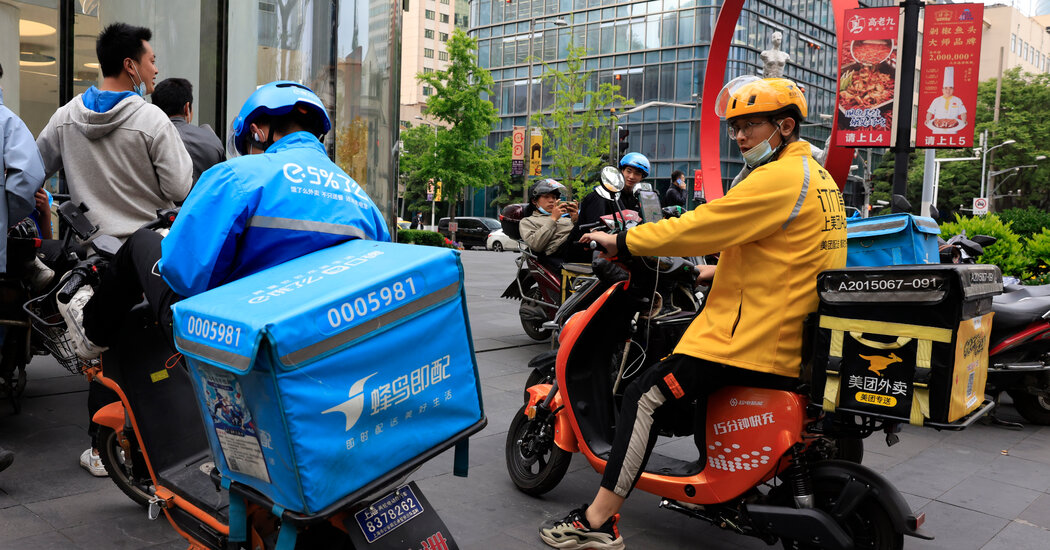
As soon as we stepped on to the metal staircase from the restaurant down to the vegetable market, we met a cool breeze carrying the scent of sap and soil from the stalls below. It was too early to go home and there was something of a thrill in the air, so Boyan and I decided to take a walk around the walls of the Forbidden City.Along the way we passed groups of older people, mostly women, dancing in formation to old Chinese pop songs playing from a beat box. We stopped to watch one group that included four or five men, one of whom performed with an alarmingly vigorous pelvic thrust for someone his age.“It’s good to be back,” Boyan said.He had flown into Beijing a few days earlier after six weeks in Brazil, where the Chinese online delivery service he works for is expanding. He has been alternating between the two countries for six weeks at a time since late last year but has not seen much of Brazil.“My working hours are from eight to two, eight in the morning until two in the morning,” he said.Boyan is based in a provincial city more than an hour’s flight from São Paulo, where he works in an all-Chinese team that is rolling out a new service. On their one day off each week, most of his colleagues fly to some other place in Brazil to see the sights but he prefers to stay where he is, exploring different neighbourhoods and becoming a regular at a few coffee shops and restaurants.The 11-hour time difference between China and Brazil accounts for some of the long hours and even when he is back in Beijing, Boyan often works until midnight to take part in team calls. But he likes the work, the pay is good and although he is a spendthrift by nature, he is hoping to put some money away over the next year or two working in Brazil.Fast, cheap and fiercely efficient, China’s ecommerce platforms are struggling to make profits in a flat domestic market where price wars are slashing everyone’s margins. That is one reason they are expanding overseas, particularly in southeast Asia, the Middle East and Latin America.[ Taiwan debates what constitutes independence in wake of Trump visit to ChinaOpens in new window ]Brazil is attractive because, like China, it is a big market with a growing middle class concentrated in larger cities. The food delivery service Meituan last year announced a $1 billion investment in Brazil, where it operates as Keeta in São Paulo and a number of other cities.Meituan is competing with Brazilian food delivery services and Chinese rivals who have also moved into the market. Each operator is scrambling to sign up restaurants, trying to keep them exclusive to their platform and spending huge amounts of money to grow their market share.The Chinese ride-hailing platform DiDi entered the Brazilian market in 2018 by acquiring a local operator and using its own technology to improve the service. DiDi has 55 million active users in Brazil, operating in more than 3,300 towns and cities, and has captured 40 per cent of the ride hailing market, with only Uber ahead of it.The platform is now offering food and grocery delivery and financial services, as it does in Mexico where it is the biggest operator in terms of market share. Didi’s autonomous driving cars are not yet operating in Brazil but they have launched in some Middle Eastern markets.Chinese online platforms have also expanded rapidly in recent years in Saudi Arabia and the United Arab Emirates, using drones for delivery. They are following a pattern set by companies such as Temu and Shein, which reshaped the global landscape of ecommerce by developing better supply chains that keep costs down.[ Beijing’s split-screen diplomacy underscores shifting global alignmentsOpens in new window ]The companies expanding overseas are mostly targeting emerging markets with large populations, rapidly rising internet penetration and a liberal regulatory regime. Many Chinese platforms avoid the United States and the European Union because of entrenched retail giants and high regulatory barriers to entry.Although most of the platforms’ workers are recruited locally, companies typically send Chinese teams like Boyan’s to set up operations. More of them are adopting the model of sending Chinese employees for a number of short stints abroad every year rather than posting them for a few years.“It works for me and I’m never away for too long. My mother doesn’t even know I’m there,” Boyan said.
Moving to a new beat: China’s businesses buoyed in Brazil
Struggling in a flat domestic market, many businesses are expanding overseas
749 words~3 min read