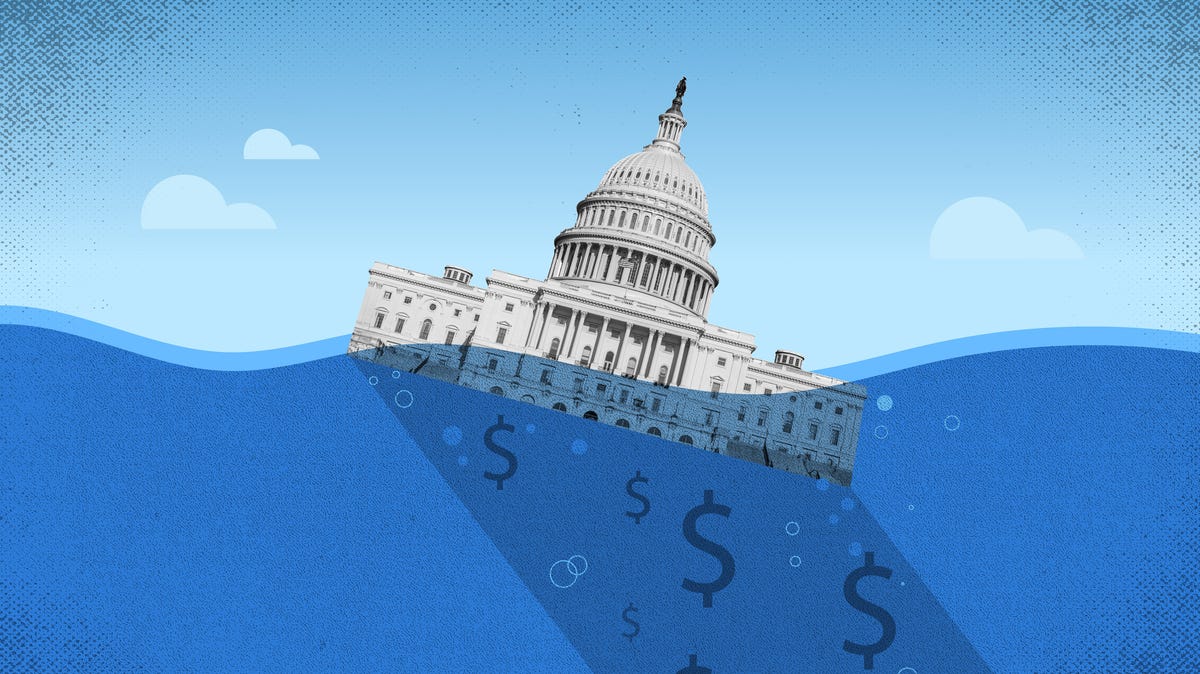
A simple way to illustrate the annual tax burden is to calculate how many days of the year it would take the “average taxpayer” to earn enough to cover their taxes. In 2026 that number is expected to be 142 days, which covers the time from the beginning of the year to May 22, which we call Tax Freedom Day. Over the past 30 years the total tax burden has increased from about 30% to 38% of GDP. Tax Freedom Day has on average arrived later by one day per year. Revised government data shows a steady increase since 2023 and wider fluctuations in previous years, depending on recessions and government budgets. In an 1819 case before the US Supreme Court, American lawyer and statesman Daniel Webster asserted “an unlimited power to tax involves, necessarily, a power to destroy”. The key word was “unlimited”. It had long been known higher taxation would make life harder, and the more you taxed something the less of it you would get. This was true at the individual level and within states and empires. In the 14th century the Tunisian historian Ibn Khaldun observed that “at the beginning of a dynasty taxation yields a large revenue from small assessments. At the end of the dynasty, taxation yields a small revenue from large assessments”. Neither Webster nor Khaldun were suggesting there should be no taxation, but rather that the unlimited power to tax is associated with national decline and the destruction of relationships that make co-operative societies possible. Webster was speaking in support of what he asserted were clear American constitutional limitations on the power to tax. Ironically, Webster’s client was a corporate agency created by the national government defending itself from taxation imposed by a state (provincial) government. If one level of government could recognise the taxation of its activities by another level of government could thwart its mandate and effectiveness, surely this recognition could be extended to the activities of society in general. The limits to a government’s power to tax can be imposed either by man or by nature, and history shows no man-made constitution or legislative policy can long survive a disregard for the realities of physical and human nature. Just as individuals cannot spend themself into prosperity, neither can a government. The more a government spends the greater the tax burden it must impose on its people. This continues to be true when a government spends more than the tax revenue it receives and must borrow to finance the difference. That deficit — the increase in public debt — represents the present value of future tax obligations. It also represents, as expressed through the political process, an unwillingness of “the people” to pay the full cost of current government expenditures. Just as individuals cannot spend themself into prosperity, neither can a government. The more a government spends the greater the tax burden it must impose on its people. The increasing debt does shift tax obligations onto future taxpayers, but the liability goes onto the balance sheet; the government has borrowed current resources from private lenders. But whether in private or government hands we must ask the same question: will you invest in a business or other productive assets or, instead, will you buy consumer goods and services that are used up in the present?In other words, will you use the cash to engage in or promote activities that generate further cash with which to service the debt? Or will you use it for current consumption or unproductive activities that will leave debt repayment dependent on other sources of expected future income? When properly conducted the core activities of government — the judiciary, policing, national defence and diplomacy — should be recognised as productive. Essential infrastructure such as roads and bridges can be expected to provide long-term service, facilitating mobility, commerce, communication and other life-enhancing relationships. For these kinds of services it is relatively easy to justify taxation and get widespread agreement from the electorate. Contrast this to government transfer payments, such as “social grants” or other welfare payments for which no productive service is expected. While it is, and has been, possible to maintain electoral support for such payments, there is no credible argument that such transfers are productive or self-supporting. If such redistributions are deemed necessary to maintain civil order, one must pray the country can grow out of its predicament, and do so quickly. But transfers make that less likely. Hand up vs handoutWhile we might hope such welfare payments are seen as “a hand up, not a handout”, the incentive structure points in the opposite direction. When people work to earn their income and are taxed to give payments to those who do not work, both sides have less incentive to work. Less is achieved and the overall standard of living is lower. This is always true. But the greater the number of people who expect payments from government, the greater the proportion of the country’s productivity that will be lower. Employment and cultural participation will also be lower. The more tax revenue you “need”, the more difficult it becomes to raise that tax revenue. This was Khaldun’s warning. If we are concerned the unemployment rate in South Africa is above 30%, so too should we be concerned that general government expenditures, and the commensurate tax burden, are greater than 30% of GDP. The two statistics are demonstrably related. The negative correlation between government spending and GDP growth is a sign government has grown beyond its core functions, in essence spending on luxuries and burdens it cannot afford while taxing more heavily the most productive actors in the economy. Those who seek salvation in higher government budgets might argue the price of freedom is too high. But given that South Africa’s per capita real GDP growth has been trending downward over the past 20 years, and for the past 10 years has been slightly negative, the price of losing freedom is far higher. • Grant, a professor of finance & economics at Cumberland University, is a senior associate at the Free Market Foundation.
RICHARD J GRANT | Tax Freedom Day highlights rising government spending
Rising public debt, linked to joblessness and stagnating growth, becomes future burden
1,016 words~5 min read