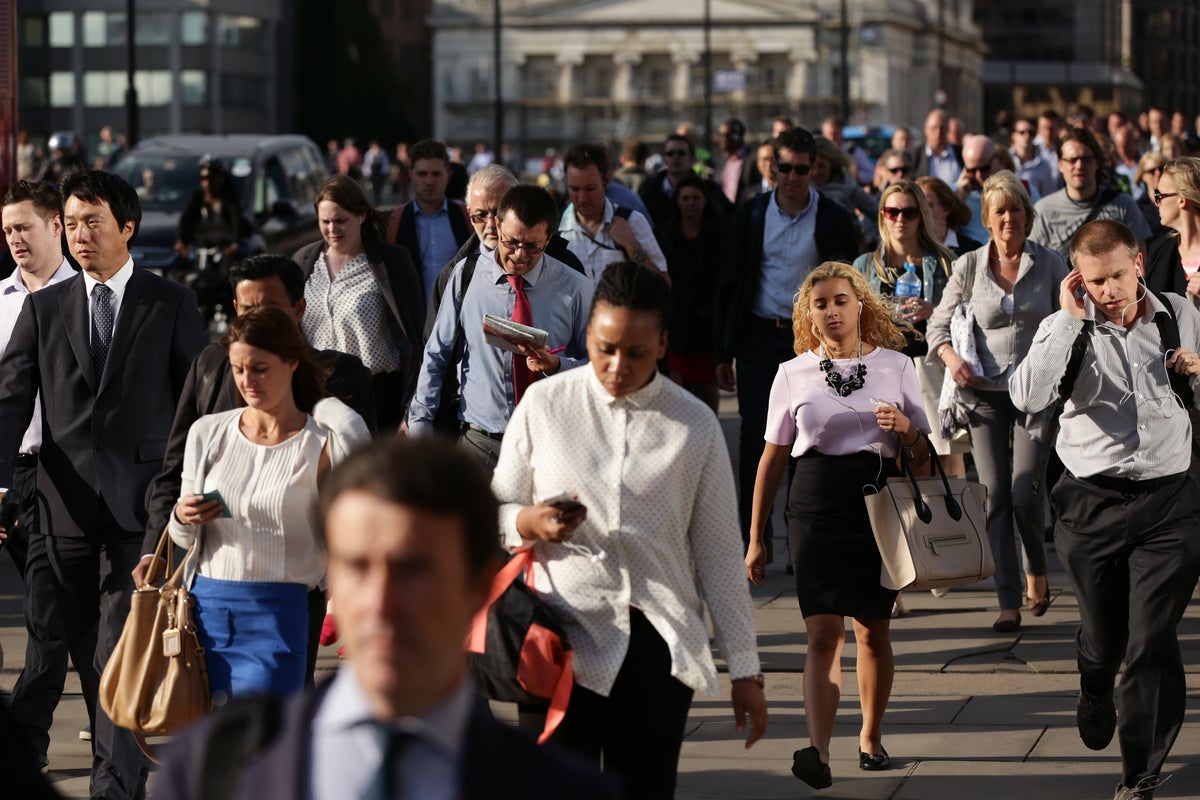
Indian students and workers topped the list of people leaving the UK last year as Britain’s net migration nearly halved, reflecting the impact of a tightening immigration regime that has sharply reduced arrivals from outside Europe.Indians lead exit wave as UK net migration halves, representational image. (Bloomberg)Data released by the Office for National Statistics (ONS) on Thursday showed that around 51,000 Indians who had moved to the UK for studies left the country in 2025, the highest among all nationalities. Another 21,000 Indians who had moved for work and 3,000 others also exited Britain during the year. Chinese nationals followed closely, with 46,000 students and workers leaving the UK.Also read | Trump directs expanded immigration checks through US banks: Know about impact on Indians and what should NRIs doThe sharp rise in departures contributed to a steep fall in Britain’s net migration — the difference between people entering and leaving the country — to 171,000 in 2025 from 331,000 in 2024. Net migration has now dropped 82% from its peak of 944,000 in the year ending March 2023.The data underlines the impact of tighter visa rules introduced first under former Conservative prime minister Rishi Sunak and continued by the Labour government led by Keir Starmer, which is under mounting political pressure from Nigel Farage’s anti-immigration Reform UK.Despite the rise in departures, Indians continued to dominate several key UK visa categories. Indians received the highest number of Health and Care Worker visa extensions in the year ending March 2026 at 107,306, ahead of Nigerians and Zimbabweans. They also topped the list for Skilled Worker visa extensions at 89,851.Among students, Indians remained the largest group receiving Graduate Route visa extensions at 70,371 and also accounted for the highest number of Sponsored Study visas granted by the UK at 90,425, or 23% of all such visas.The ONS said the fall in migration was driven primarily by a sharp decline in arrivals from outside the European Union for work-related reasons. Non-EU work migration fell 47% last year. “Net migration continues to fall and is at levels last seen in early 2021 — when the new immigration system was introduced and COVID-19 pandemic travel restrictions were still in place,” said ONS deputy director Sarah Crofts.“The recent decrease is being driven by fewer people arriving from outside the EU, particularly for work,” she added.The estimate for total long-term immigration to the UK stood at 813,000 in 2025, down 20% from the previous year.The figures are politically significant for the Labour government, which has sought to harden its immigration stance after Reform UK made major gains in local elections earlier this month by capitalising on voter anger over migration and pressure on public services.Home Secretary Shabana Mahmood said the government was “restoring order and control” to Britain’s borders.“Net migration is now at 171,000, down from a high of 944,000 under the Conservatives,” she said. “We will always welcome those who contribute to this country and wish to build a better life here. But we must restore order and control to our borders.”Mahmood has proposed a new “skills-based migration system” that would make it harder for low-income migrants to gain residency while favouring highly skilled workers. She has also proposed time-limited refugee protections and warned of visa restrictions for countries unwilling to cooperate on deportations.Migration has emerged as one of the defining political fault lines in Britain, even overtaking the economy as a voter concern last year before inflation and growth worries resurfaced.The debate has also intensified within Labour itself, with divisions emerging over how aggressively the party should curb immigration as Prime Minister Starmer faces growing pressure after the party’s poor local election performance.Economists and migration experts have meanwhile warned that a sharp reduction in immigration could hurt Britain’s economy by worsening labour shortages and constraining growth. “Migration is down now, but the economic impacts depend more on who is — or is no longer — migrating than how many,” said Ben Brindle of the Migration Observatory at the University of Oxford.The ONS data also showed Britons and Europeans continued to leave the UK in large numbers. EU nationals leaving Britain outnumbered arrivals by 42,000, while the figure for British citizens stood at 136,000.At the same time, applications for British citizenship crossed 300,000 in the year ending March, the highest on record, with a sharp rise in applications from US nationals as migrants rushed to secure permanent status amid fears of tighter immigration rules.(With inputs from PTI and Bloomberg)
Indians lead exit wave from UK as tighter immigration rules drive net migration down sharply
The estimate for total long-term immigration to the UK stood at 813,000 in 2025, down 20% from the previous year. | World News
742 words~3 min read