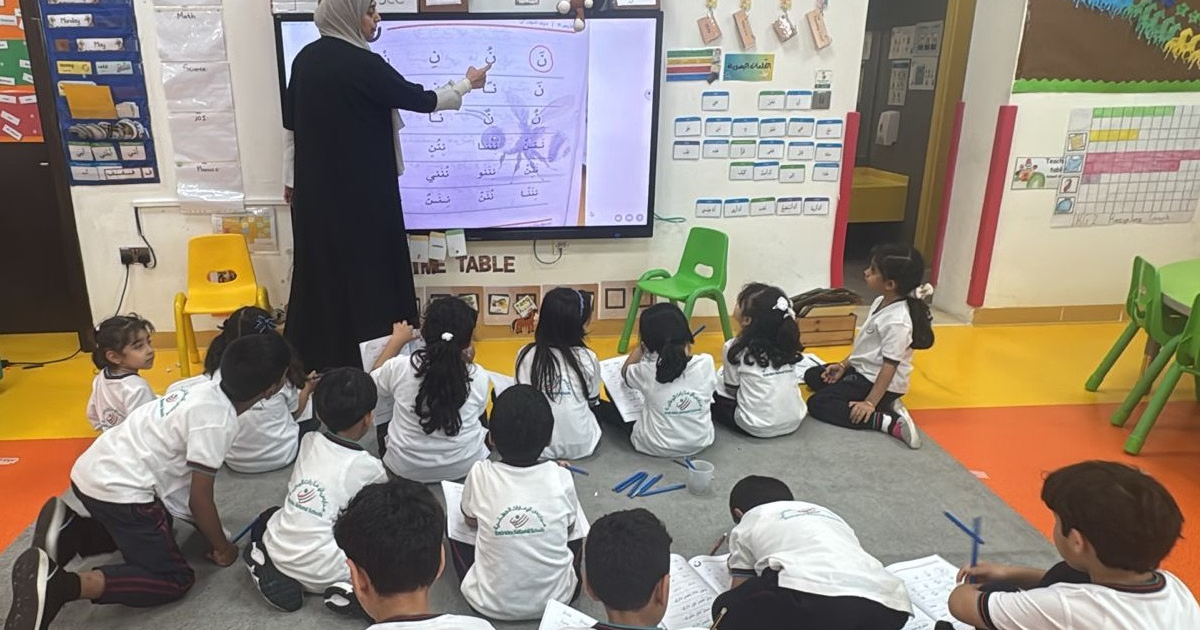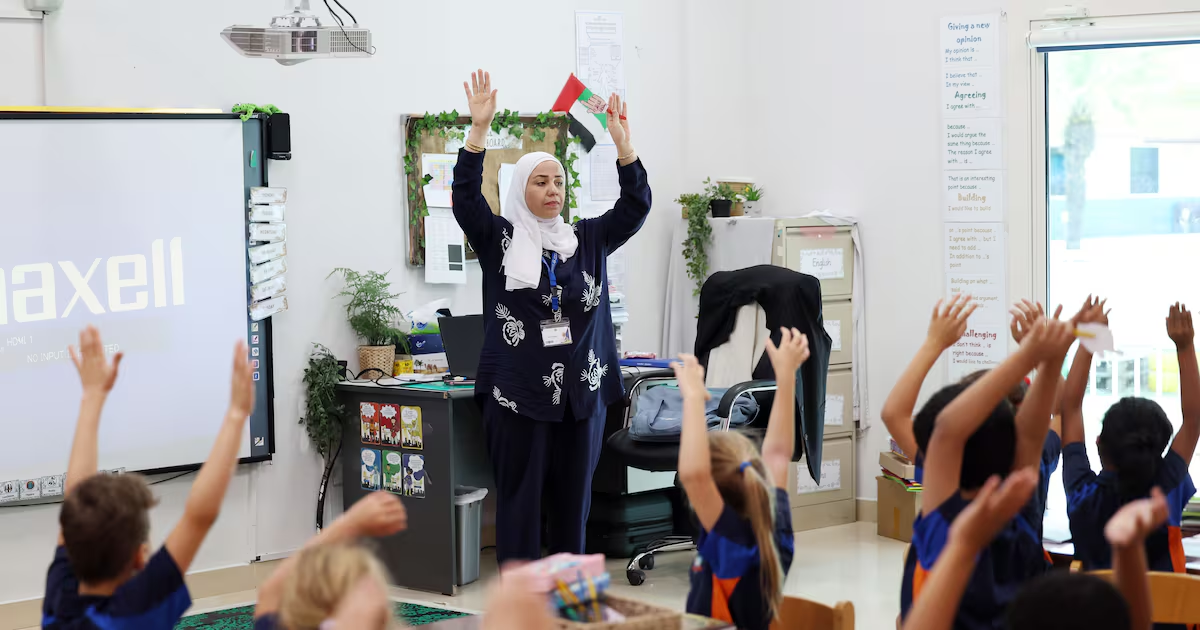
A project in Ras Al Khaimah is helping to make learning Arabic easier for children by placing the emphasis on how letters and words sound rather than on traditional grammar and textbook teaching.The programme, developed by the Sheikh Saud bin Saqr Al Qasimi Foundation for Policy Research, is called Iqra, the Arabic word for read. It ran as a trial in 83 classrooms across 26 schools in Ras Al Khaimah during the 2024-2025 academic year.The scheme was such a success that it is due to be rolled out across all private schools in the emirate for the school year starting in September.“Iqra differs from many traditional Arabic literacy classrooms in both instructional structure and classroom practice,” said Hanadi Mohammed, education and community development manager at the Al Qasimi Foundation.“Traditional classrooms often introduce multiple literacy skills simultaneously and may place greater emphasis on memorisation, comprehension, grammar, or textbook coverage from an early stage. “Iqra instead focuses very intentionally on foundational reading fluency and decoding skills first.”Lessons include repeated oral reading, paired reading, echo reading involving shorter texts, and choral reading, in unison, to reinforce automaticity and reading speed, she said.The project is designed to complement and support the existing Ministry of Education Arabic curriculum by strengthening students’ foundational reading fluency, said Ms Mohammed. This “can then support comprehension and broader language learning outcomes later on” she added.Zinab Esmaeil uses the Iqra method to teach children Arabic at RAK Academy. Chris Whiteoak / The NationalInfoThe programme was designed to address Arabic diglossia – the gap between the Arabic children speak at home and Modern Standard Arabic (MSA), which they encounter in school and formal reading, she added.“Across the Arab world, many children struggle with reading not because they lack ability, but because the Arabic they speak at home is different from the Modern Standard Arabic they are expected to read at school,” said Ms Mohammed.“This challenge affects reading fluency and comprehension from the earliest years of education. By the end of Grade 3, many students can comfortably read texts of only 200 to 400 words, as a result Arabic-speaking children can be up to two full years behind their global peers.”The Iqra programme, she said, is designed to address this by giving children structured and repeated exposure to written Arabic patterns from the earliest stages of literacy learning. This helps them to recognise letters, sounds and common word structures systematically so they become more comfortable.Last year, it was confirmed that private schools in the UAE must teach Arabic to kindergarten-age pupils for 40 minutes each day from the start of the current academic year, in support of a nationwide push to champion the use of the language from an early age.The strategy mandated that Arabic language lessons be held for 200 minutes a week (40 minutes daily), increasing to 300 minutes (an hour a day) by the 2027-2028 academic year in all private schools, across all approved curriculums.Language barriersAn independent evaluation of the Iqra programme, conducted by J-PAL Mena, the regional office of the Abdul Latif Jameel Poverty Action Lab, found it helped young learners make Arabic reading progress about 25 per cent faster than pupils following the standard curriculum.“When Arabic is taught in a way that reflects how children actually learn to read, progress can be rapid, measurable, and achievable within existing school systems,” said Dr Natasha Ridge, the Al Qasimi Foundation's executive director.“Evidence-based teaching can strengthen Arabic literacy for both native and non-native speakers, and it offers a scalable model for education systems across the region.”The programme is aimed at children from Kindergarten 1 to Grade 1 and aligns with the UAE Ministry of Education’s Arabic curriculum, acting as a support system rather than a replacement, officials said.Children at RAK Academy learn Arabic. Chris Whiteoak / The NationalInfoThe J-PAL Mena evaluation randomly assigned 41 classrooms to use Iqra and 42 classrooms to continue with the standard Arabic curriculum. The study found statistically significant gains in Arabic literacy among students using Iqra.According to the findings, the programme improved outcomes for both native and non-native Arabic speakers and led to gains in letter identification, word reading, non-word decoding and oral reading fluency.The biggest improvements were seen in word reading – a core early skill that underpins overall literacy and helps children become more fluent readers.Overall literacy improvements were equivalent to moving a median student from the 50th to the 54th percentile, while in word reading Iqra moved the median student from the 50th to the 58th percentile.“The evaluation shows that Iqra changed classroom practice and translated it into measurable improvements in student learning,” said Nayera Adly Husseiny, lead of Egypt Impact Lab at J-PAL Mena. “The programme improved Arabic literacy across key areas.”She added that the findings showed improving learning was “not only about adding more resources or technology”.“Pedagogy matters. How children are taught can make a significant difference,” she said.In 21 of the 26 participating schools, Iqra was implemented entirely during regular curriculum hours, making it relevant for education systems seeking to improve Arabic outcomes without adding pressure to school timetables.Iqra has also been trialled in classrooms in Morocco, Egypt and Jordan and has shown promise for older students experiencing reading difficulties.Dr Ridge said Arabic literacy was not only an educational issue but also a cultural, social and economic priority.“If children struggle to read fluently in the early years, the consequences follow them throughout their schooling,” she said.“Iqra gives us a way to intervene early, effectively, and at scale.”
Ras Al Khaimah classroom scheme to make Arabic easier to learn will be expanded | The National
Iqra programme will be rolled out in emirate's private schools from September
908 words~4 min read