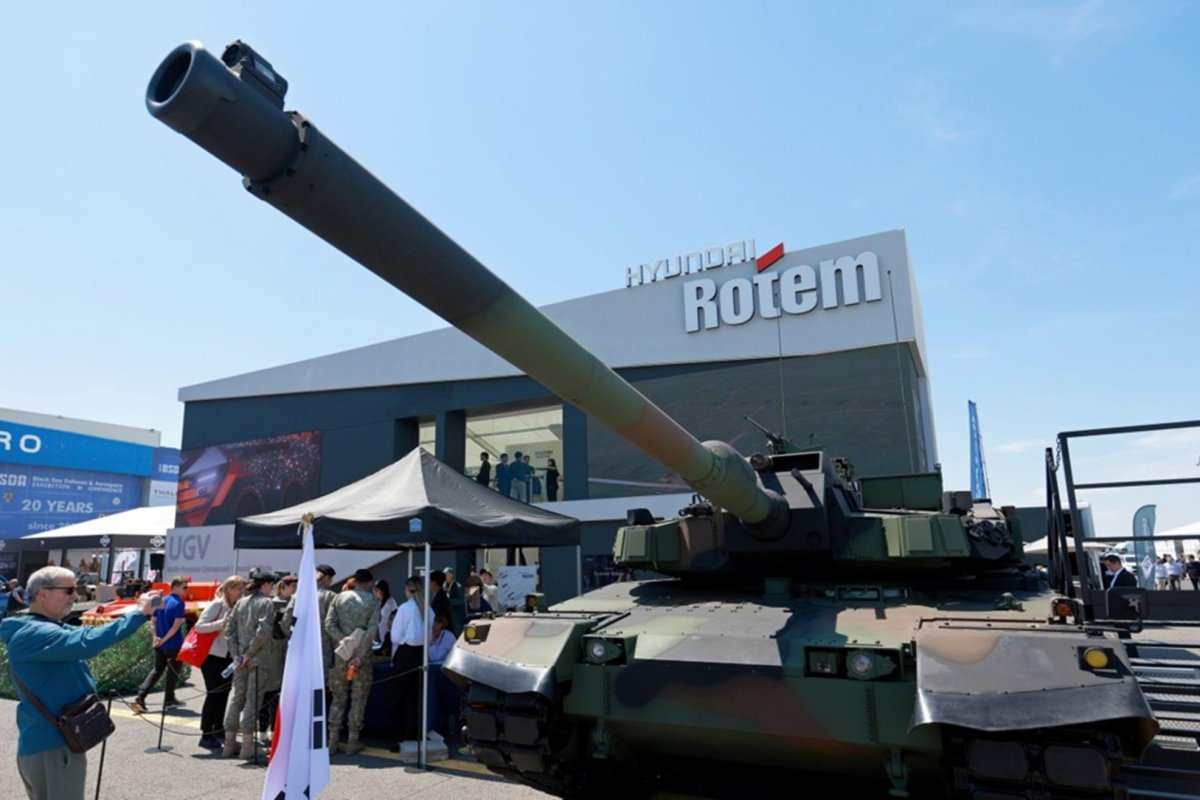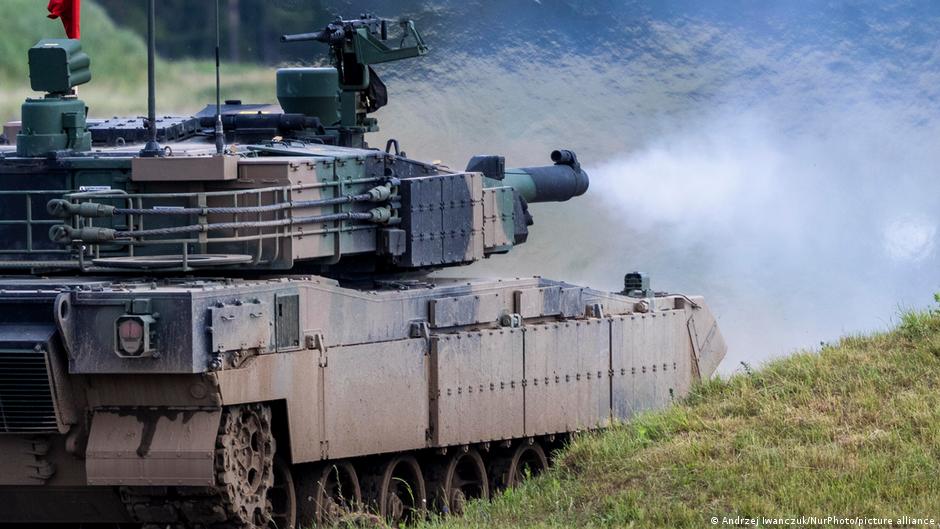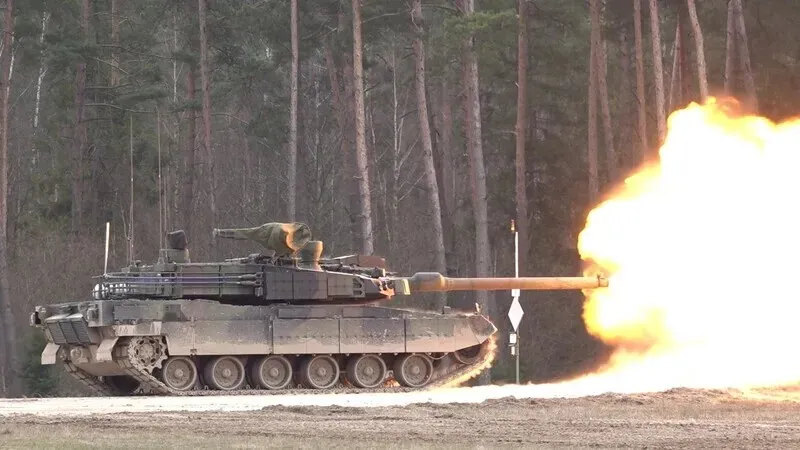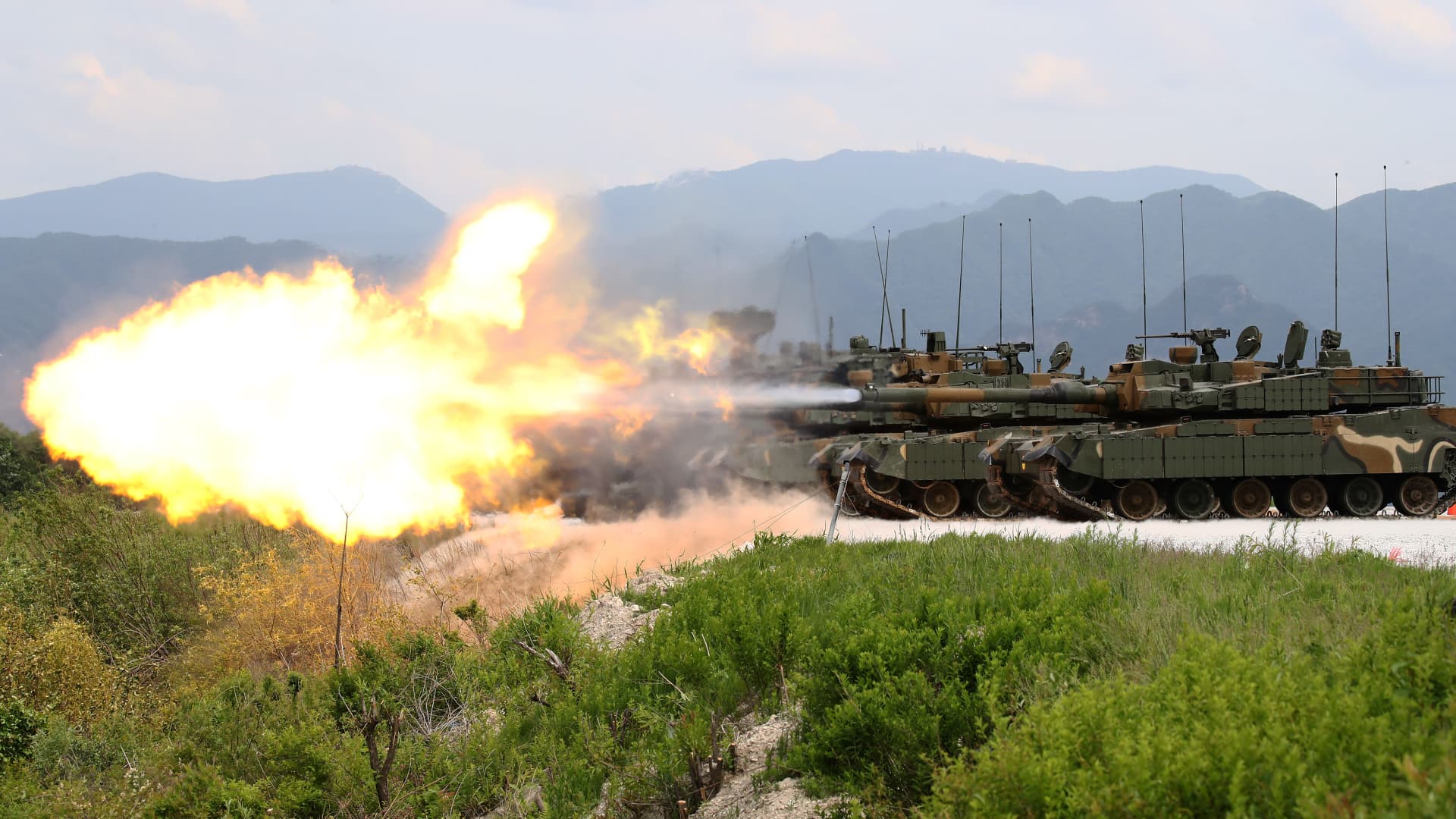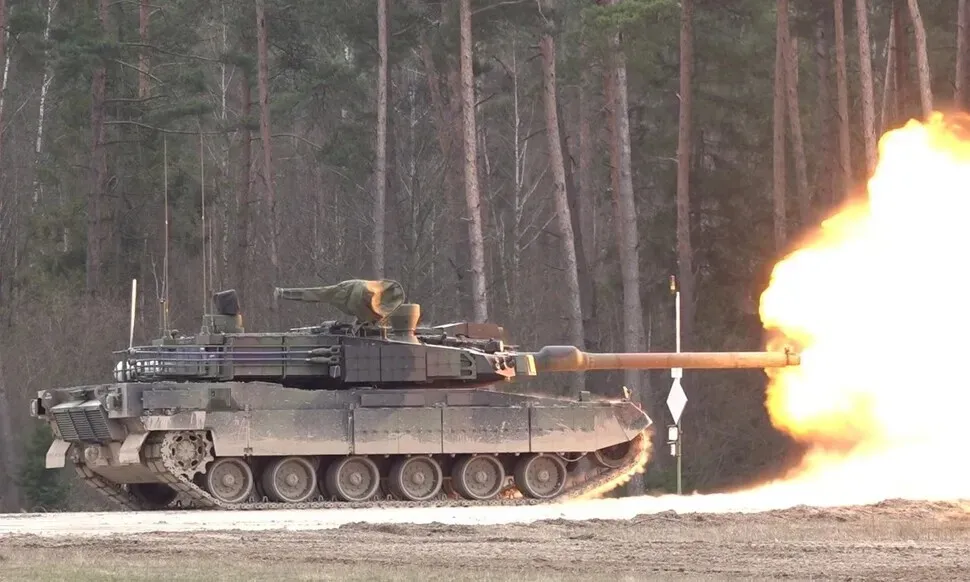
A K2 tank carries out a firing test in Poland. (courtesy Hyundai Rotem)
South Korea was the world’s No. 4 exporter of weapons last year, new data shows. The country climbed in the rankings as its defense industry enjoyed rapid growth after securing massive contracts to supply European nations, who started rearming after Russia invaded Ukraine. As Korean weapons systems have proven reliable in the Gulf states throughout the ongoing war in the Middle East, observers expect Korea’s arms industry to continue growing this year. However, as Korean weapons systems improve their performance and are exported to a rapidly growing list of client countries on a greater scale, some observers are raising concerns about Korea becoming indirectly involved in international conflicts and wars. Others point to the risk of Seoul inadvertently sponsoring human rights violations. According to data from the Stockholm International Peace Research Institute (SIPRI), which tracks large-scale international weapons shipments, analyzed by the Hankyoreh on Monday, South Korea’s share of global arms exports grew to 6% last year, the highest level on record. The South Korean defense industry went from accounting for 3.6% of global arms shipments in 2024 (No. 8 in the rankings) to 6%, a growth rate of 83% in the span of a year. South Korea accounted for the fourth-largest share of global arms exports in 2025, behind the US (42%), France (10%), and Israel (7.8%). The country bested traditionally strong arms exporters, including Russia, which came in at No. 5 (5.8%), Italy at No. 6 (5.7%), Germany at No. 7 (5.1%), China at No. 8 (2.6%), the UK at No. 9 (2.1%), and the Netherlands at No. 10 (1.8%). Last year, Poland signed a contract with Korean defense firms for an additional 180 K2 main battle tanks. The Philippines ordered an additional 12 units of the FA-50 light attack aircraft.From the administration’s perspective, this marks the first step toward President Lee Jae Myung’s stated goal of becoming one of the world’s top four defense powers. However, as Korea’s arms exports grow, the chances of the country becoming drawn into an international conflict have become that much higher. “Seoul’s ballooning defense industry has always had a blind spot: the operational and political consequences of its weapons systems being put to use,” read the subtitle of an article published by The Diplomat on March 19 regarding the use of Korean air-defense systems in the Middle East.Referring to the buildup of Korean weapons systems in the UAE in particular, the author stated, “At each of these stages, Seoul has accumulated a stake in the conflict’s outcome, and a corresponding set of expectations from Abu Dhabi, regardless of whether it consciously sought either.”Arms deals come with political and diplomatic responsibilities, irrespective of the intentions of who is exporting the weapons. Currently, the South Korean government is reaching out to Iran to resume shipments of oil through the Strait of Hormuz. At the same time, it is communicating with the surrounding Gulf nations about additional contracts for Korean weapons. There are laws and institutions for reducing the risk of exporting arms. According to the Enforcement Decree of the Defense Acquisition Program Act, the Defense Acquisition Program Administration, or DAPA, can issue an order to restrict or adjust arms exports “where it is necessary for international peace, maintenance of safety, and national security, or where there are urgent changes in international situations, such as war and terrorism.” The Foreign Trade Act calls for compliance with international export control systems, including the Arms Trade Treaty; Korea served as the chair of the decision-making body of the ATT in 2022. “Weapons exports are ultimately decided by the Defense Industry Export Council, comprising representatives from the Defense Ministry, the Foreign Ministry, and the National Intelligence Service, and an outside adviser committee,” a DAPA insider commented. “When arms are exported to conflict zones or diplomatically unstable regions, inter-agency dialogue can result in restrictions to or prohibitions of weapons exports.”However, in a situation where public-private partnerships are being emphasized, some are skeptical about whether such principles and standards are upheld. “We need to be able to deny or suspend weapons export decisions based on considerations of the military and diplomatic sensitivity of the issue, but the government and the media keep framing this as a ‘defense industry jackpot’ or ‘defense stocks surging.’ It’s doubtful whether meaningful screenings are taking place,” commented Moon A-young, the president of PeaceMomo, a Korean organization that is a partner of SIPRI.“If President Lee’s criticism of Israel was based on his belief in universal human rights, such criticism needs to be consistently applied to weapons exports,” she said.A defense industry insider, who spoke on the condition of anonymity, said, “Currently, weapons shipments to countries at war and to conflict zones are prohibited, and firms are required to confirm the ‘end user’ in their contracts. However, weapons systems exported for defense purposes sometimes end up being used in wars and conflicts. In such instances, the government needs to resolve the matter diplomatically.” Another insider in the defense industry said, “Most domestic defense firms are affiliates of parent companies that are involved in other industries, conglomerates that export products unrelated to defense. As arms exports rapidly increase, firms have a growing list of factors to consider.” By Kim Nam-il, staff reporterPlease direct questions or comments to [english@hani.co.kr]