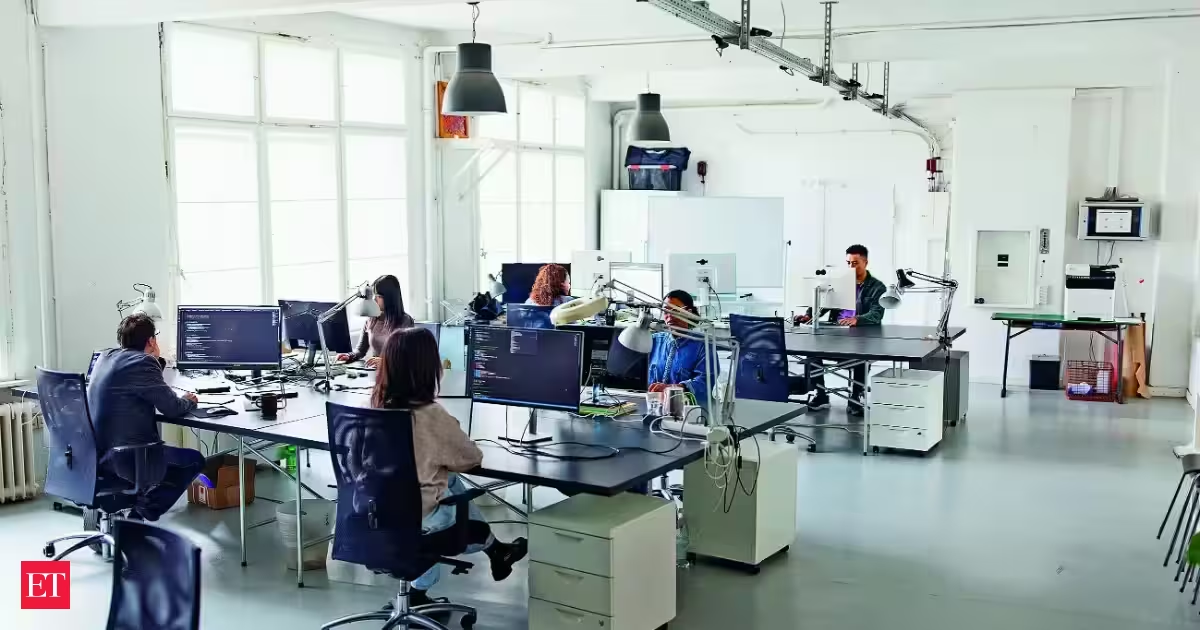
The boom in global capability centres (GCC) is influencing the way multinational firms view office space in India, with experts saying flexible workspaces are emerging as long-term operating hubs instead of being mere beachheads.“The story of flex in India has fundamentally changed,” said Karan Virwani, managing director and chief executive, WeWork India, a flexible workspace provider. “GCCs are no longer entry-level customers; they are one of the most strategic ones.”Virwani said GCCs now contribute 35-40% of WeWork India’s revenue and are increasingly looking beyond office space to bundled workplace services such as fit-outs, facilities management, information technology (IT) infrastructure and compliance support. “The workspace partner is increasingly expected to be an operations partner,” he said.According to industry experts, multinational companies are no longer using managed office spaces simply as a means of entering the market quickly, but for growth in India over the long term. As companies demand flexibility, quicker expansion and reduced upfront capital commitments, they are signing larger and longer-duration deals across cities.Meghna Agarwal, co-founder of IndiQube, a workplace solution provider, said GCCs account for nearly 42% of the company’s client base. “Demand is no longer limited to technology firms, with healthcare, manufacturing, financial services and consumer internet companies increasingly expanding through managed office models,” she said.“These are no longer support centres,” Agarwal noted. “India is increasingly handling core product, engineering, analytics and innovation mandates for global enterprises.”Deals: Longer, fatterThe change is also visible in the size of deals, experts said, with companies increasingly opting for large office mandates running into several years rather than using flex spaces solely as a stopgap measure.According to Vikram Ahuja, cofounder of ANSR, an Accenture-backed GCC enabler, managed and flexible offices have “moved from being supplementary offerings to becoming a core part of enterprise real estate strategy.”Industry estimates cited by ANSR show the share of GCCs with more than 10% flex exposure in their office portfolio is expected to rise to 48% from 22% currently. Nearly 65% of office occupiers in India are expected to include flex spaces in their portfolio strategy by 2027.“Almost every new GCC entrant to India now begins operations through a flex or managed workspace model,” said Suhas Kulkarni, senior associate director, real estate, at Embark.GCCs accounted for nearly 60% of flex and managed workspace demand over the last two years, Kulkarni said, while adding that existing GCCs are expected to increase the share of flex spaces in their office portfolios to nearly 25% over the next three years.Nilesh Thakker, president of Zinnov, said workplace decisions are increasingly becoming part of how GCCs attract talent and build their employer brand in India, especially for mid-market and PE-backed firms expanding into the country.India’s flex workspace market has crossed 110 million sq ft after growing at 20-25% annually over the last few years, according to Embark. The firm said GCC demand is also pushing developers to build better office spaces, including Grade A buildings, integrated campuses and green-certified projects.Experts noted this shift marks a broader change in India’s office market, where flexible workspaces are increasingly being used not as temporary offices but as the first layer of GCC expansion in the country.
MNCs turning flex spaces as main hubs as GCC story deepens - The Economic Times
Global capability centres are transforming India's office space market, shifting from temporary entry points to strategic, long-term operating hubs. These centres are increasingly opting for flexible workspaces, signing larger and longer-duration deals, and demanding bundled services beyond just office space.
522 words~2 min read